
Key Points:
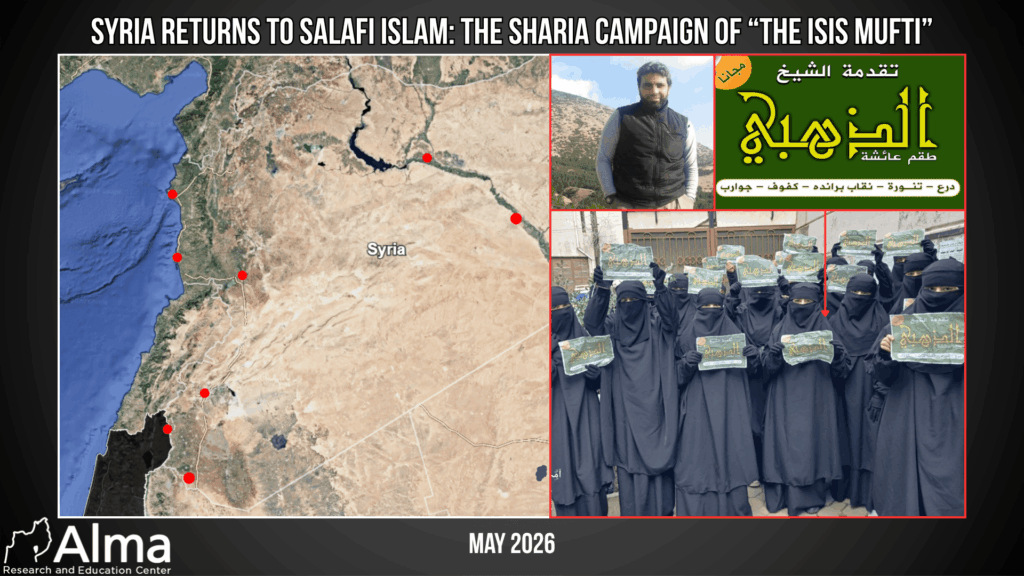
Over the past year, a campaign focused on “Da’wah” (دعوة – inviting individuals to learn about and return to the path of Islam as part of preaching and spreading of Islam) has been underway throughout Syria. The campaign is titled:
“The Sheikh al-Dhahabi Campaign – Sharia-compliant clothing” (حملة الشيخ الذهبي – اللباس الشرعي)
The campaign promotes an ideology of returning to Salafi Islam (associated with al-Qaeda and ISIS), while instilling strict dress norms and distributing Qur’an kits—as a conscious choice to return to the “correct” Islam.
The campaign is led by a figure known as “Sheikh al-Dhahabi.”
The campaign has recently expanded into regions previously vacated by Kurdish forces.
The new regime appears to be allowing the campaign to operate, with internal security forces even providing protection for its gatherings. The campaign may also receive ideological backing from the Sharia Council, led by Abd al-Rahim Atoun—a prominent religious figure since the era of Jabhat al-Nusra and Hay’at Tahrir al-Sham (see further details below), the earlier incarnations of Ahmad al-Shara’s organization prior to its rebranding as HTS.
The campaign is financially and logistically supported through donations via social media.
According to social media publications, the campaign also supports terrorist organizations in Gaza, including Hamas’ military wing (Izz ad-Din al-Qassam Brigades), but this cannot be verified and may be propaganda intended to raise additional funds.
Even if the campaign is not directly funded by the regime, it reinforces suspicions of Ahmad al-Shara’s dual strategy: tactical national pragmatism outwardly, alongside deepening Salafi-jihadist indoctrination internally.
Who is “Sheikh al-Dhahabi”?

According to reports, his real name is Hani Dahab (هاني دهب) or Hani al-Dhahabi (هاني الذهبي), originally from the Damietta (دمياط) governorate in Egypt. His ideological radicalization process began during his studies at the Faculty of Arts at Cairo University. During those years, he married three times and began associating with extremist Islamist movements in Egypt. According to the same report, his uncle stated that during his studies at Cairo University, he had numerous relationships with women, began wearing a galabiya, grew a beard, and became strictly observant—unlike his family. He also said that his father denies his existence and his mother, who has not seen him for years, hopes for his death along with all ISIS members.[1]
Already then, while moving among Egyptian ideological organizations established in 2011, he called on young people, primarily via social media, to adopt “militant Salafism” (السلفية القتالية) and to follow other jihadist brigades in Syria.[2] Al-Dhahabi himself did the same. In 2012, he travelled to Syria to join ISIS. There, he took an active part in terrorist operations in Iraq and Syria. Later, he received training in preaching and issuing fatwas (الفتوى) gaining the trust of the organization’s leadership—making him one of its prominent Sharia clerics responsible for the religious enforcement mechanism (الحسبة) present in jihadist organizations. After some time, al-Dhahabi was granted the title “Mufti (مفتي) of ISIS.”[3]
After encountering ideological disagreements with ISIS leadership, al-Dhahabi transferred to Jabhat al-Nusra (جبهة النصرة) al-Qaeda’s Syrian branch, which later evolved into Hay’at Tahrir al-Sham (هيئة تحرير الشام – HTS), founded by Abu Muhammad al-Julani (Ahmad al-Shara, Syria’s current president).
In Syria as well, al-Dhahabi actively participated in armed conflicts and terrorist activities against the Assad regime and its supporters and even issued a fatwa on the obligation to fight anyone not affiliated with Jabhat Nusrat Ahel al-Sham (“Support Front for the People of al-Sham” – (جبهة نصرة أهل الشام.[4]
Al-Dhahabi published a book titled “Ideas Like Rocket Launchers” (افكار كالراجمات), in which he outlines ideology on various topics: who is a Muslim, what constitutes a moral woman, her rights, the goals of ISIS and ISIS society, Sharia clothing, the 9/11 attacks, the liberation of Syria, the liberation of “Palestine,” and when the Muslim nation will prevail. Through these themes, he advances the central idea tied to his current campaign: only after returning to the original and “correct” Islam, uniting the entire Muslim nation under a single caliphate, will it be possible to liberate, or effectively conquer, the world.[5]
The Idea Becomes Reality:

Al-Dhahabi’s campaign activities have taken place numerous times over the past year in various provinces across Syria, including Tartus, Aleppo, Latakia, Raqqa, al-Hasakah, Deir ez-Zor, Homs, Deraa, Quneitra, and Damascus.
Within the framework of these activities, under the protection of Syrian security forces, al-Dhahabi’s followers gather large groups of women dressed in abayas and niqabs, holding Syrian and HTS flags and official campaign banners (previously attached to bags used to distribute campaign materials).[6] At the same time, Qur’an and hadith kits are distributed to men. Moreover, regime personnel themselves boast about the campaign and have been photographed numerous times proudly holding al-Dhahabi’s flags.
The primary purpose of the women’s demonstrations is to show that women adopt “modesty” by choice, thereby contributing to the jihadist effort in Syria. This modest clothing is sewn in black (and other colours for younger women)[7] in al-Dhahabi’s private workshops established in Idlib province, recently expanded across Syria.[8]
Al-Dhahabi’s campaign follows the regime’s fighting against those labelled “infidels” in Syria (Druze, Christians, Alawites, and Kurds). The campaign’s guiding principle is spreading the “correct” Islam, based on the ideological assumption that the “Small jihad” (الجهاد الاصغر – armed jihad in the name of Islam), with its ideological distortion in fighting “infidels,” must occur alongside practitioners’ commitment to the “great jihad” (الجهاد الاكبر – internal/spiritual jihad) through returning to religious practice.
During 2025 and January 2026, immediately after Kurdish forces withdrew from northeastern Syria and al-Shara’s forces deployed in their place, numerous documentations emerged showing al-Dhahabi’s preachers arriving in Raqqa and al-Hasakah alongside al-Shara’s soldiers, distributing Qur’an and hadith books, Islam kits, and bags containing niqabs for local women.[9]

It is important to emphasize: while the hijab (head covering with the face visible) is the standard covering in the Muslim world, the niqab (full covering except for the eyes) is far less common and is primarily associated with the Salafi current in conservative jihadist organizations such as the Taliban, al-Qaeda, ISIS, and others.
For further details on Salafism—see Appendix.
Sources of Support:
Similar to Hay’at Tahrir al-Sham itself, and to other projects and campaigns conducted under it in Idlib province, it is plausible that Sheikh al-Dhahabi’s campaign also operates based on donations to its social media channels from Muslims worldwide who believe in its goal: turning Syria into a Sharia state.
Since May 2025, al-Dhahabi has been sharing on social media updates regarding the campaign’s activities throughout Syria, including the sewing workshops, demonstrations, and his financial support to the Gaza Strip. He also routinely posts documents (of uncertain authenticity), purporting to show that his al-Dhahabi “society” has donated tens of thousands of dollars to Hamas’ Izz ad-Din al-Qassam Brigades in Gaza.[10]

Some claim these documents are forged and intended to generate sympathy and attract donations that al-Dhahabi collects for himself under the guise of supporting Gaza residents or needy populations in Syria.[11]
Alongside philanthropic support, a successful Sharia campaign is also expected to receive backing from the ruling regime in Syria. Accordingly, the “Sheikh al-Dhahabi Campaign” likely receives approval from the Sharia Council within the HTS regime.
The head of this council is Sheikh Abd al-Rahim Atoun (عبد الرحيم عطون), known as Abu Abdallah al-Shami (ابو عبداللة الشامي). Atoun served as Mufti and head of the Sharia Council of HTS and Jabhat al-Nusra[12] and was recently promoted to head of the Religious Advisory Office of the Syrian Presidency under al-Shara’s regime.[13] In this role, he is the most influential figure in al-Shara’s regime regarding the ideology disseminated in Syria. This body is responsible for issuing religious rulings on various matters, including positions toward enemies, local laws, and religious guidelines for societal conduct.

The “Sheikh al-Dhahabi – Sharia Compliant Clothing” Campaign – Another Islamist-Jihadist Project in Syria under Ahmad al-Shara:
On December 8, 2025, Syria marked Ahmad al-Shara’s rise to power. Since then, al-Shara has attempted to present himself as focused on rebuilding the state. At the same time, he has drawn closer to the West by joining the U.S.-led anti-ISIS coalition, destroying ISIS infrastructure across Syria, and highlighting his forces’ efforts against Hezbollah arms smuggling. In doing so, al-Shara has marketed his regime and policies to Western countries as committed to cooperation.
At the end of January, the Syrian Presidency officially announced a conversation between President al-Shara and U.S. President Donald Trump, in an attempt to demonstrate Syria’s closeness and commitment to the Western bloc.[14] However, al-Shara’s Salafi-jihadist roots are gradually being embedded within Syrian society through initiatives such as this campaign, alongside his efforts to erase his past designation as a “global terrorist” affiliated with al-Qaeda, ISIS, and his leadership roles in Jabhat al-Nusra and HTS.
In our December 2025 report (link), we examined whether al-Shara is conducting a tactical manipulation through a pragmatic approach aimed at advancing long-term Salafi-jihadist ideological goals, presenting the stricter view that al-Shara seeks to return to being Abu Muhammad al-Julani as a head of state, implementing al-Qaeda’s ideological strategy step by step.
We also emphasized that while Western policies misinterpret the intentions of actors such as al-Qaeda, the Taliban, Hamas, Hezbollah, and al-Shara—these actors view such relationships as legitimate temporary alliances to facilitate a prolonged internal jihad process.
Additionally, in that same month, we published another report exposing the Islamist-Salafi education network “Dar al-Wahi al-Sharif” of HTS (link), which has been expanding across Syria over the past year and has become an official educational institution. This network promotes militant religious indoctrination from a young age, enforces full gender segregation and strict dress codes including niqab for girls, and is organizationally and ideologically managed through direct appointments of senior HTS figures close to al-Shara. This network poses a potential threat in shaping a future generation with Salafi-jihadist Islamist identity in Syria near Israel’s border.
Appendix – The Salafi Movement:
The Salafi movement (السلفية) is a Sunni Islamic movement that seeks to return to the “original”, ancient Islam, based on the belief that it reflects the path of the “al-Salaf al-Salih” (السلف السالح)— a term referring to the “righteous forefathers”: the Prophet Muhammad, his companions (Sahaba), and the two generations that followed. Salafis adhere to a highly conservative lifestyle including strict clothing, gender segregation, and opposition to Western values (liberalism, feminism, secularism).
In this context, the Salafi movement can be divided into three activist schools:
Quietist Salafism – education and preaching;
Political Salafism – Islamic governance, Islamic law, and criticism of “non-Islamic” regimes;
Militant Salafism – political violence and armed jihad as a religious duty, primarily associated with a minority within the Salafi movement, particularly in organizations such as al-Qaeda and ISIS. This does not mean that Salafism directly leads to terrorism, but its ideological rigidity can enable a slippery slope toward armed jihad.

[1] [1] https://makhaterltakfir.com/ar/mainstreamingview/8995/%D9%87%D8%A7%D9%86%D9%89-%D8%AF%D9%87%D8%A8-%D9%85%D9%86-%D8%A3%D9%88%D9%8A%D9%85%D8%AC%D9%89-%D9%81%D9%89-%D8%AF%D9%85%D9%8A%D8%A7%D8%B7-%D8%A5%D9%84%D9%89-%D9%85%D9%81%D8%AA%D9%89-%D8%AF%D8%A7%D8%B9%D8%B4-%D8%A8%D8%B3%D9%88%D8%B1%D9%8A%D8%A7
[2] https://www.elaosboa.com/1529166/
[3] Ibid
[4] Ibid
[5] https://www.scribd.com/document/658144397/%D8%A3%D9%81%D9%83%D8%A7%D8%B1-%D9%83%D8%A7%D9%84%D8%B1%D8%A7%D8%AC%D9%85%D8%A7%D8%AA
[6] https://x.com/Azahabi19/status/2017236567622877416?s=20
[7] https://x.com/Azahabi19/status/1944496238508068933?s=20
[8] https://x.com/Azahabi19/status/2006357561956766112?s=20
[9] https://x.com/SyrDemObs/status/2013934200370422036
[10] https://x.com/Azahabi19/status/1926336341777727542?s=20 ; https://x.com/Azahabi19/status/1925143158704251226?s=20
[11] https://www.elaosboa.com/1529166/
[12] https://www.noonpost.com/304248/
[13] https://www.arrahmah.id/presiden-suriah-resmi-angkat-mantan-mufti-hts-abdul-rahim-atoun-sebagai-penasehat-agama/?utm_source=chatgpt.com
[14] https://x.com/SyPresidency/status/2016220680321176029?s=20



One Response
Dear Dvir,
The grand mufti – Hitler alliance of one century ago brought upon us the WWII death camps that my father helped liberate as a soldier in the US Army in the Rhineland Campaign defeating the Evil Nazi regime in Germany. We must learn from this history. Syria is the breeding ground for the next genocidal evil to grow in this generation. Tolerance of Evil is also Evil. Let us consider:
Radical jihaddist ideology MUST be confronted and DEFEATED. Death cult indoctrination of children and societies have predictable outcomes, we cannot live in denial. The DEI (LIE) is exposed: Delusional Egotistical Insanity. We cannot take that path.