
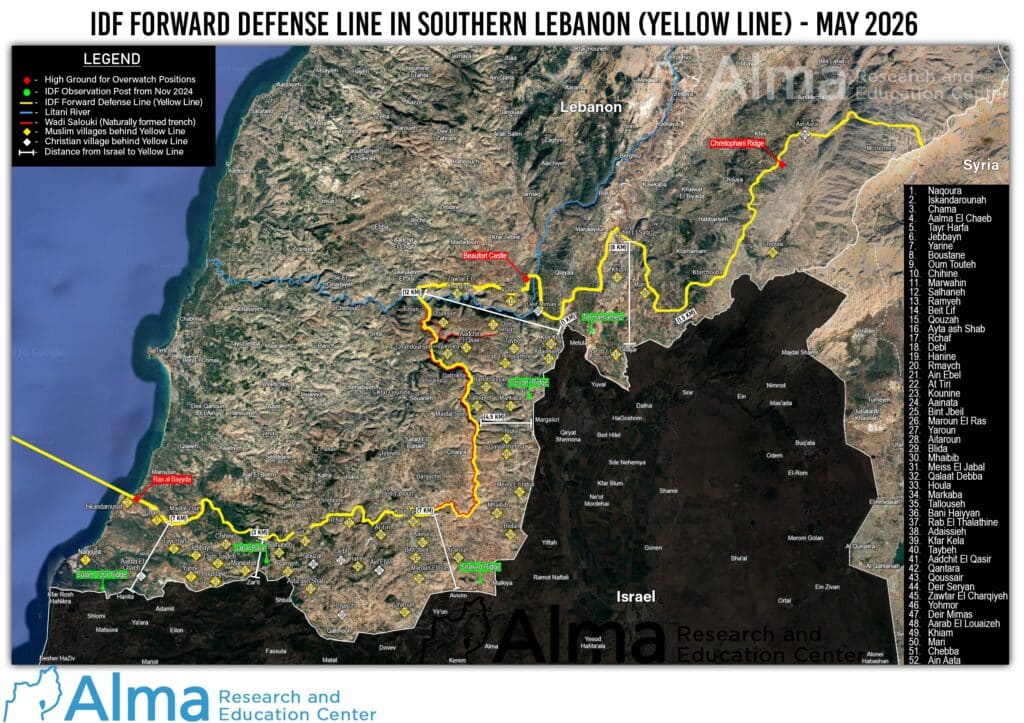
The forward defense line of the IDF in southern Lebanon (Yellow Line) is deliberately demarcated along key terrain for both defensive advantage and to establish a well-defined buffer zone keeping Israel’s northern communities from Hezbollah’s ground forces. The high ground positions of Ras Al Bayyada, Beaufort Castle, and Christophani ridge all have overwatch and a deep line of sight over Hezbollah’s areas of operation. Wadi Salouki, a naturally formed trench used as one of Hezbollah’s strongholds, continues to reveal Hezbollah infrastructure to be dismantled since its capture in March 2026. 52 villages fall behind the IDF’s Yellow Line, most of which had already been evacuated since fighting began on October 8th, 2023. IDF forces do not occupy a series of fighting positions along the entire 130-kilometer stretch of the Yellow Line. Enforcing the Yellow Line is manageable through a combination of constant UAV patrols, maneuver elements holding key terrain, and other capabilities employed. This barrier serves as a warning to Lebanese against crossing into the once Hezbollah-dominated villages south of it, while IDF forces discover and dismantle more Hezbollah weapons and infrastructure. If Lebanese civilians were to be permitted to cross the Yellow Line, Hezbollah operatives would be the first to return to 52 villages and threaten Israeli communities directly.




One Response
Dear Alma Staff,
It is essential to maintain this forward defense line until hezbollah is totally defeated and removed from Lebanese society.
HOLD THE LINE!!!
Remove the cancerous, venomous hezbollah snake, crush its head, and then the process toward peaceful coexistence can proceed.