
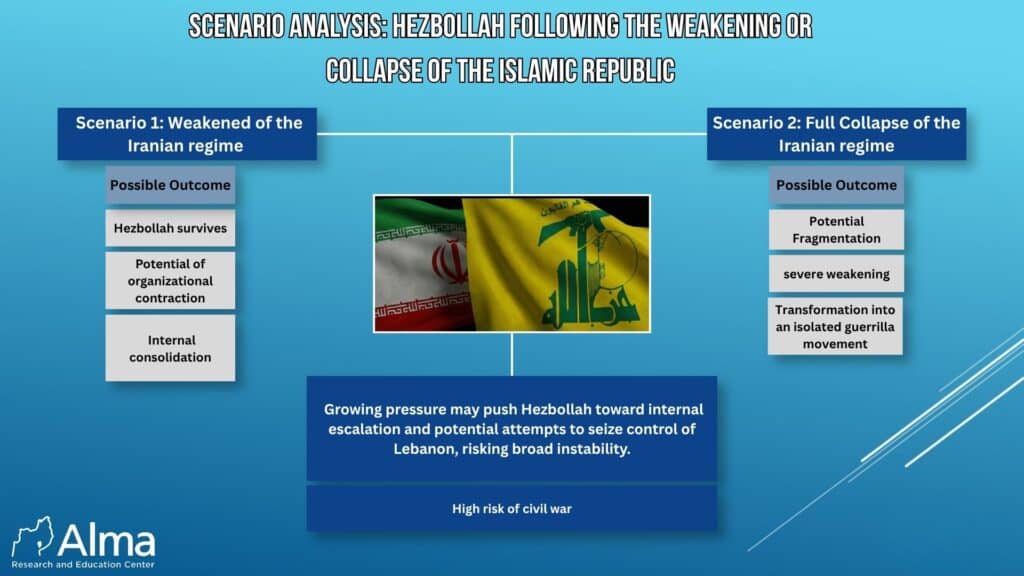
A Scenario Analysis
By: Yaakov Lappin, Dr. Zoe Levornick, and Tal Beeri
The regional campaign that began in March 2026 constitutes a strategic turning point for Hezbollah, transcending a standard military conflict. The combination of military attrition in Lebanon, damage to its regional supply routes, and the weakening of Iran creates overall systemic pressure, undermining not only its operational capabilities but also the civilian-economic envelope that allows Hezbollah to operate as a “state within a state.”
Against this backdrop, two primary strategic trajectories are emerging. In the scenario of a weakened Iran (de facto, the current situation today), Hezbollah does not collapse but adapts: it deepens its grip on Lebanon, reduces external dependence, transitions to structural decentralization, and strengthens local legitimacy through “Lebanonization”. Simultaneously, it compensates for the decrease in resources by strengthening the ideological component and expanding alternative funding sources, including a shadow economy.
Conversely, a scenario of the total collapse of Iran places Hezbollah before a multi-domain existential crisis: the loss of economic, organizational, and ideological support undermines the foundations of its activities and harms its ability to preserve the “state within a state” model. This situation is expected to lead to an erosion of control mechanisms, the weakening of civilian infrastructure, and an increased risk of internal fragmentation.
Meanwhile, the organization would be required to choose between political integration and military radicalization, with both alternatives carrying risks of internal escalation and damage to its legitimacy. Unlike the weakened Iran scenario, which allows for adaptation, a total collapse of the Iranian regime constitutes a trigger for deep structural and identity-related destabilization, which is liable to lead in the long term to significant attrition and even the gradual disintegration of the organization.
In both scenarios, the weakening of Hezbollah does not necessarily lead to stability, but may create a vacuum in which regional and other actors will attempt to expand influence. Simultaneously, there is also the possibility of violent escalation, an attempt by Hezbollah to take over Lebanon, and the ignition of a civil war.
The regional campaign that began in March 2026 is not just another round of escalation between Israel and Hezbollah, but a strategic turning point that shakes the foundations of the organization’s operational model. A combination of direct military attrition in Lebanon, damage to regional supply infrastructures, and the profound weakening of Iran – the central patron – places Hezbollah before a historical dilemma: deep adaptation or structural disintegration.
The central conclusion arising from the analysis is that Hezbollah’s strength stems from the tight integration between its various dimensions – military, civilian, political, and ideological – but its vulnerability is also derived from that exact same structure. When one component is eroded, the effect spreads to the entire system. In the scenario of a weakened Iran, the organization manages to contract and adapt while deepening its internal control; in the scenario of an Iranian collapse, the entire system enters an identity crisis that may lead to gradual disintegration.
| Domain | Scenario 1: Weakened Iran (But exists) | Scenario 2: Total Collapse of Iranian regime |
| Nature of Change | Structural change and adaptation – Hezbollah changes shape and deepens internal grip | Deep strategic rupture and essential change – Hezbollah enters an existential crisis that could lead to disintegration |
| Military Arena | Reduced weapons supply and funding Shift toward domestic production and decentralization of power Transition from hierarchical force to decentralized guerrilla structure Strategy: attrition, hit-and-run, force preservation | Collapse of Iranian supply networks Breakdown of command structure Shift to localized guerrilla/militia model Reduced long-term operational capability |
| Economic Arena | Loss of state funding Reliance on a limited criminal economy Competition over local revenue sources Decline in force-building capacity | Transition to a survival struggle; contraction or radicalization. Attrition in legitimacy; a survivalist attempt. Use of internal force – higher probability of using force to preserve status. Possibility of full political integration: increases – including the possibility of giving up the military wing. Institutional arena (“state within a state”) – disintegrates and becomes a burden. |
| Political Arena | Deepening penetration into state institutions (“controlled Lebanonization”). Attempt to strengthen Lebanese legitimacy. Use of internal force – possible but limited. Possibility of full political integration: low – maintaining a hybrid model. Institutional arena (“state within a state”) – strengthens as a replacement for external dependence. | Transition to a survival struggle; contraction or radicalization. Attrition in legitimacy: a survivalist attempt. Use of internal force – higher probability of using force to preserve status. Possibility of full political integration: increases – including the possibility of giving up the military wing. Institutional arena (“state within a state”) – disintegrates and becomes a burden. |
| Social Arena | Preservation of the “Resistance Society” with adjustments. Welfare and service systems contract but function. | Legitimacy crisis and erosion of the base. Welfare and service systems – collapse or significantly weaken. |
| Ideological Arena | Relative stability; continued affinity for Iran. Resistance narrative – strengthens as compensation for material weakness. | Deep identity crisis. Resistance narrative – radicalizes but erodes without a material and ideological basis. |
| Internal Lebanese Arena | Increasing tension. Potential for deterioration into civil war. | Scenario 2: Total Collapse of the Iranian regime |



One Response
Dear Yaakov, Tal and Dr Zoe,
The entire snake den of the IRGC led ring of fire is highly stressed, with all snakes now writhing in their cave dens in fear. The left boot of the US and Israeli military is on the neck of the mother of all snakes. It is now necessary that the Right Boot now crush the head of the snake. The nature of the hostile snake, hissing and writhing with hatred, requires that it be permanently destroyed.