
Dana Polak
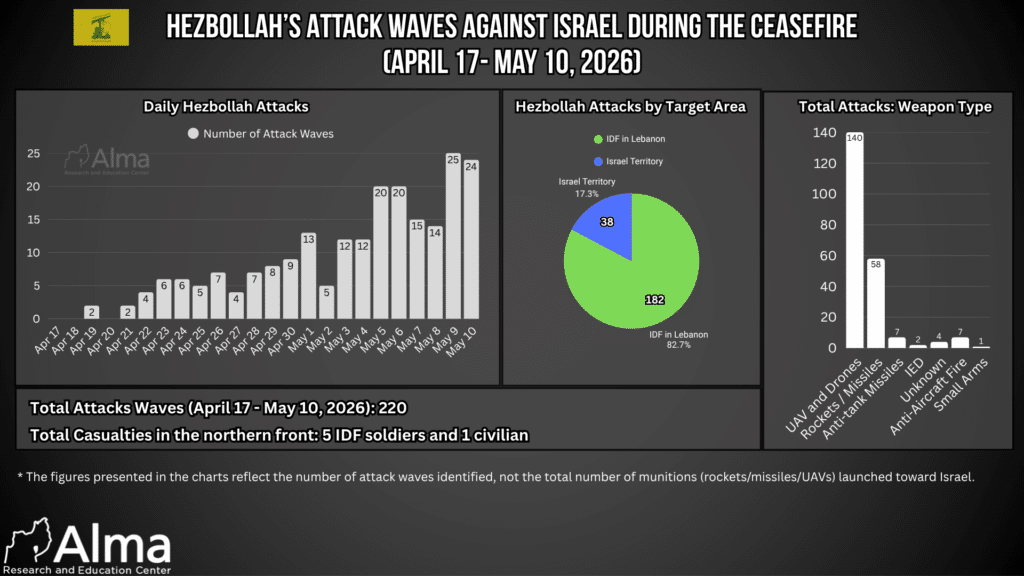
During the past week (04–10 May), the escalation trend in Hezbollah’s activity against Israel and against IDF forces operating in southern Lebanon continued. Data analysis indicates a further increase in the daily volume of attacks and the continued dominance of drones.
Since the beginning of the ceasefire on 17 April and through 10 May, 220 attack waves launched by Hezbollah were identified. The majority of the attacks — 182 attacks (82.7%) — targeted IDF forces in southern Lebanon, while 38 attacks (17.3%) targeted Israeli territory.
Increase in the Rate of Attacks
Hezbollah’s daily average this week stood at 18.5 attacks per day, compared to an average of 8 attacks per day last week. This represents a significant increase in operational activity, with between 20 and 25 attack waves recorded per day in recent days — the highest figures since the start of the ceasefire.
Main Weapons Used
This week as well, the extensive use of UAV’s drones stood out. Since the beginning of the ceasefire, Hezbollah has carried out:
- 140 attacks using UAVs and drones (most of them involving explosive drones)
- 58 attacks using rockets and missiles
- 22 attacks using anti-tank missiles, explosive devices, anti-aircraft fire, and small arms
Shift in the Attack Pattern and the Return to Official Claims of Responsibility for Attacks on Israeli Territory
Since the beginning of the ceasefire, the organization had claimed responsibility for only two attacks on Israeli territory, after which it consistently refrained from issuing official statements regarding most incidents. During the past week, this pattern changed. Beginning on 7 May — one day after the elimination of a Radwan commander in Dahieh — Hezbollah resumed publicly and officially claiming responsibility for attacks carried out against Israeli territory.
Although the organization presents these attacks as targeting military objectives, in practice some incidents were directed toward areas adjacent to civilian populations and Israeli communities, creating a tangible risk to civilians.
Another unusual and significant event this week was the launch of several rockets toward the Acre and Krayot area in response to an Israeli strike in Beirut’s Dahieh district, in which a Radwan Force commander was killed. Until now, most Hezbollah attacks against Israeli territory had focused only on border-adjacent communities.
Casualties
During the past week, one IDF soldier was killed. Since the start of the ceasefire, 5 IDF soldiers and 1 civilian have been killed. Four fatalities were caused by exploding attack drones, and two were killed by explosive devices.
Summary
The data from the past week point to a continued upward trend in Hezbollah activity and the deepening of combat patterns that have developed since the beginning of the ceasefire. The organization continues to focus primarily on IDF forces in southern Lebanon, while simultaneously maintaining the capability to expand the range of attacks into Israeli territory when it chooses to do so. The extensive use of explosive drones continues to be one of Hezbollah’s central operational characteristics during this period.


One Response
Dear Dana,
Terrorists cooperate in terror escallation. They rely on intimidation by hostility and threats. There can be no retreat to defeat in this conflict. On the contrary, I vote for escallation to total annihilation of the terrorists on all fronts, including the PA within Israel. The Pernicious Atrocity must also be removed as a cancerous tumor, to restore healthy governance in Israel.