
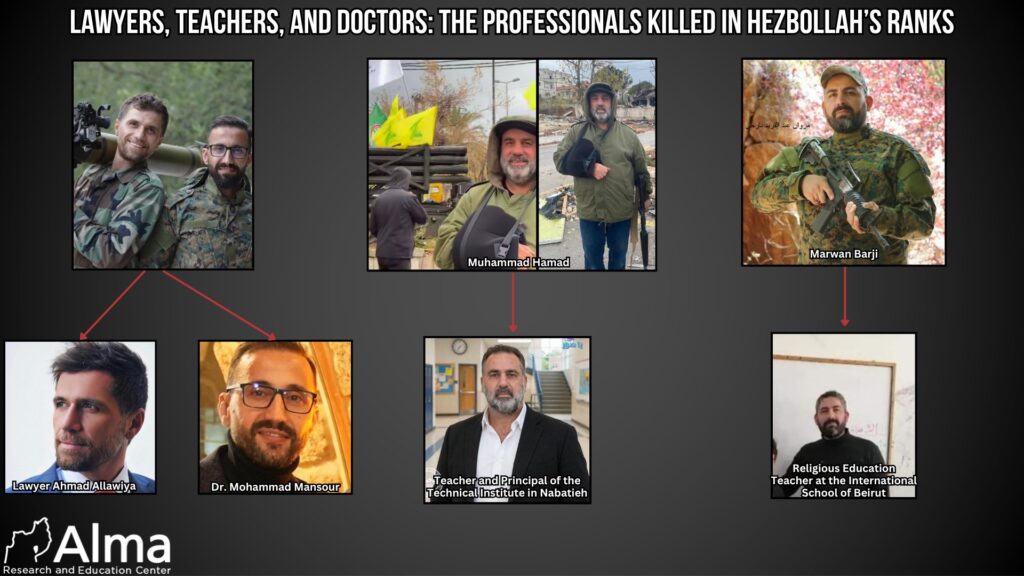
During the current conflict, Hezbollah’s death list have repeatedly revealed a striking pattern: many of those killed within the organization’s ranks were not only military terrorist operatives, but also professionals and public figures — teachers, school principals, lawyers, doctors, religious clerics, and municipal officials. This phenomenon reflects one of the core principles behind Hezbollah’s concept of the “Resistance Society” — the idea that resistance is not confined to a purely military framework, but is deeply rooted within civilian society itself. At the same time, this model helps build popular legitimacy, as the resistance is portrayed as a natural and integral part of society. Among the Hezbollah operatives killed in recent months were, for example: •Muhammad Hamad, teacher and principal of the Technical Institute in Nabatiyeh •Dr. Mohammad Mansour, physician •Lawyer Ahmad Allawiya •Marwan Barji, religious education teacher at the International School of Beirut Hezbollah’s casualty lists demonstrate that the concept of a “Resistance Society” is far more than a slogan. For Hezbollah, resistance constitutes a comprehensive social model — one in which a teacher, doctor, lawyer, or mayor can simultaneously serve as a terrorist operative and as part of the broader “resistance” infrastructure.



One Response
Dear Alma Staff,
Every hezbollah member must be considered to be a terrorist. They train their youth from their mother’s milk to hate, steal, destroy and kill all Jews. Until the educational death cult propaganda is removed both within Lebanon and even within Judea and Samaria, the terrorist problem will remain.