
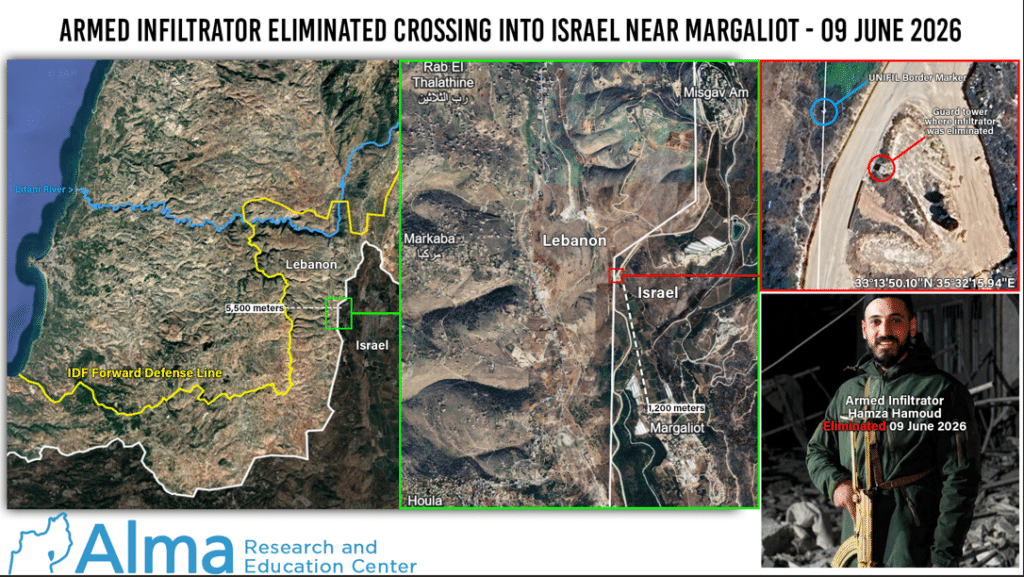
Yesterday (June 9), a terrorist who infiltrated from Lebanon into Israeli territory managed to reach the Wadi Hunin area, north of the community of Margaliot, and hide inside an abandoned IDF guard post located only a few hundred meters from the homes of the community. The terrorist was identified during searches conducted by IDF forces in the area following reports of a brush fire. After being identified, he was killed by IDF troops.
The terrorist was wearing camouflage fatigues (associated with Hezbollah operatives) and was carrying a pistol and a knife. According to assessments, his intended target was one of the communities along the Ramim Ridge.
The terrorist, Hamza Hammoud, was a resident of the village of Markaba in southern Lebanon—a village with a predominantly Shiite population that is considered part of Hezbollah’s traditional area of activity and support. Following the incident, photographs were published showing him carrying weapons, reinforcing the assessment that he was a military operative.
On accounts identified with Hezbollah, Hammoud has already been referred to as “the first to cross into the Galilee”—a phrase reflecting that despite the severe damage inflicted on Hezbollah’s capabilities, the idea of infiltrating the Galilee and the narrative of the “conquest of the Galilee” remain present within the organization’s consciousness and among its supporters, even after the significant blows Hezbollah has suffered during the fighting.
However, no information has yet been published confirming his organizational affiliation.
IDF operations in Lebanon since Operation Northern Arrows in September 2024, along with the ongoing campaign against Hezbollah, have significantly degraded the organization’s military capabilities, particularly its ability to implement the Radwan Force’s original invasion plan for the Galilee. That plan, which was based on a large-scale, coordinated infiltration by numerous forces operating simultaneously across multiple sectors, has lost the operational conditions necessary for its execution due to the damage inflicted on Hezbollah’s command structures, personnel, infrastructure, and operational deployment in southern Lebanon.
Nevertheless, despite the significant degradation of the Radwan Force, the threat of infiltration into Israeli territory has not disappeared. While the organized invasion plan required complex command, control, and coordination frameworks, infiltrations by individual operatives or small cells can be carried out with limited resources and without extensive preparation. As a result, this is a threat that is difficult to eliminate entirely, even under improved security conditions along the border.
This incident does not stand alone. On May 22, in the early morning hours, two terrorists who approached to within approximately 400 meters of the border fence near the communities of Dovev and Bar’am were killed in an airstrike. This incident serves as an additional indication that the potential for localized infiltration attempts and limited offensive activity along the border remains.
As of the time of writing, insufficient information has been published to determine with certainty the circumstances surrounding the terrorist’s actions or his organizational affiliation. Accordingly, it is not possible to assess whether this was an independent infiltration attempt by Hamza Hammoud or an operation carried out under instructions, guidance, or prior planning by an organization or other actor.
If Hammoud was indeed a Radwan Force operative, it is important to remember that the force’s modus operandi is based, among other things, on the operation of relatively small cells that enjoy a degree of operational autonomy and local decision-making authority. Therefore, several scenarios remain possible:
- The operative independently decided to carry out an attack after finding himself isolated in the field.
- There is a standing directive for operatives who become isolated or cut off to exploit operational opportunities and attack Israeli targets.
- The operative maintained contact with commanders in Lebanon and received instructions to carry out an attack after it became clear that extraction or return was no longer possible.
Under any of these scenarios, it is reasonable to assume that the operative understood that the mission was effectively a suicide attack.
The incident demonstrates that the motivation to attack northern Israeli communities and IDF forces has not disappeared. Alongside the continued degradation of Hezbollah’s military capabilities, the persistent threat posed by individual infiltrators and small cells must continue to be taken seriously—a threat that cannot be entirely eliminated, even when the broader, organized invasion threat has been significantly disrupted.





One Response
Dear Dana,
Thanks for your report about hezbollah infiltration for the purpose of terror attacks on Israeli citizens. Again this is the hezbollah mission taught to children from birth: kill Jews! And no “ceasefire” is going to help solve that problem. Just like the Islamo-nazis of the 1940’s, they must NOW be defeated until dead, or be brought to Enforced Justice!