
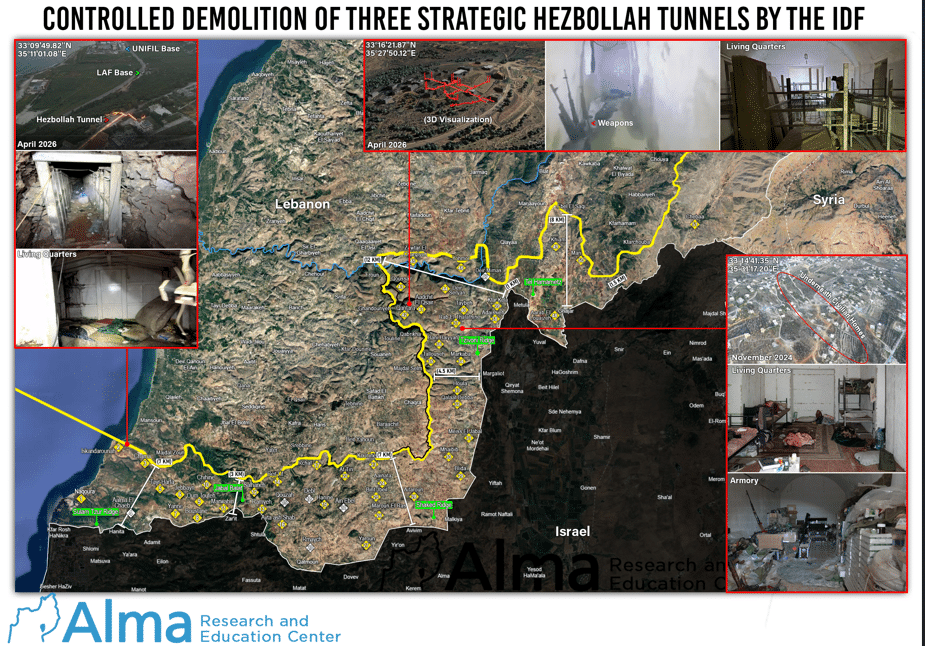
Tal Beeri and Yehuda Kfir
In December 2018, the IDF exposed six Hezbollah offensive tunnels that had penetrated Israeli territory and were intended to serve as an underground platform for the Radwan Unit’s invasion of the Galilee.
In August 2021, the Alma Center published a special report entitled “Hezbollah’s Land of Tunnels – The North Korean and Iranian Connection.” The publication emphasized the strategic tunnels possessed by the organization.
Over the past several years, we have monitored Hezbollah’s “Land of Tunnels,” a vast and clandestine project developed over at least two decades with North Korean and Iranian assistance. The project encompasses strategic tunnels, tactical tunnels, approach tunnels, offensive tunnels, and, in our assessment, also includes explosive tunnels.
Following the outbreak of the war in October 2023 and continuing to the present day, large portions of Hezbollah’s “Land of Tunnels” have been publicly exposed, including strategic tunnels (located within Hezbollah’s operational centers of gravity in southern Lebanon and smuggling tunnels along the Syria–Lebanon border), tactical tunnels (throughout the entire “Yellow Line” area in southern Lebanon), and approach tunnels (in the contact line area). In addition to these, dedicated underground infrastructures (for example, for the storage of weapons or for the launching of rockets or UAVs) have been exposed, constituting an integral part of the “Land of Tunnels.”
At present, we are working on a comprehensive mapping and research project concerning the “Land of Tunnels” project in light of its exposure during the recent war.
Realistic assessments by military engineering and operational construction experts worldwide estimate Hezbollah’s total investment in its underground infrastructure in Lebanon over the past two decades at billions of dollars (at least between $1 billion and $3 billion).
Any estimates lower than those presented above, if they exist, are underestimations and do not reflect the engineering and logistical reality on the ground, for several principal engineering, geological, and economic reasons:
Quantity of Tunnels and Geographic Distribution
In reality, as has been revealed, these are not isolated tunnels or individual shafts, but rather interconnected and fortified underground defense systems (underground routes and subterranean combat infrastructure). Beneath many villages (almost every Shiite village in southern Lebanon), extensive networks were excavated, comprising dozens of shafts, storage facilities, living quarters, and command posts interconnected with one another.
Cost of Excavation and Reinforcement in Mountainous Rock
Excavation through hard limestone and dolomite rock (characteristic of southern Lebanon, for example the Beaufort Ridge and Ali al-Taher) requires heavy excavation equipment, explosives (Drill & Blast), and massive support systems (steel structures, mesh, and sprayed concrete—shotcrete), in order to prevent long-term collapse.
Even a fortified and structurally reinforced tactical tunnel with a relatively narrow cross-section cannot realistically be valued at only a few hundred thousand dollars for the entire project.
In civil engineering, the construction cost of a small but technically complex tunnel under such conditions, including the requirements of clandestine logistics, typically ranges between $2,000 and $5,000 per linear meter (and may be even higher due to the need to conceal and discreetly dispose of the excavated material).
A one-kilometre-long tunnel alone would cost between $2 million and $5 million just for the quarrying and basic structural support.
Electromechanical Engineering Systems (MEP)
A large, equipped tunnel is not merely “a tunnel.” In order to accommodate dozens of operatives, weapons depots, living quarters, command rooms, launch shafts, logistical infrastructure, and similar facilities over an extended period, critical systems are required:
Complex ventilation and air-filtration systems (including carbon dioxide removal and oxygen supply to underground depths).
Drainage systems and groundwater pumping systems (the limestone formations of southern Lebanon are karstic and contain numerous water cavities, particularly during the winter).
Electrical networks, lighting, encrypted wired communications, and backup systems (generators).
Water supply and sewage infrastructure.
These systems alone increase the cost of each such underground infrastructure by many millions of dollars, irrespective of the excavation costs themselves.
Concealment and Transportation Logistics
Every cubic meter of excavated rock (amounting collectively to hundreds of thousands of tons) had to be removed under complete secrecy in order to avoid detection by observation and aerial intelligence collection assets. The removal of excavated material (the “bulking volume” of the excavated rock) by trucks (possibly at night), in a dispersed manner, and the filling of wadis or remote quarries, generates an enormous logistical cost that does not exist in ordinary civilian projects.
============================================
Tal Beeri is the Head of the Research Department at the Alma Center.
Eng. Yehuda Kfir is a civil engineer and construction and infrastructure project manager and serves in the reserves as Commander of the Home Front Command Construction Unit during emergencies.



One Response
Dear Tal and Yehuda,
Thanks for the cost and engineering analysis. It would be beneficial to follow up with a reverse funding analysis to determine every revenue source that provided this terrorist infrastructure. Then bring prosecuted accountability throughout the terror funding chain until every root is eliminated. Exposure of this dark money chain is critical to prevent any future rebuilding. This must end now.