
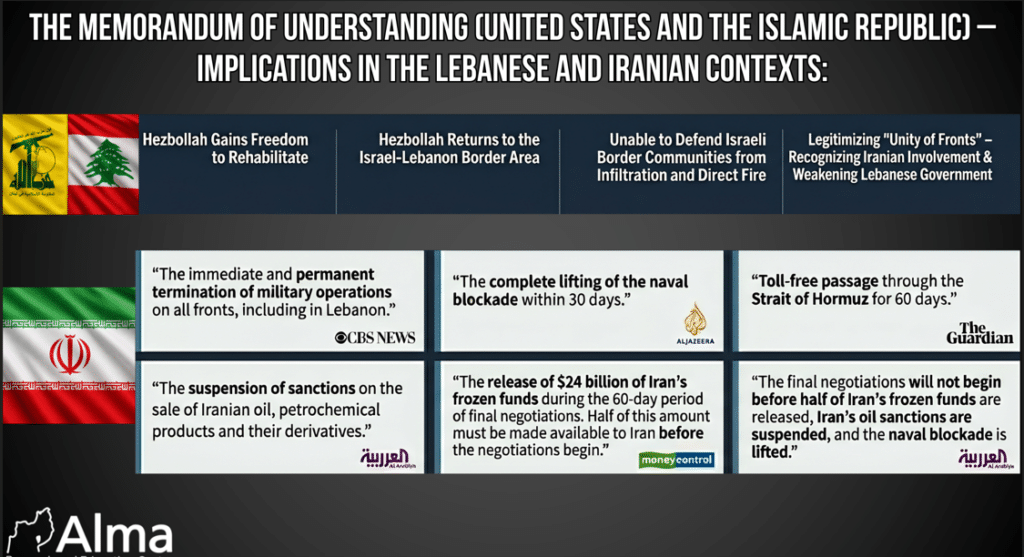
The memorandum of understanding signed on June 17 between the United States and the Islamic Republic of Iran carries several key implications, both for the Lebanese arena in particular and for the regional and global arenas more broadly:
A comprehensive ceasefire in Lebanon. For Israeli residents living near the border with Lebanon, this ostensibly means a return to normalcy. However (the key word), will Hezbollah truly honor this ceasefire as stipulated in the memorandum of understanding?
On the ground – as of June 17, exchanges of fire between Hezbollah and the IDF are continuing. This follows Hezbollah’s launch of drones and rockets toward IDF forces.
The implication – Hezbollah is being granted freedom of action to rebuild and recover.
The withdrawal of the IDF from Lebanon. The memorandum of understanding contains language suggesting an expectation that the IDF will withdraw from Lebanon. Iranian officials have also been careful to reiterate this point in their various public statements.
The implication – Hezbollah will return to the area adjacent to the Israeli border in southern Lebanon.
Hezbollah’s return to this area stands in complete contradiction to Israel’s security doctrine following October 7, according to which the deployment of the IDF in Lebanese territory would effectively serve as a buffer zone between Israeli civilians and any hostile and dangerous actor on the other side of the border. (This also applies to Syria—through the presence on the Syrian Hermon and at key points along the Golan Heights—and to the Gaza Strip through a presence along the Yellow Line.)
The implication – It will not be possible to protect the Israeli communities located near the border in a situation where the other side has the freedom of action to build up infiltration capabilities and conduct direct fire attacks into these communities.
Legitimization of the “Unity of the Fronts” concept. The memorandum of understanding grants legitimacy to the Iranian concept of the Unity of the Fronts, rather than dismantling it.
The implication – The memorandum of understanding effectively recognizes Iranian involvement in Lebanon and turns Hezbollah into a proxy that has “succeeded” in bringing about a ceasefire. As a result, the agreement strengthens Hezbollah in Lebanon and, inevitably, weakens the Lebanese government and the likelihood that it will move to disarm the organization in accordance with its own decisions.
From a broader perspective, the main component is money:
• In principle, the Islamic Republic of Iran is granted legitimacy to collect payments in the Strait of Hormuz, since free passage through the Strait of Hormuz is guaranteed for 60 days, after which the issue will be subject to further discussion.
• Money will begin flowing to the Islamic Republic immediately, as it will resume oil exports, and this takes effect upon the signing of the memorandum of understanding.
The implication – The rationale of “help is on the way” is undermined, while the Islamic Revolutionary Guard Corps (IRGC) is strengthened. The money will not reach the Iranian people; rather, it will go to the IRGC, the proxies, the missile and UAV programs, and, of course, the nuclear program.
• An American commitment that, after 60 days, a fund (financed by private sources) worth $300 billion will be established for the reconstruction of the Islamic Republic. However, there is no clear commitment by the Islamic Republic not to enrich uranium on its own territory, nor is it clear from the agreement what exactly will happen to the fissile material.
• Sanctions against the Islamic Republic have traditionally also targeted the ballistic missile program and human rights violations. The memorandum of understanding speaks of lifting all sanctions as part of the final agreement, without addressing the Islamic Republic’s obligations regarding these issues.
Bottom line – The Islamic Republic is expected to benefit from a substantial influx of resources. A rhetorical question: Will this money reach the Iranian people, or will it go to the IRGC, the proxies, the missile and UAV programs, and the nuclear project?
In general, it appears that throughout the memorandum of understanding, the United States is committing to concrete promises in exchange for highly vague Iranian declarations.
On the nuclear issue – it appears that the road ahead remains long. We would like to issue a warning here: Iran has deceived the international community in the past and has even admitted doing so. An Iranian declaration that it will not develop nuclear weapons is not sufficient. Both with regard to the removal of enriched material from Iran and the issue of uranium enrichment on Iranian soil, it is essential to establish an effective monitoring mechanism with unrestricted access to all facilities in Iran, operating impartially and in parallel with ongoing intelligence collection on the matter.
Today has demonstrated that what happens in the Middle East does not stay in the Middle East.
Despite highly successful military operations against the Islamic Republic (June 2025 and March 2026), the message conveyed by the memorandum of understanding signed by the President of the United States is that the extremist regime of the Islamic Republic of Iran can continue to threaten global security and suppress its own people. Not only does it not suffer consequences for doing so—it actually benefits.
For the attention of all relevant parties – this message is also being received by other actors around the world, including China, Russia, and North Korea.


One Response
Dear Alma staff,
Congratulations! It is good to know that your newsletter is being followed by the CRINK axis of evil oppressors! Their fear and instability have reached a critical mass of selfdestructive tyrranticide. The world will soon be fully liberated from their fantasies of empires.
Regarding the MOU, better described as the DOD (Document of Delusion), it is just a paper for temporary emotional reactive behavioral analysis of societal cognitive dissonance due to widespread islamo-nazis propaganda being propagated by the CRINK axis of evil oppressors with the assistance of radical islamic puppets in Turkey and Qatar….
The world will soon be cleansed from the lies that all these oppressive regimes promote over the globe. This darkness will be cast out by the Light of Truth. And the entire CRINK axis with its jihaddist terror will collapse into oblivion.