
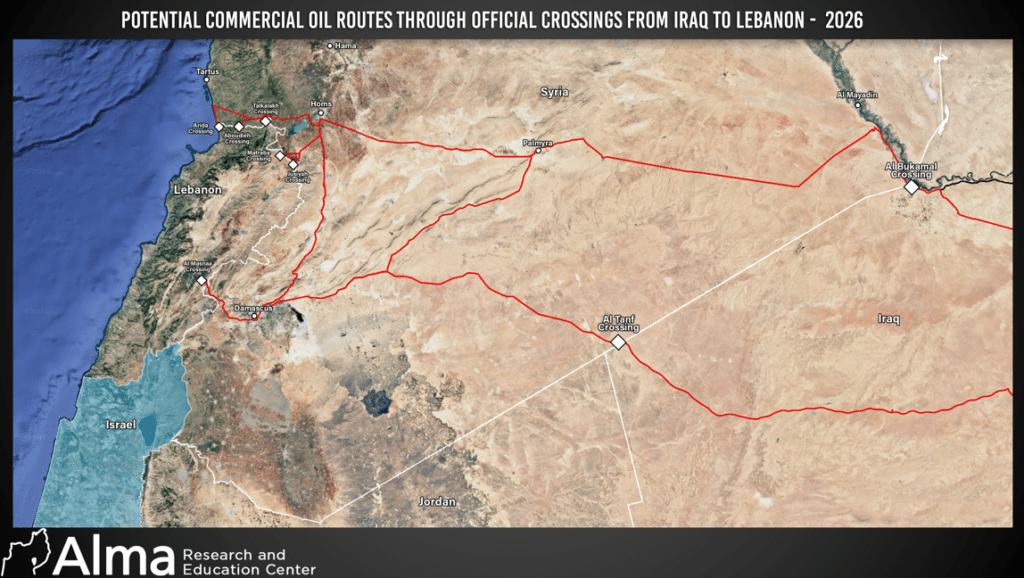
On August 10, Lebanese Prime Minister Nawaf Salam convened an interministerial meeting to discuss preparations for transporting crude oil and petroleum products from Iraq through Lebanon. Under the plan being considered, Lebanon would initially serve as a hub for storing the shipments and re-exporting them. The discussions addressed the rehabilitation of roads for tanker traffic, the adaptation of border crossings, the preparation of storage facilities, and the formulation of safety and operational procedures.
For Lebanon, this represents a significant economic opportunity: revenue from transit and storage fees, the reactivation of energy facilities, and a stronger role as a link between Iraq, Syria, and the Mediterranean. For Iraq, it forms part of an effort to develop export alternatives to the Strait of Hormuz. As we reported in July, a corridor has already been operating since April 2026, transporting Iraqi fuel oil in hundreds of tanker trucks through the al-Waleed–al-Tanf crossing in Syria to the port of Baniyas.
However, the expansion of Lebanon’s role also increases the security risk. Every new component in the system, a border crossing, road, transportation company, storage facility, terminal, or port, creates another potential point of entry for Iran and Hezbollah. If Lebanon becomes not only a transit country but also a storage and re-export hub, shipments will remain on its territory for longer periods, pass between different actors and facilities, and be reloaded. This will make it more difficult to track their origin, contents, and final destination.
The danger is not theoretical. As we reported in July, Syrian authorities thwarted the smuggling of advanced weapons from Iraq intended for Hezbollah. According to reports, the shipment included dozens of fiber-optic drones, cruise missile components, anti-tank missiles, and related equipment. It was concealed inside an oil tanker traveling along the commercial route to Baniyas. Hezbollah denied the allegations, but the incident demonstrated how legitimate energy traffic can provide effective cover for weapons smuggling.
Iran does not need to control the entire project. A small number of drivers, transportation companies, customs officials, storage-facility employees, or port personnel would be enough to insert prohibited equipment into a large flow of legitimate cargo. As the volume of activity grows, so will the pressure to avoid delays and conduct only rapid, partial inspections. Storage facilities could also enable the replacement of documents, the mixing of cargo, the transfer of equipment between vehicles, and the concealment of its final destination.
Iran has lost the freedom of action it enjoyed along the overland corridor during the Assad era, but its objective has not changed: rebuilding Hezbollah’s capabilities and transferring weapons, money, and advanced components to Lebanon. New regional oil infrastructure could provide it with civilian cover and a more convenient alternative smuggling platform.
Therefore, any expansion of Lebanon’s role in the oil sector must be accompanied by a corresponding expansion of oversight mechanisms: technological scanning, electronic seals, GPS tracking, cargo verification at loading and unloading points, surprise inspections, and transparency regarding transportation companies and operators. Without such a framework, the more important Lebanon becomes as an energy hub, it will make it easier for Iran and Hezbollah to use the oil transportation platform to Lebanon for smuggling purposes.


One Response
Dear Dr Zoe,
Lebanon along with Syria must be held accountable by the USA and Israeli governments to maintain sanctions against ALL oil exports and oil storage from terror-ran Tehran! Violators Will Be Prosecuted!!! Accountability Will Be Enforced!!!
All illegal shipments will be destroyed!!!