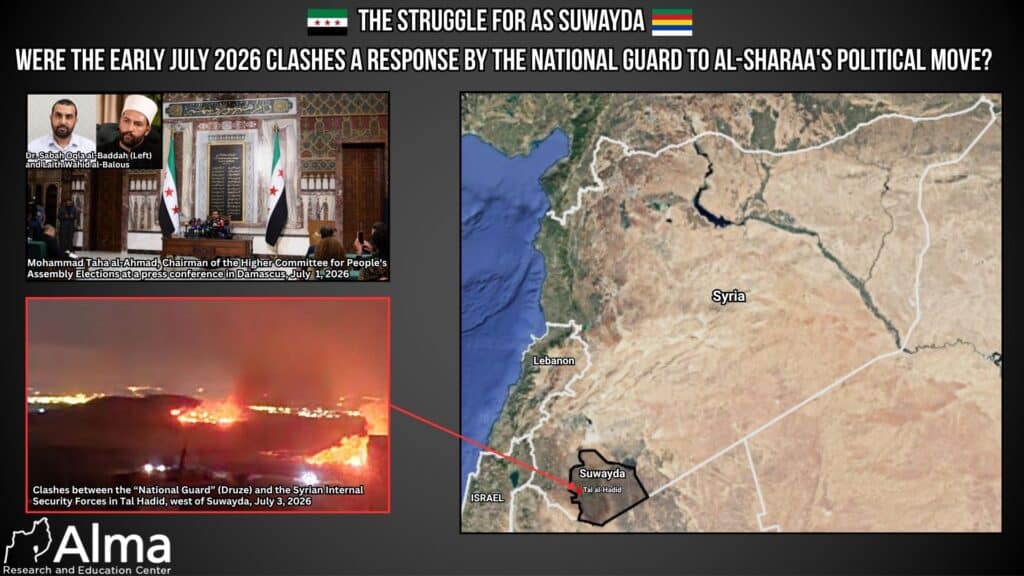
Just two days after President Ahmad al-Sharaa appointed two representatives from Suwayda Governorate to the Syrian Parliament (for further reading, see: “Suwayda’s Representation in Parliament: The Politics of Appointments Amid a Crisis of Trust“), violent clashes erupted between the regime’s security forces and the (Druze) National Guard in the Tal al-Hadid area, west of the city of Suwayda (July 3, 2026).
The focal point of the fighting was the Tal al-Hadid outpost, one of the regime’s Internal Security positions established as part of the ceasefire arrangements following the Suwayda crisis in the summer of 2025. The outpost controls the western entrance to the city, the road leading to al-Tha’la Airbase, and several key transportation routes. As such, it constitutes one of the regime’s most important control points in the governorate.
According to the Syrian Ministry of Interior, National Guard forces opened fire on Internal Security positions at the outpost and attempted a ground advance but were repelled. In contrast, local sources in Suwayda refrained from determining which side initiated the fighting and described the incident as part of the continuing cycle of clashes between the two sides. At this stage, it is not possible to determine conclusively who initiated the confrontation.
The clashes continued for several hours and involved the use of heavy machine guns, medium weapons, and mortars. In addition, there were reports that the regime’s forces employed explosive drones. According to the reports, one of the drones struck a military position of Rawad Abdul Khalek, commander of the National Guard’s Rapid Intervention Battalion, wounding him.
The clashes did not end after the fighting at Tal al-Hadid. On July 6, the Syrian Parliament convened for its first session following the swearing-in of its members, including the two representatives from Suwayda appointed by al-Sharaa. The following day, July 7, reports indicated continued reinforcement of regime forces in the Tal al-Hadid area, along with sporadic exchanges of fire.
The close timing between the political developments and the continued friction on the ground illustrates that the struggle over Suwayda is being fought not only on the military front, but also over the question of the governorate’s legitimacy and representation.
Between the Political Move and the Military Confrontation
At first glance, these appear to be two separate events—the appointment of Suwayda’s representatives to Parliament on the one hand, and the military clashes on the other. However, the close timing of the events, together with the broader political and security context in the governorate, suggests that they may form part of a wider struggle over control of Suwayda.
The National Guard was established to consolidate the bulk of the Druze military force in the governorate under a unified security framework operating under the spiritual leadership of Sheikh Hikmat al-Hijri (for further reading, see: “The Druze in Suwayda and the Fighting Force“). This concept stands in contrast to the regime’s policy, which seeks to restore the governorate to the full control of the Syrian state.
The appointments made by al-Sharaa were not merely a parliamentary step. From the regime’s perspective, they represented an effort to re-establish Damascus’ authority in a governorate where elections were not held, by appointing representatives perceived as more pragmatic toward the central government and not identified with the National Guard camp. The two appointees are Laith Wahid al-Balous )Druze) and Dr. Sabah Oqla al-Baddah (Bedouin(.
At the same time, the Tal al-Hadid outpost represents the regime’s security presence at one of the most important control points in the western part of the governorate. If the National Guard did indeed initiate the attack – as claimed by the Syrian Ministry of Interior – it may have been more than an attempt to strike a military position. It may also have been intended as a message to Damascus that, despite the regime’s efforts to consolidate its authority through state institutions, effective power on the ground still rests with the local armed forces.
Although it is not yet possible to establish a direct causal link between the appointment of Suwayda’s representatives and the outbreak of the clashes, the timing of the events and the targets involved suggest that both developments are part of the same ongoing struggle between the regime and the Druze power centers over one central question: who will hold the authority and legitimacy to govern Suwayda—the Syrian state or the local Druze power centers?