
Background
Suwayda Governorate, the stronghold of the Druze community in Syria, is experiencing a period of ongoing instability, which intensified further during 2025–2026 following the rise of Ahmad al-Sharaa’s regime.
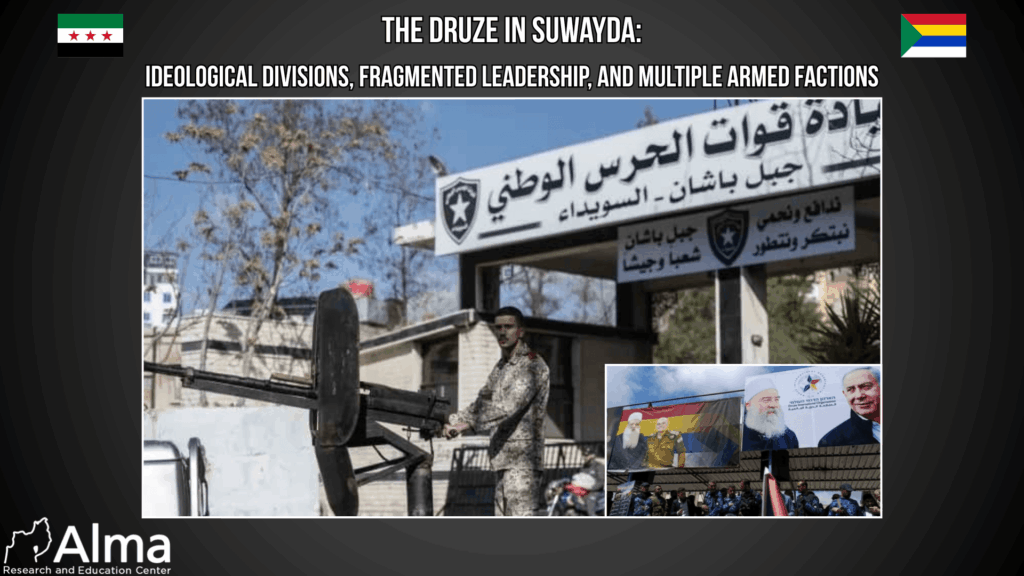
On April 11, 2026, a demonstration was held in Al-Karama Square in central Suwayda, with the participation of local residents expressing support for the positions of Sheikh Hikmat al-Hijri. Earlier that year (January 2026), al-Hijri stated that his central demand was autonomy for Suwayda Governorate from the Syrian regime, contingent upon the presence of an external guarantor (which he argued only Israel could provide). His remarks reflect an emerging narrative portraying the crisis in Suwayda as evidence of Damascus’s failure to protect the Druze community. From this perspective, a purely internal solution is viewed as insufficient without outside backing, with Israel presented as the primary actor capable of ensuring Druze security under current regional conditions.
During the demonstration, flags were raised and signs displayed that included images of Israeli Prime Minister Benjamin Netanyahu alongside images of Sheikh al-Hijri, Sheikh Mowafaq Tarif (the spiritual leader of the Druze in Israel), and Major General Ghassan Alian – the IDF Coordinator of Government Activities toward the Druze. According to local reports, the demonstrators demanded the right to self-determination and the disclosure of the fate of missing and detained Druze held by the Syrian regime.
The demonstration took place against the backdrop of rising internal tensions in Suwayda Governorate, after Sheikh al-Hijri announced several days earlier the dissolution of the “Judicial Committee” and the establishment of an alternative body called the “Administration Council in Jabal Bashan.” The move, presented as an attempt to streamline local governance and rely on professional qualifications, was also perceived as a response to internal struggles within the Druze leadership amid security incidents and ongoing tensions in the governorate.
The Druze community in Suwayda, often perceived externally as a closed and ostensibly unified community, is in practice a dynamic socio-political group in which factions with differing interests and armed forces operate without being subordinate to a single leadership, while holding divergent interests and ideological lines regarding governance and relations with Damascus.
In July 2025, instability worsened amid ongoing friction between Druze gunmen and Bedouin tribes surrounding the governorate, driven by kidnappings, revenge attacks, and competition for local control. Within a short time, the clashes escalated into significant fighting causing numerous casualties leading to the intervention and incursion of Syrian security forces affiliated with al-Sharaa’s regime into the governorate.
During the fighting, hundreds of deaths were reported – on both sides, as well as among civilians. Regime forces (the army and internal security), according to reports, videos, and images from the field, committed massacres against innocent civilians, war crimes, abuse, religious humiliation, and persecution on religious grounds. It should be noted that on the other side, there is also serious evidence of acts committed by Druze forces against regime forces and Bedouins (abuse, revenge attacks, killings, arson of property, and similar acts).
At the same time, Israel carried out strikes against Syrian security forces in southern Syria and other areas, in an attempt to prevent harm to Druze communities and establish “red lines” regarding the deployment of Syrian forces near the Israeli border (see report regarding “The Suwayda Events: From a Local Conflict to a Regional Crisis” – link).
Non-Uniform leadership
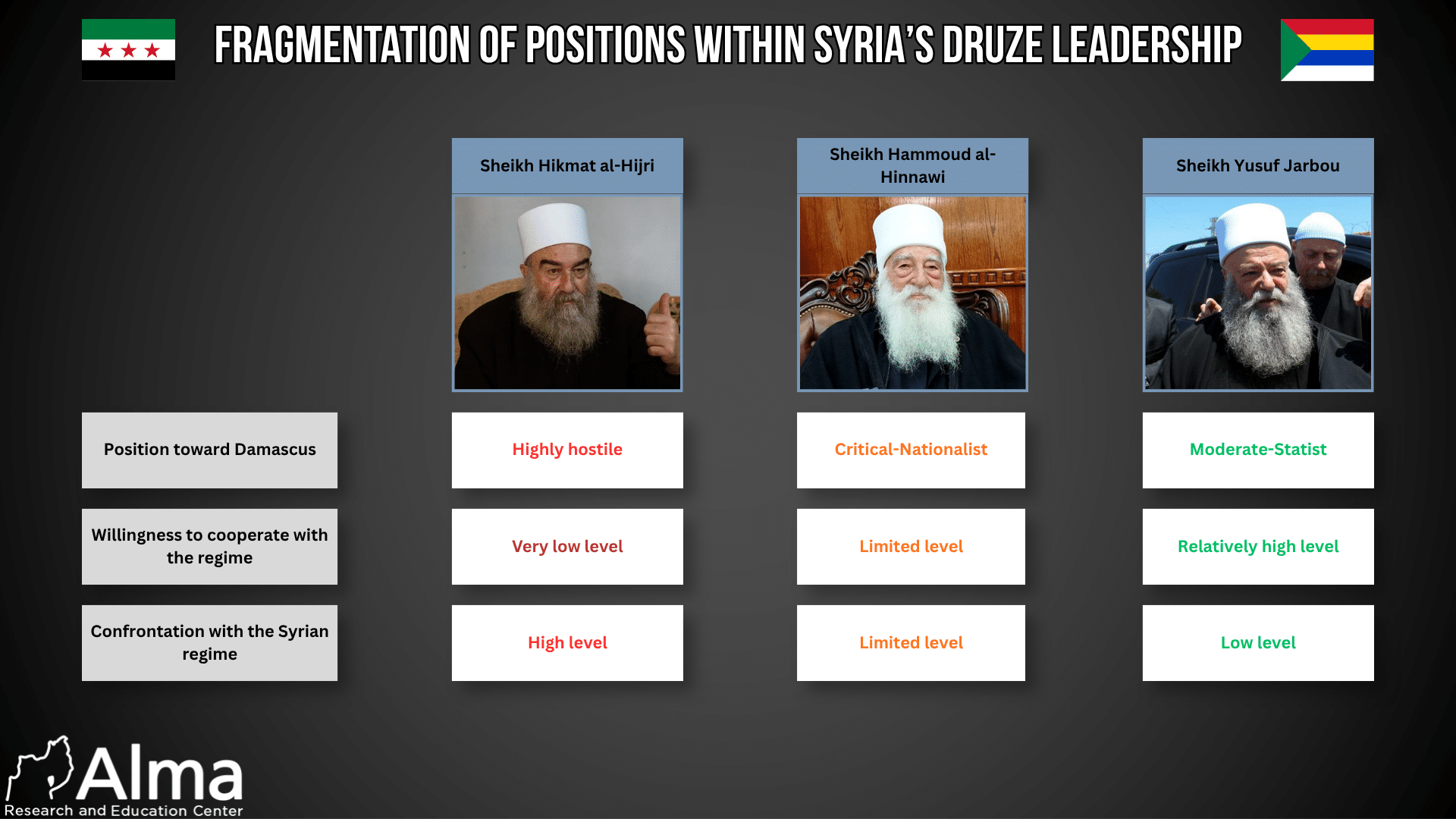
Against the backdrop of the escalation, the rift within the Druze leadership itself became sharper. The religious-communal axis of Suwayda Governorate is built around the sheikhs known as “al-Aql” (العقل – wisdom): three sheikhs who serve as the spiritual leaders of the Druze community in Syria and who can influence the armed apparatus.
On one side stands Sheikh Hikmat al-Hijri, the most prominent figure, who currently leads a line advocating Druze-Syrian autonomy. That is, not official separation from Syria, but rather the creation of an independent governing-security space for Suwayda while reducing Damascus’s influence and increasing reliance on external ties, foremost among them ties with the Druze community in Israel. His supporters promote a firm line of self-defense and rejection of regime forces, arguing that the regime humiliates and harms the Druze.
In the middle stands Sheikh Hammoud al-Hinnawi, engaging an intermediate and more separatist position calling for national unity while remaining critical of the regime. His position ranges from a pragmatic line of preserving Syrian identity and giving the new Syrian state an opportunity. However, following the Suwayda crisis in July–August 2025, he aligned himself with the harsh opposition to Damascus’s policies in the governorate. Al-Hinnawi emphasizes the protection of the Druze as a central principle through international pressure and assistance, but without explicitly calling for Israeli guarantees/involvement or separate autonomy.
On the other side of the divide stands the “state-oriented” position associated with Sheikh Yusuf Jarbou’, which promotes a solution within the framework of the Syrian state and strongly opposes Israeli involvement. According to Jarbou’, escalation with Damascus should be avoided. This line, which views preserving the Syrian framework as a vital interest of the community, is also supported by other Druze actors who believe Israeli involvement would brand the Druze as a separatist factor and undermine their legitimacy within Syria.
From a broader perspective, Suwayda has become a volatile arena in which key axes of dispute generate internal fractures within the community:
– Relations with Damascus – accommodation with the state or security autonomy
– The question of weapons – a state monopoly or “weapons as a survival tool” for the community
– Leadership and legitimacy – Hikmat al-Hijri or other leaders / the Druze leadership or the Syrian framework
– External relations – external guarantees (including Israel) versus fear of harming legitimacy
Two opposing camps regarding Damascus:
The camp opposing the Syrian regime, under Sheikh Hikmat al-Hijri, who supports maintaining independent weapons and resisting their surrender, supports a form of autonomy in the governorate, all within the framework of sectarian unity.
In contrast, the camp coordinating with the Syrian regime, under Sheikh Yusuf Jarbou’ (and to some extent Sheikh Hammoud al-Hinnawi), supports integrating the state into security management, reducing external dependence, and emphasizing Syrian unity.
The Armed Druze Forces
Alongside the weakening grip of the Syrian state over the governorate and amid the rift within the Druze leadership, armed tribal and communal power mechanisms became increasingly entrenched in Suwayda, imposing order and security based on political identity. Within this context, the armed Druze force evolved from a model of “local civilian defense” into a broad regional system of militias and local factions differing in size, subordination, and above all, in deep disagreements regarding the correct way to govern the governorate and relate to the regime in Damascus.
The gap between the camps concerns fundamental questions of sovereignty, weapons, political and sectarian identity, and the future of the governorate within the Syrian governing system.
On the ground, the governorate is managed through a combination of religious-communal authority structures, local armed forces, local influence networks of families and clans, and a violent local economy that includes smuggling, kidnappings, and extortion — among some of the groups. In this reality, the armed Druze force in Suwayda has become highly significant.
This is a multi-player arena: large factions with hundreds of fighters alongside small family-based groups, some with a local security character and others associated with a criminal economy involving smuggling, kidnappings, and extortion.
In this context, according to reports, there are indications of involvement by local actors in southern Syria in smuggling activities, and the use of Suwayda Governorate as a transit and storage area for smuggling operations (particularly drugs). Therefore, on May 3, the Jordanian Air Force carried out a series of airstrikes against targets in southern Syria, mainly in Suwayda Governorate. This was not the first time the Jordanians attacked this area and likely will not be the last. According to the Jordanian military statement, the strikes targeted storage, production, and smuggling facilities for weapons and drugs from Suwayda toward the Jordanian border. Local reports noted that warehouses and facilities linked to key figures in the governorate’s smuggling networks were also targeted, and that the strikes were accompanied by drones and intensive aerial surveillance intended to curb smuggling activity along the border.
The armed forces can be mapped according to their relations with Damascus, their commanders or leaders, their size, and their activities:
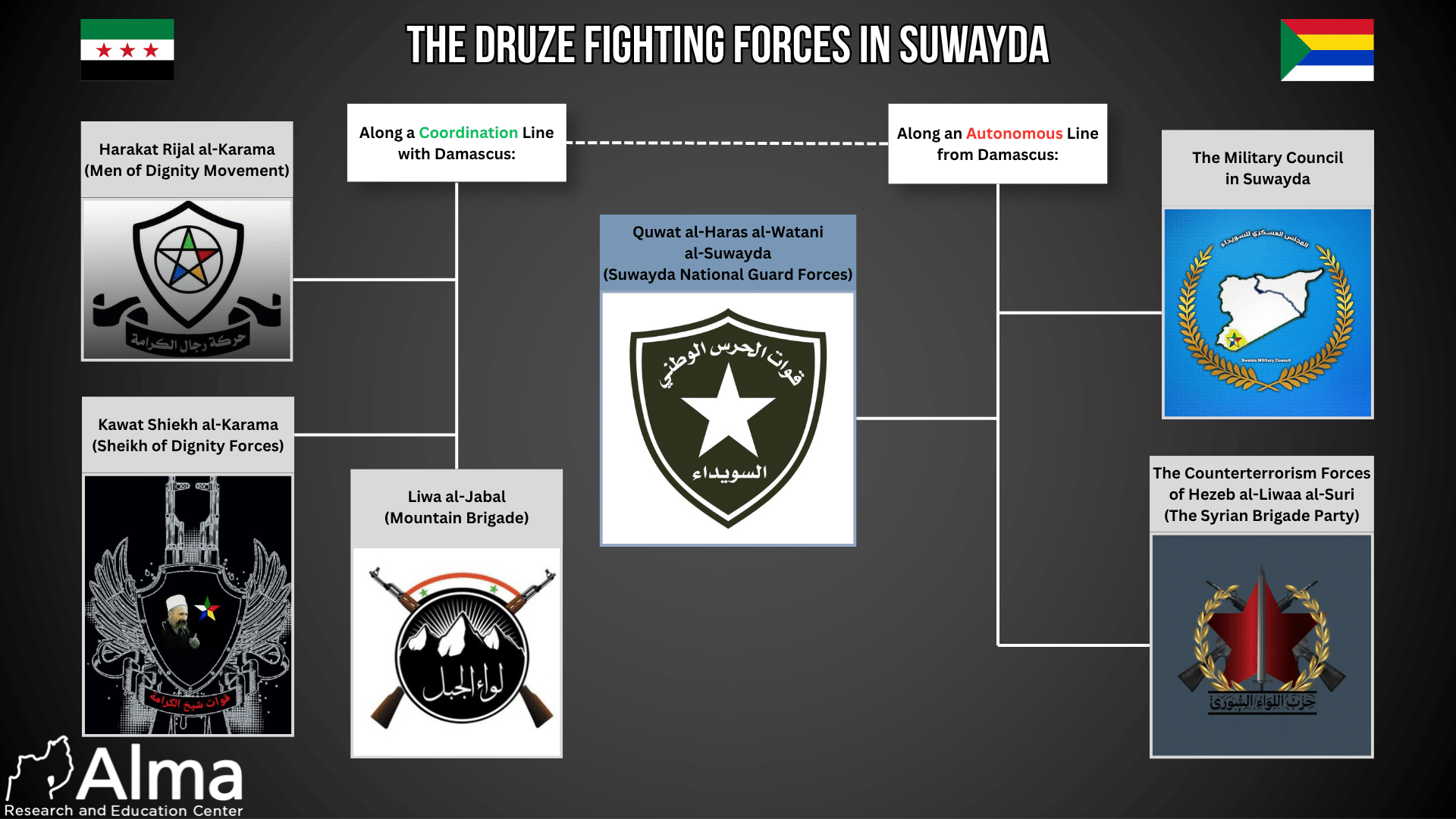
Those Favoring Autonomy from Damascus:
The Suwayda Military Council (المجلس العسكري السويداء) was established in February 2025 as a body intended to unite several armed Druze frameworks under coordinated command, against the backdrop of worsening security instability in southern Syria and the weakening control of Damascus. It is headed by Tariq al-Shoufi and presents itself as the defender of the governorate, operating according to the ideological line of Sheikh Hikmat al-Hijri, who supports self-management for Suwayda and the building of independent defense capabilities.
Quwat Mukafahat al-Irhab (قوات مكافحة الارهاب – Counterterrorism Forces), established in 2021 as the military wing of Hizb al-Liwaa al-Suri (حزب اللواء السوري – The Syrian Brigade Party), are estimated at around 700 fighters under the command of Samer al-Hakim. The organization presents itself as a force intended to combat ISIS and other jihadist actors and to fight criminal infrastructures and drug smuggling networks in southern Syria. This is a medium-sized and highly significant military force in the local Druze arena. Hizb al-Liwaa al-Suri is an opposition Druze party operating from Suwayda under the leadership of Malik Abu Khair.
The National Guard Forces – A Unified Druze Army
Against the backdrop of the complexity of the armed forces, efforts intensified to unify some of the forces under a broader and more unified framework under the title Quwat al-Haras al-Watani al-Suwayda (قوات الحرس الوطني السويداء – Suwayda National Guard Forces) as a unified Druze army in Suwayda Governorate.
If the entire Druze community in Suwayda Governorate were indeed to organize and consolidate all factions under the National Guard Forces, while declaring this body to operate under the spiritual leadership of Hikmat al-Hijri, the estimated strength of the “unified Druze army” would be approximately 15,000-armed fighters with a reserve force of similar size.
Following the Jordanian aerial operation on May 3, the Suwayda National Guard Forces issued an unusual statement condemning Jordan and claiming that the strikes were carried out without coordination and harmed civilians. At the same time, members of the National Guard Forces attempted to distance themselves from involvement in drug smuggling, claiming that the production centers were located outside the area.
Despite its original purpose, the initiative intended to create a sectarian army that would serve as a deterrent against external threats, with a chain of command that would reduce internal anarchy and create a large, organized armed force managing security autonomously vis-à-vis Damascus – is itself controversial. One criticism concerns the integration of former officers from Assad regime institutions (around 800 officers), due to fears that the unified army would become a tool of power groups rather than a “defense mechanism.”
Therefore, some of the large factions are not rushing to join fully and emphasize that they support unification but not necessarily subordination.
Those Favoring Coordination with Damascus:
Harakat Rijal al-Karama (حركة رجال الكرامة – The Men of Dignity Movement), led by Yahya al-Hajjar, is an organization established in 2014 by Sheikh Wahid al-Balous with the aim of protecting Druze communities in the governorate. Since then, it has grown into one of the most prominent organizations in southern Syria and even the largest Druze organization. According to estimates, the force numbers between 5,000 and 8,000 fighters. The organization’s position is relatively neutral and aligns with support for defending Suwayda against the regime while remaining open to coordination with it. Regarding the broader Druze framework, the organization is cautious about unification under unclear leadership. Rijal al-Karama sees itself as the largest and most responsible framework within the community.
Quwat Sheikh al-Karama (قوات شيخ الكرامة – Sheikh of Dignity Forces) is an organization led by Laith and Fahad al-Balous (sons of Sheikh Wahid al-Balous) that split from the Rijal al-Karama movement after the assassination of the elder al-Balous in 2015. During the fall of the Assad regime (December 2024), the organization helped seize control of the Suwayda area and even attacked Damascus from the south. The organization also supports the line of coordination and integration with the regime and opposes external intervention (by Israel). Alongside it stands Midhafat al-Karama under the leadership of Laith al-Balous.
Liwaa al-Jabal (لواء الجبل – Mountain Brigade), led by Suleiman Abd al-Baqi, is an organization established in 2014 that became one of the prominent organizations in the area, focusing on protecting the Druze community in the governorate. This organization operated against the Assad regime, Iranian militias, Hezbollah, and ISIS, and currently serves as a liaison and mediation actor with the Syrian Ministry of Defense while promoting the idea of a unified Syrian army rather than a separate sectarian force.
Informal fighters:
In Suwayda, there is a broad layer of informal fighters numbering approximately 5,000-armed individuals who do not officially belong to or identify with any armed force. These are local residents who maintain civilian routines but possess weapons and basic skills, and in emergencies quickly mobilize to defend the community, effectively operating as a communal reinforcement force.
They join fighting “as local Druze” but not under the name of a leader or organization — based on the perception that the supreme commitment is the protection of members of the Druze community and Druze settlements in the governorate. Therefore, during conflicts they may fight alongside any local force present on the front line to protect the Druze population, regardless of the political disputes between factions, if the confrontation is against external “attackers” threatening the community.
Summary
While the Druze community advances toward a form of autonomy, whether in coordination with Damascus or without coordination with Damascus, the community is also creating vulnerabilities within itself, with the main risks being internal clashes among the Druze themselves, struggles over legitimacy, and external influence that could intensify internal fragmentation over the long term.
In the near term, armed forces may continue to proliferate and attempts to unify under the National Guard Forces may remain only partial, while the central escalation factor will be the attempt by the Syrian state to force the surrender of weapons by the Druze community in the governorate. If this fails, regime forces may enter Suwayda once again to bring the conflict to an end.
Regarding Israel, it too is a factor intensifying the internal fragmentation in Suwayda, located approximately 80 km from the border. Israel is increasingly perceived as an actor with influence over the future of the governorate. However, the more visible the Israeli presence becomes, the more Israel turns into a political lever in the hands of al-Hijri’s camp and simultaneously into a destabilizing factor vis-à-vis other camps trying to preserve an opening for arrangement with Damascus. The issue of Israeli involvement in Suwayda has become a central internal dispute among the Druze themselves.


One Response
Dear Alma staff,
After the terror attacks upon the Druze in Syria, it is understandable that fear and distrust are present among the different clans. Thank you for the detailed report of current events. There will continue to be conflict as long as Erdogan continues his inflammatory muslim brotherhood propaganda and terror financing, and retains influence with the al Sharra regime.