
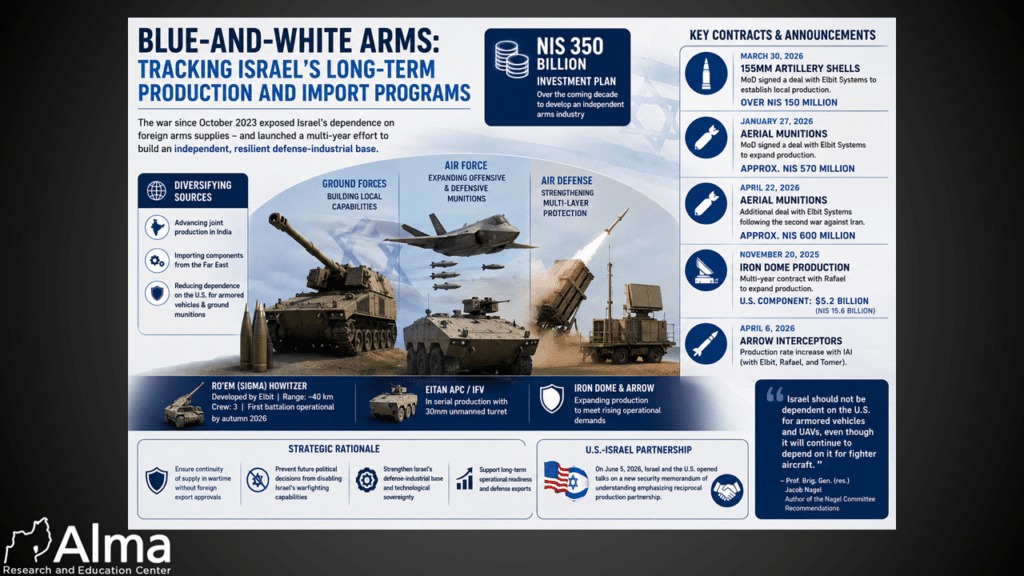
The multi-front war that has continued since October 2023 exposed Israel’s dependence on ammunition supplies from the United States in particular, and from additional countries more broadly, and pushed the defense establishment and the Israeli government into a multi-year effort to build an independent production infrastructure.
At the level of national policy, Prime Minister Benjamin Netanyahu announced on December 24, 2025 a plan to invest approximately NIS 350 billion over the coming decade in the development of an independent arms industry.
Contract announcements have consistently illustrated the new policy. In the ground forces sphere, on March 30, 2026, the Ministry of Defense signed a deal worth over NIS 150 million with Elbit Systems to manufacture 155 mm artillery shells in Israel.
For the Air Force, two aerial munitions procurement deals were signed with Elbit — one worth approximately NIS 570 million on January 27, 2026, and the second worth approximately NIS 600 million on April 22, 2026.
In the air defense arena, on November 20, 2025, the Ministry of Defense signed a multi-year contract with Rafael to expand Iron Dome production, and alongside it, on April 6, 2026, an increase in the production rate of Arrow interceptors was announced with IAI.
In terms of diversifying procurement sources, Israel is advancing joint production in India and importing components from the Far East, while simultaneously seeking to reduce dependence on the United States with respect to armored vehicles and ground munitions.
At the same time, on June 5, 2026, Israel and the United States opened talks on a new security memorandum of understanding that emphasizes a reciprocal production partnership. The drive for independence in ground munitions aligns with the recommendations of the Nagel Committee, whose author, former National Security Advisor Prof. Brig. Gen. (res.) Jacob Nagel has said that Israel should not be dependent on the United States for armored vehicles and unmanned aerial vehicles, even though it will continue to depend on it for fighter aircraft.
The guiding rationale is that local production lines for shells and armored fighting vehicles will prevent a situation in which a political decision by a future U.S. administration disables warfighting capability in the midst of a conflict.
Ground Forces Munitions Production
A central lesson of the war is the need to develop and maintain local production lines for ground munitions that are not dependent on foreign export approvals. On March 30, 2026, the Ministry of Defense signed a deal worth over NIS 150 million with Elbit Systems to establish a local production line for 155 mm artillery shells, with the aim of ensuring continuity of supply during wartime. Alongside this, on December 24, 2025, the IDF received the first Ro’em (SIGMA) wheeled self-propelled howitzer (artillery gun), developed and to be manufactured at Elbit’s plant in Yokneam, with a range of approximately 40 km and a crew of three soldiers; the first battalion is expected to reach operational readiness by autumn.
The howitzer is gradually replacing the veteran “Doher” system and represents a transition to blue-and-white production of artillery systems. The industrial base for manufacturing 105 mm and 120 mm tank shells, mortar bombs, and 155 mm shells is currently concentrated in Elbit’s land division.
Behind this preparation stands the rebuilding of the armored vehicle array, in which the IDF relies on a network of approximately 200 local defense industries that supplied components for the Barak tank, the Namer tracked APC, and the Eitan wheeled combat vehicle, which recently received a 30 mm turret.
The two deals with Elbit, less than three months apart, illustrate the rapid pace of Ministry of Defense contracting with local industry since the start of 2026, as part of cumulative local procurement totaling more than NIS 9 billion between January and March 2026.
The Eitan wheeled APC entered serial production as an APC, as did the IFV version (infantry fighting vehicle) with an unmanned turret and a 30 mm cannon.
Beyond the air defense field, Rafael also plays a central role in manufacturing ground systems, including Spike missiles, Trophy active protection systems, and additional anti-tank systems that have become a leading component in Israel’s armored vehicle array and in defense exports.
Air Force Munitions Production — Offense and Defense
The effort to expand the local production base stood out especially in the field of aerial munitions, where Israel had previously faced delays and restrictions from the Biden administration (which delayed the arrival of 2,000-pound MK84 bombs and 500-pound bombs (MK-82) during the war), Britain, and Canada (which froze or canceled export licenses to Israel) concerning air-to-ground bombs.
On January 27, 2026, the Ministry of Defense signed a deal worth approximately NIS 570 million (about $183 million) with Elbit Systems for the procurement of aerial munitions, as part of expanding the defense-industrial base. About three months later, on April 22, 2026, another deal worth approximately NIS 600 million (about $200 million) was signed for the production of aerial munitions, after the second war against Iran.
In the air defense arena, the multi-year contract signed on November 20, 2025 with Rafael to expand Iron Dome production included a U.S. component (for all Israeli air defense capabilities) worth approximately $5.2 billion (NIS 15.6 billion) that was allocated for procurement.
At the same time, on April 6, 2026, an increase in the production rate of Arrow interceptors was announced with Israel Aerospace Industries (IAI) as the prime contractor, together with Elbit, Rafael, and the Tomer plant. In addition, Israel is advancing the “Or Eitan” (Iron Beam) laser system, developed by Rafael (prime contractor) and Elbit at a scope of approximately NIS 2 billion, as a low-cost response for intercepting short-range threats.
The simultaneous expansion of aerial munitions and interceptor production lines is intended to ensure that even in a prolonged multi-front conflict, no shortage will emerge, as happened during certain phases of the war against Iran and its proxies. This creates a structure in which air defense and offensive munitions are produced in parallel by the same leading companies — Rafael, Elbit, and Israel Aerospace Industries — thereby deepening the interdependence between the state and the local defense industries.
In November 2025, R2S (a joint venture of Raytheon and Rafael) opened a new manufacturing facility in East Camden, Arkansas, to produce Tamir interceptors for the Iron Dome system and their American version, Sky Hunter, for the U.S. Marine Corps’ Medium Range Intercept Capability (MRIC) program.
The facility, established following a groundbreaking ceremony in February 2024, is designed to support the Israeli Ministry of Defense initiative to accelerate the pace of serial production of Iron Dome interceptors in the framework of a reciprocal production model between Israel and the United States.
Naval Munitions Production — Offense and Defense
In the maritime arena, the Navy is advancing a blue-and-white shipbuilding program aimed at reducing dependence on foreign shipyards. On February 18, 2025, the Ministry of Defense inaugurated the start of production of five Reshef missile ships at Israel Shipyards, in a deal worth approximately NIS 2.8 billion (about $780 million) signed on December 12, 2024, with the first delivery expected around 2028. The program was defined as a “blue-and-white” independence move, even though some hull modules are manufactured by an American subcontractor funded by security assistance.
The Reshef ships join the Sa’ar 6 fleet, which was built at ThyssenKrupp shipyards in Germany but equipped with Israeli systems, including the C-Dome system, an advanced radar (MF-Star, produced by Elta), Barak 8 defense systems by IAI, and, according to foreign reports, offensive Gabriel 5 missiles. The combination between a ship hull manufactured abroad and local weapons and defense systems illustrates the broader pattern of hybrid production — independence in critical systems alongside dependence on platform components. Independence in the defensive component of the ships reduces the Navy’s exposure to political restrictions by foreign suppliers, similar to the trend in the land and air arenas.
The Trend — Blue-and-White and the NIS 350 Billion Plan
The most prominent move in the current period is the positioning of production independence as a national strategic objective. On December 24, 2025, at a ceremony at the Hatzerim Air Force Base, Prime Minister Netanyahu announced an investment of approximately NIS 350 billion (about $110 billion) over the coming decade to develop an independent arms industry. The plan relied on the conclusions of the Nagel Committee, which recommended a hybrid capability in a ratio of approximately 70% offense and 30% defense (while some aircraft can serve both offensive and defensive roles). The committee chairman, Yaakov Nagel, emphasized that Israel should not be dependent on the United States for armored vehicles and unmanned aerial vehicles, but would continue to depend on it for fighter aircraft, while in other fields, hybrid procurement systems (dependent on both imports and local industries) would be developed.
As early as January 2025, two deals with Elbit totaling approximately NIS 1 billion were signed — one for heavy aerial munitions and the other for the establishment of a national raw materials plant — a step described by the then director general of the Ministry of Defense and current IDF chief of staff, Eyal Zamir, as a central lesson of the war.
According to the understandings between Defense Minister Israel Katz and Finance Minister Bezalel Smotrich, the 2026 defense budget stands at approximately NIS 112 billion (about $34 billion), after the military initially requested a larger budget.
The budget reflects a significant increase compared with previous years due to war expenditures, but it also provides a macroeconomic framework for long-term investments in local production plants and in production lines for munitions, interceptors, and armored fighting vehicles.
This policy also relies on export momentum: Israel’s defense exports reached a record of approximately $19.2 billion in 2025, an increase of about 30% compared with 2024.
In the background, there are reports according to which Israel reached understandings with several countries on the regular supply of munitions in the next war, including joint production of artillery and armor shells and the transfer of emergency stockpiles.
According to the official data, the export record stemmed to a large extent from systems that were battle-tested during the war, which strengthened international demand and the economic feasibility of expanding the local production base. The record in defense exports provides Israeli industry with the economic scale needed to justify the major government investment in expanding production lines, and helps keep production lines open on a routine basis.
Diversifying Procurement Sources — Not Only the United States
Alongside building internal independence, Israel is acting to diversify its procurement and production sources in order to reduce exposure to the political restrictions of a single supplier. One of the central axes is India, where a transition is being promoted from a buyer-seller model to a production partnership: IWI is cooperating with the Adani Group in the production of small arms, Elbit is producing the Hermes 900 UAV with Adani at a plant in Hyderabad, and Israel Aerospace Industries is cooperating with India’s HAL in the production of Heron UAVs, and Barak 8 air defense systems in cooperation with DRDO (the research and development arm of the Indian Ministry of Defence) and BEL.
This move is anchored in a concept of reducing dependence on the United States while building an independent production architecture. Expanding the supplier circle to the Far East and other countries is intended to ensure that even if a major supplier imposes an embargo, as happened with Britain and Canada on the issue of air-to-ground bombs, Israel will retain alternative supply channels. The choice of India as a central axis stems from the scale of Indian demand, the relatively low production costs, and the political stability of the relationship between the two countries, which enables long-term joint production and not only one-time sales.
Alongside the effort to reduce dependence, Israel is seeking to reshape the security relationship with the United States around the principle of reciprocity in production. On June 5, 2026, talks opened on a new security memorandum of understanding (the current memorandum expires in 2028), with the Israeli side led by Ministry of Defense Director General Amir Baram and Ambassador to the United States Yechiel Leiter, and the American side led by Daniel Holler, a senior adviser at the State Department, and Ambassador Mike Huckabee. The new logic is also reflected in the American National Defense Authorization Act (NDAA) for fiscal year 2027, which includes in Section 224 (later changed to Section 219) an initiative called the “US-Israel Defense Technology Cooperation Initiative,” aimed at cooperation in the fields of artificial intelligence, quantum computing, directed energy, and autonomous systems.
The transition from a pattern of one-way dependence on American aid to a reciprocal production partnership reflects the same concept that drove the NIS 350 billion move: ensuring continuity of supply in wartime, while combining local independence with diversified production alliances. The Israeli side is seeking to anchor in the new memorandum a mechanism that will allow Israel to continue developing independent production capabilities without losing access to critical American components and technologies, chief among them fighter aircraft engines and systems for which there is no local substitute.
Conclusion
The current period marks Israel’s declared transition from a country that relied on external ammunition supplies with a limited weapons stockpile that is unsuited to the era of long wars, to a country building a multi-year independent production base, backed by significant investment over the coming decade, in order to build a large weapons stockpile for every scenario.
The move is operating simultaneously on three levels: deepening local production of ground, air, and naval munitions; diversifying procurement sources with an emphasis on India and the Far East; and redesigning the alliance with the United States around reciprocity in production.
Israel’s dependence on the United States for critical needs such as fighter aircraft is not expected to disappear in the near term, and therefore the emerging policy is not disengagement but rather a balance among the three levels — building alternative supply routes alongside preserving the central alliance.
The ultimate objective is to preserve a large weapons stockpile, and all the means for achieving that objective are supposed to serve it, so that Israel will not again find itself in a situation in which it depends on the goodwill of decision-makers in Washington in order to fight and defend itself in an existential war.
- https://www.reuters.com/world/middle-east/netanyahu-israel-spend-110-billion-develop-independent-arms-industry-next-decade-2025-12-24/
- https://www.timesofisrael.com/liveblog_entry/defense-ministry-signs-48m-wartime-artillery-shell-deal-with-elbit/
- https://www.army-technology.com/news/imod-elbit-systems-artillery/
- https://www.ynetnews.com/article/skghgwyqwl
- https://www.whoprofits.org/companies/company/3794?elbit-systems
- https://www.elbitsystems.com/news/israel-mod-expands-defense-industrial-base-approximately-183-million-air-munitions-procurement
- https://www.timesofisrael.com/liveblog_entry/defense-ministry-inks-183-million-deal-with-elbit-for-aerial-munitions/
- https://www.israelhayom.com/2026/04/23/idf-signs-major-deal-with-elbit-for-munitions-production/
- https://www.fdd.org/analysis/2026/03/27/israel-aims-to-bolster-domestic-munitions-production/
- https://www.timesofisrael.com/liveblog_entry/defense-ministry-signs-multibillion-dollar-contract-with-rafael-to-expand-iron-dome-system/
- https://breakingdefense.com/2026/04/israel-to-ramp-up-production-of-arrow-interceptors/
- https://mod.gov.il/en/press-releases/press-room/israel-mod-marks-start-of-production-for-new-reshef-naval-vessels
- https://www.navalnews.com/naval-news/2024/12/israel-initiates-reshef-class-corvette-program/
- https://www.timesofisrael.com/larger-more-powerful-navy-declares-fleet-of-saar-6-class-warships-operational/
- https://www.jns.org/analysis/israel-cant-again-find-itself-unable-to-buy-what-it-needs/
- https://www.jns.org/analysis/domestic-defense-contracts-a-major-step-in-israeli-self-sufficiency/
- https://www.reuters.com/world/middle-east/battlefield-tested-israeli-defence-exports-jump-nearly-30-2025-2026-06-02/
- https://www.calcalist.co.il/local_news/article/rkode6uvbg
- https://www.thehindubusinessline.com/economy/logistics/israel-looks-to-shift-defence-manufacturing-to-india-as-bilateral-ties-move-beyond-buyerseller-model/article70372713.ece
- https://organiser.org/2026/01/29/337431/world/israel-anchors-on-india-to-accelerate-a-self-reliant-defence-architecture-as-it-seeks-to-limit-dependency-on-the-us/
- https://www.aljazeera.com/news/longform/2026/5/23/not-just-the-us-india-to-brazil-51-nations-armed-israel-amid-gaza-war
- https://www.jns.org/analysis/a-completely-reciprocal-partnership/
- https://www.rafael.co.il/news/r2s-opens-new-manufacturing-facility-in-east-camden-arkansas/rafael
- https://www.rtx.com/news/news-center/2025/11/21/r2s-receives-1-25-billion-tamir-production-contract-for-facility-in-camden-arkartx
- https://www.timesofisrael.com/liveblog_entry/smotrich-katz-agree-to-allocate-nis-112-billion-for-defense-spending-in-2026-budget/timesofisrael
- https://www.jpost.com/israel-news/defense-ministry-begins-serial-production-of-the-idfs-eitan-apc-617011jpost
- https://www.i24news.tv/en/news/israel/defense/artc-israel-sets-new-defense-export-record-surpassing-19-billion-in-2025i24news
- https://breakingdefense.com/2026/06/israels-defense-exports-reach-record-19-billion-in-2025





One Response
Dear Yaakov,
I am in full support of peace through strength. However, it is more important to realize that although Moses was trained in all the technology and war armaments of Egypt, he returned to Egypt to defeat the most powerful nation in existence with only his shepherd’s staff, and the Torah of G-d.