
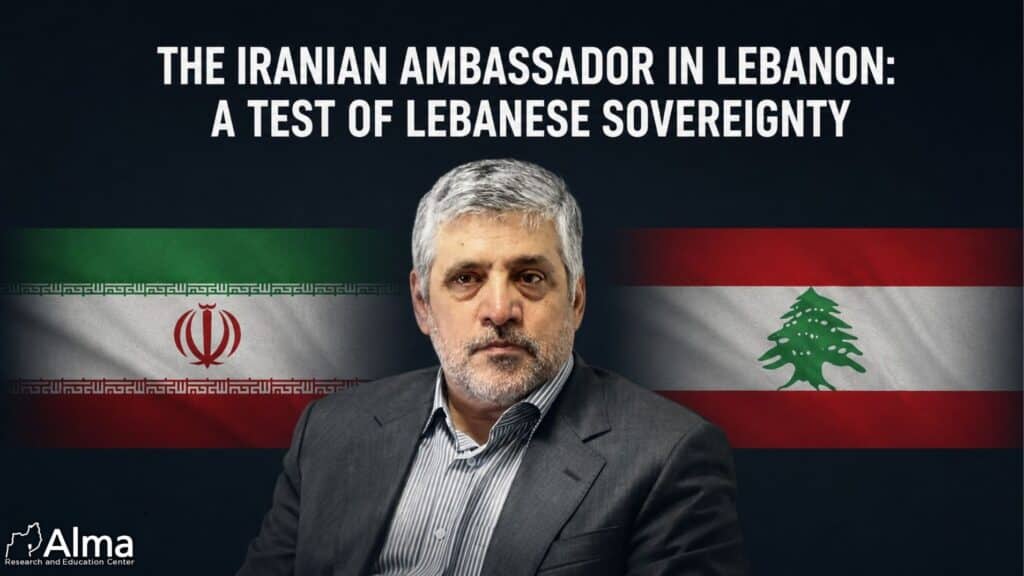
Next month, the residency permit of Iran’s designated ambassador to Lebanon, Mohammad Reza Sheibani, is due to expire, and the question of whether he will be allowed to remain in the country has already become the focus of political and legal controversy in Lebanon.
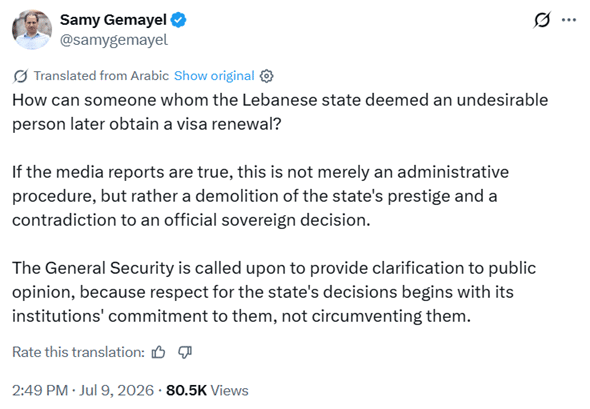
Kataeb Party leader Sami Gemayel reignited the issue when he asked on X: “How can someone who has been declared persona non grata receive an extension of his residency permit?” The question followed reports that Lebanon’s Directorate General of General Security (DGGS) is considering extending Sheibani ‘s residency permit despite Foreign Minister Joe Rajji’s decision last March to declare him persona non grata.
According to Gemayel, if the reports are accurate, this is not a routine administrative measure but rather a violation of Lebanon’s sovereignty and a breach of an official decision by the Lebanese government.
The controversy places Lebanon’s Directorate General of General Security (DGGS), one of the country’s principal security agencies, at the center of the debate. The agency is responsible, among other duties, for border control, residency permits, monitoring foreign nationals, and internal security.
Is the organization aligned with the Shiite camp?
Its current Director General is Hassan Choucair, a Shiite figure affiliated with the Amal Movement, Hezbollah’s partner in the “Shiite Duo.” Choucair was appointed to the position on March 13, 2025.
The key question, which we have examined in several of our previous publications (see our March 2025 article on appointments within Lebanon’s security organizations and our April 2026 article on smuggling through the al-Masnaa border crossing), is the extent of the cooperation and relationship between the Directorate General of General Security and Hezbollah.
In this context, allegations of Hezbollah’s infiltration of the DGGS have intensified in recent years.
In May 2026, the U.S. Department of the Treasury imposed sanctions on “Amid” (Brig. Gen.) Khattar Nasser al-Din, head of the National Security Department at the Directorate General of General Security headquarters, alleging that he had provided intelligence to Hezbollah during the war.
According to reports in the Lebanese media, the Directorate General of General Security has not yet received an official request regarding Sheibani ‘s status. However, it has been claimed that neither the Lebanese government nor the Ministry of Justice has issued any decision concerning the Iranian diplomat. This argument could serve as a legal basis for circumventing the Foreign Ministry’s decision and preventing its implementation in practice.
By contrast, the authority to determine the status of foreign diplomats rests with the Foreign Ministry, not the Directorate General of General Security. From Foreign Minister Joe Rajji’s perspective, his declaration of Sheibani as persona non grata in March 2026 already rendered the diplomat’s residency permit invalid, making it ineligible for renewal.
Meanwhile, reports citing sources close to Amal Movement leader and Parliament Speaker Nabih Berri dismissed these claims. According to those sources, the ambassador is far from being persona non grata. If that were the case, President Aoun would not have sent Defense Minister Michel Menassa to the funeral of Iran’s former Supreme Leader, Ali Khamenei.
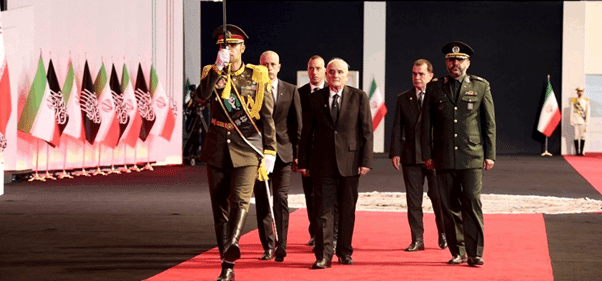
It is worth noting that during recent meetings between an Iranian delegation and both the Speaker of the Lebanese Parliament and Lebanon’s Deputy Prime Minister, it was the Iranian Embassy’s chargé d’affaires, rather than Sheibani himself, who represented the embassy.
Does this reinforce the assessment that Sheibani is no longer effectively serving as Iran’s ambassador in Beirut?
Beyond the question of Sheibani ‘s personal status, the controversy reflects the ongoing power struggle between Lebanon’s state institutions and the centers of influence of Iran and Hezbollah. With Iranian backing, Hezbollah has, over many years, built a network of influence in Lebanon that relies not only on its military strength but also on the gradual penetration of state institutions, security agencies, and decision-making centers. In cooperation with the Amal Movement, Hezbollah has thus been able to influence senior appointments, shape the implementation of government decisions, and even affect the ability of state institutions to enforce Lebanon’s sovereignty.
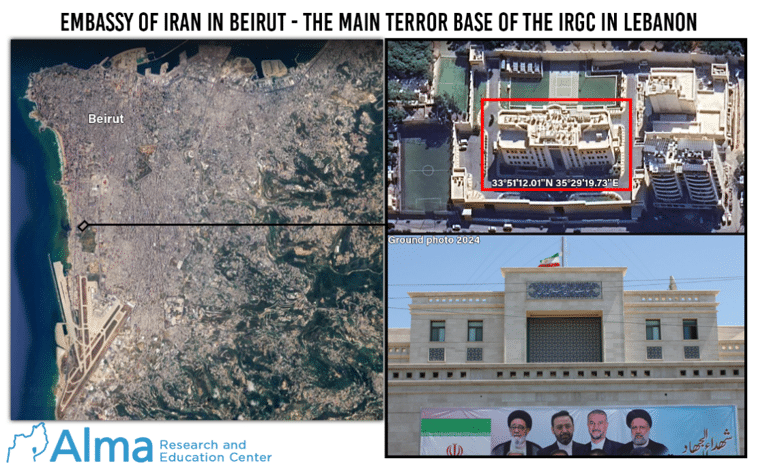
If Sheibani ‘s residency permit is indeed extended despite the Foreign Ministry’s position, it would provide further evidence of the ability of actors aligned with the Iranian axis to undermine official decisions of the Lebanese state through administrative and legal mechanisms. Conversely, enforcing the Foreign Ministry’s decision and bringing Sheibani ‘s stay in Lebanon to an end would constitute a significant precedent, indicating an effort by the country’s leadership, headed by President Joseph Aoun and Foreign Minister Joe Rajji, to strengthen the independence of Lebanon’s state institutions and reduce the influence of Iran and Hezbollah over the country’s decision-making processes.
The dispute over Sheibani ‘s residency permit extends far beyond a diplomatic or administrative matter; it represents a genuine test of the Lebanese state’s ability to exercise its sovereignty in the face of the power centers established by the Shiite axis in Lebanon over decades.
In reality, the struggle over the identity of the Lebanese state continues. Who will prevail?





One Response
Dear Dr Zoe,
You make a good case. We will be watching. The parasitic infiltration and subjugation of good governance is the IRGC strategic model. It is from the proven islamonazi grand mufti-hitler methodology of the last century. Pure antisemitic genocidal evil at its worst. Every decision must be observed, and Justice executed when evil emerges. There can be no more hesitation to destroy evil.l