
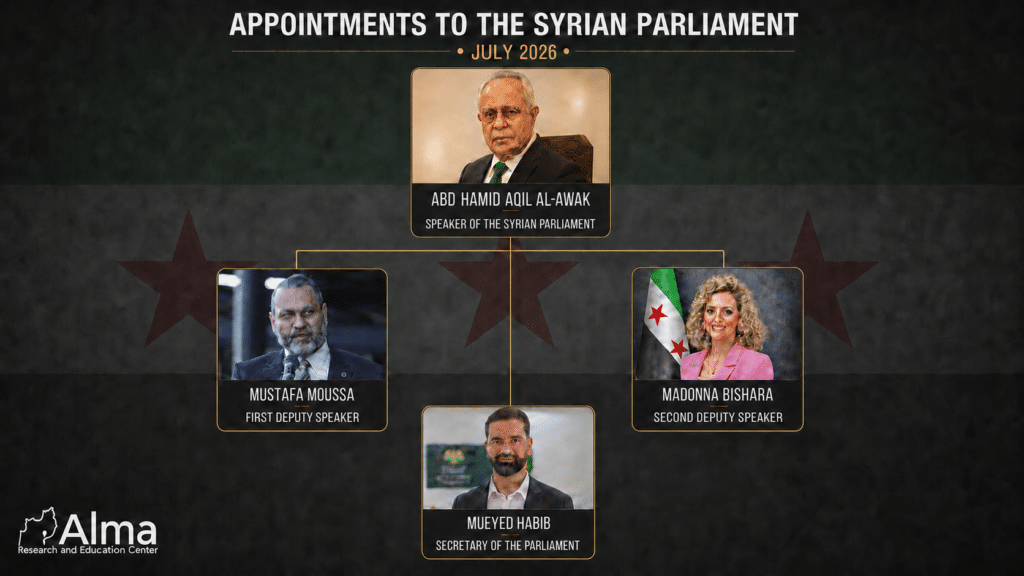
On July 12, the Syrian People’s Assembly (parliament) convened in Damascus for its first session since the fall of the Assad regime, with President Ahmed al-Sharaa in attendance. The members of the parliament took the oath of office and then elected its leadership:
Legal scholar Abd al-Hamid Aqil al-Awak was elected speaker after receiving 99 of 206 votes; Mustafa Abd al-Wahhab al-Moussa was elected first deputy speaker; Madonna Suhail Bashara, second deputy speaker; and Mueyed Habib, parliamentary secretary. The second session was scheduled for July 26. By then, a special committee is expected to draft the parliament’s internal regulations and submit them for debate and a vote.
Abd al-Hamid Aqil al-Awak, the new parliament’s speaker, is a legal scholar from al-Hasakah who served as a judge for approximately 16 years and holds a doctorate in constitutional law. He left Syria in 2014 after being summoned for questioning over his support for opponents of the Assad regime and his refusal, according to him, to detain protesters brought before him. During his exile in Turkey, he taught political science and international relations and worked on constitutional issues, decentralization, and the structure of the future state. Following the fall of the Assad regime, he returned to Syria and chaired the committee that drafted the interim constitutional declaration. Al-Awak, who was appointed to the parliament as part of the “complementary third” (the 70 members appointed by the president), supports the separation of powers, a state based on citizenship, and the preparation of a permanent constitution through an elected constituent body and public approval.
Mustafa Abd al-Wahhab al-Moussa, who was elected first deputy speaker with a majority of 122 votes, is a pharmacist from the Jisr al-Shughur area. At the beginning of the civil war, he was active in humanitarian relief, healthcare, and politics. He later became one of the founders of the General Shura Council, which operated in the Idlib enclave. In 2021, he was elected head of the council, and in February 2025, he was appointed to the preparatory committee for the National Dialogue Conference. In October 2025, he was elected to parliament as a representative of Jisr al-Shughur. His background in the governing institutions established in the Idlib enclave illustrates the integration into the state’s new institutions of figures and mechanisms that emerged during the rule of Hayat Tahrir al-Sham.
Madonna Suhail Bashara (a Christian), who was elected second deputy speaker after receiving 67 votes, is a researcher and academic specializing in civil engineering. She heads the Department of Construction Engineering and Management at Latakia University and is also active in civil society. Bashara was appointed to the parliament as a representative of Latakia Governorate as part of the “complementary third” and is one of the 15 women included on this list. Her election to a senior position gives women greater visibility in the parliamentary leadership, although their overall representation in the parliament remains low.
Mueyed Habib, who was elected parliamentary secretary with a majority of 87 votes, is a political and civil society activist from Darayya. He participated in the civil war from its outset, was among the founders of the city’s local council and the Free Syrian Army there, and took part in the negotiations that led to the evacuation of Darayya in 2016. From 2018 onward, he focused on political and civil society activities in Turkey. He was among the founders of the Makaribat Center for Political Development and Research and participated in initiatives opposing racism and sectarianism. Following the fall of the regime, he participated in the National Dialogue Conference, and in October 2025, he was elected to parliament as a representative of the Darayya area.
The composition of the parliamentary leadership reflects an effort to establish and strengthen the institution’s legitimacy through legal and academic expertise, participation in the revolution and the opposition, experience in Idlib’s governing institutions, and the representation of women and different regions.
The election of al-Awak as speaker carries particular symbolic significance because of his background as a judge and an expert in constitutional law. In his first address, he emphasized that parliamentary work should be collective rather than individual and called for the separation of powers, the abolition of exceptional courts, the establishment of a state based on citizenship rather than sectarian quotas, and a “legislative revolution” that would reassess the laws of the former regime.
However, the establishment of the parliament and the election of its leadership do not in themselves make the transition process democratic. The parliament comprises 210 members, but none were elected in direct general elections. Two-thirds of its members, 140 representatives, were selected through regional electoral bodies formed under a mechanism subject to government influence. Al-Sharaa personally appointed the remaining 70 members. The internal election of the parliamentary leadership therefore took place within a body whose composition had been determined from the outset through a limited process, without direct public participation.
The process of forming the parliament lasted more than eight months and gave the president direct and indirect influence over a substantial portion of its composition. Two of the four members of the parliamentary leadership, al-Awak and Bashara, were appointed as part of the presidential “complementary third.” The parliament’s powers are also constrained by the centralized presidential system established for the transitional period, under which most political and institutional power remains in the hands of al-Sharaa and the executive branch.
The improvement in women’s representation also stems primarily from presidential appointments rather than from the results of the selection mechanism. Of the 70 members appointed by al-Sharaa, 15 are women, bringing the total number of women in parliament to just 22, approximately 10.5 percent of its membership. This means that the indirect selection process brought only seven women into parliament. Bashara’s election as deputy speaker gives women a more prominent presence in the parliamentary leadership, but it does not alter their structural underrepresentation. In practice, the presidential appointments served to partially correct the shortcomings created by the selection mechanism itself.
The problem of representation is particularly pronounced with regard to minorities and regions where the central government’s control has been contested.
In Suwayda Governorate, which is partly controlled by Druze forces opposed to Damascus, no selection process was held at all. Al-Sharaa appointed two representatives from the governorate, but a top-down appointment is not equivalent to representatives being chosen by the local population.
In northeastern Syria, a selection process was held only in May 2026, after regime forces regained control of the area following clashes with Kurdish forces. The presence of Kurdish, Druze, Alawite, and Christian members in parliament creates the appearance of greater diversity, but it does not guarantee that these representatives act independently or express the will of the communities they are meant to represent.
The establishment of the People’s Assembly/parliament is another step in building state institutions. After more than a year and a half during which most authority was concentrated in the hands of the president and the executive branch, the very existence of a legislative body could create a forum for debate, drafting legislation, and exercising some oversight of the government’s activities. The relatively competitive election for speaker, in which three candidates ran and none received an absolute majority of all members of parliament, also suggests the possibility of internal debate.
At this stage, however, this is primarily a top-down process of institution-building. The parliament was not elected by the public, it has no organized political opposition, the president’s powers remain extensive, and women and minorities are not represented in proportion to their share of the population.
The new parliament therefore marks a certain move away from the institutional vacuum created following the fall of Assad, but it does not yet signify a transition to representative democracy. Its main test will not be the mere holding of votes or the presence of representatives from different groups, but rather its ability to operate independently, oversee the executive branch, allow genuine criticism, and lay the groundwork for general, direct, and equal elections.


One Response
Dear Dr Zoe,
Thanks for the snapshot of the current Syrian government. We should not expect a crop of constitutional republicanism to develop from seeds of islamo-marxist terrorism. My advice is for Israel to clean up its own house, restore the Higher Law foundation needed internally, and then project that Light into the World.