By: Tal Beeri & Dvir Peri
Overview:
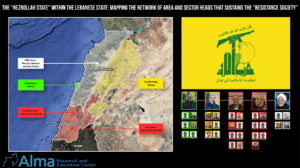
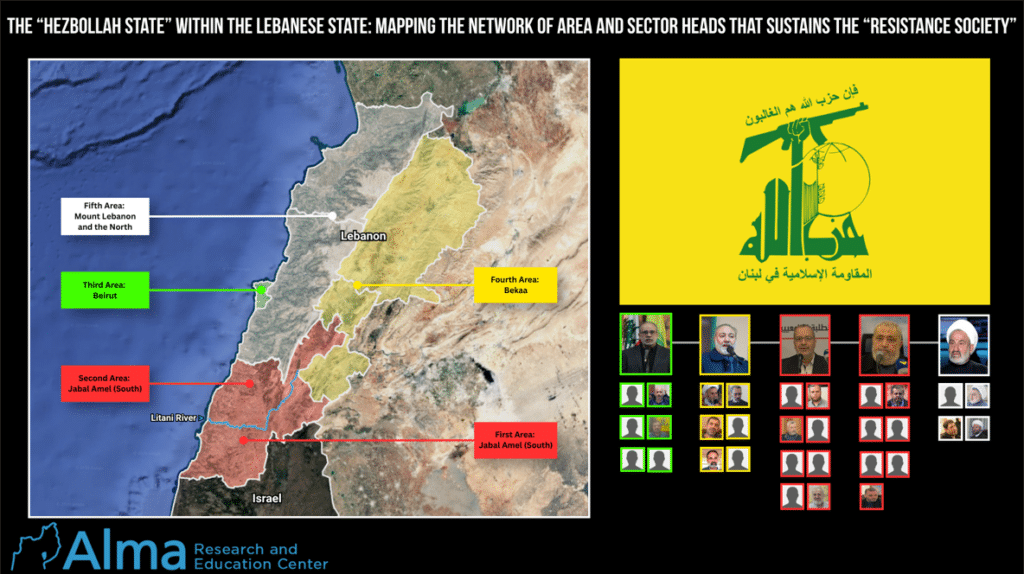
Hezbollah conducts its local civilian activities in Lebanon through a structure of areas and sectors. While Lebanon is officially divided into nine administrative regions, Hezbollah has divided the country into five areas: the two southern Areas, known as the ‘First Area’ of Jabal Amel and the ‘Second Area’ of Jabal Amel; the Beirut Area, designated the ‘Third Area’; the Bekaa Area, designated the ‘Fourth Area’; and the Mount Lebanon and North Area, designated the ‘Fifth Area’ (see further details below).
The Area Head (مسؤول منطقة) is Hezbollah’s senior civilian representative within a geographical area encompassing several local Sectors. The role involves coordination, participation in ceremonies, meetings with local leadership, and representation of Hezbollah’s positions in Lebanon’s public and civilian spheres.
The Sector Head (مسؤول قطاع) operates within a more narrowly defined local area, maintaining ties with municipal authorities, mukhtars, institutions, religious figures, associations, and political actors.
Area and Sector Heads enable Hezbollah to maintain continuous contact with local society and help address the population’s needs. In doing so, they deepen Hezbollah’s influence and strengthen its standing among the Lebanese public, particularly its core constituency, and its presence in citizens’ daily lives. They are not military officials or commanders, but their activities sustain the “resistance society” that enables Hezbollah’s military activity.
Area and Sector Heads are a highly significant component of the “Hezbollah state” operating within the Lebanese state. They serve an important function in Hezbollah’s civilian infrastructure, which supports the daily lives of its Shiite base and provides services, some of a state-like character, while taking advantage of the Lebanese government’s persistent weakness.
Hezbollah’s civilian infrastructure is its “game changer.” It is more than a support mechanism for the organization: it is one of the central sources of strength that enable its continued existence as a military force.
Hezbollah’s Geographical Division of Lebanon:
Hezbollah divides Lebanese territory into five areas: the two southern Lebanon Areas, Jabal Amel (red); Beirut (green); the Bekaa (yellow); and Mount Lebanon and the North (white).
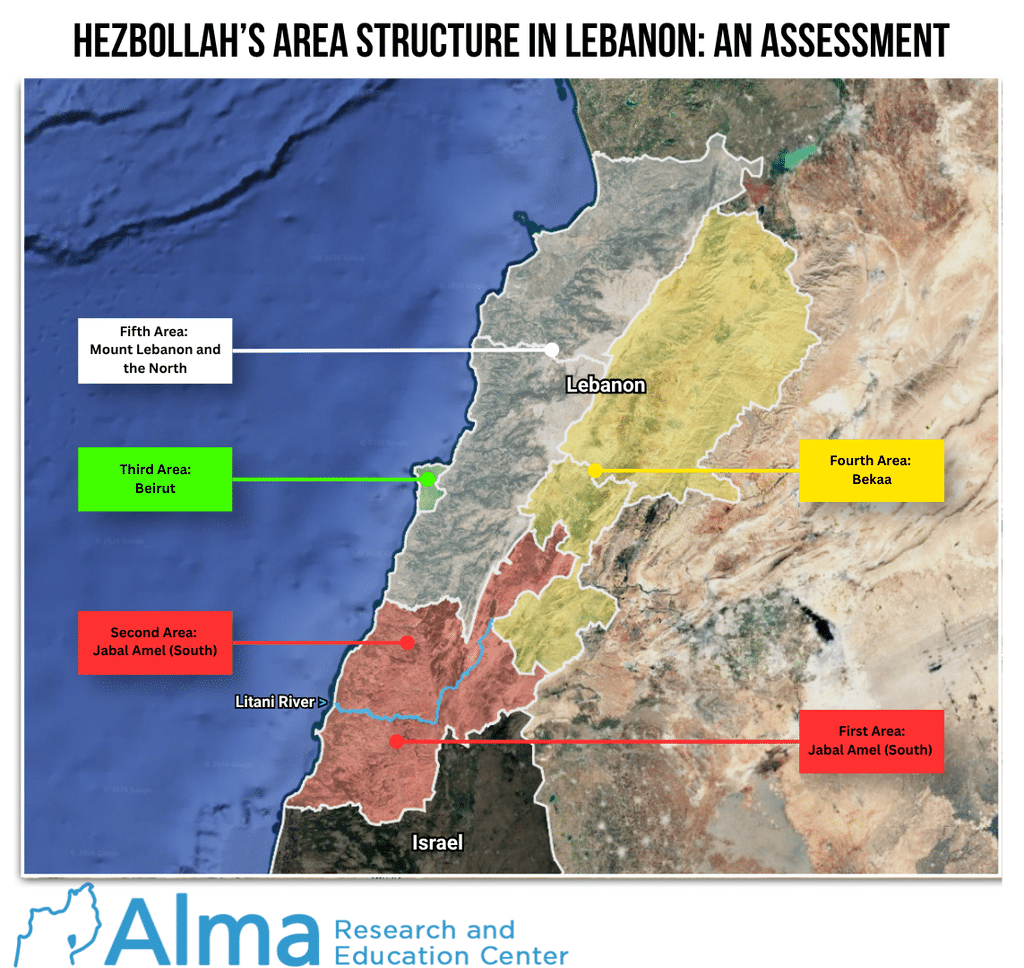
In the south, the ‘First Area’ of Jabal Amel (the part shaded red on the map south of the Litani River) is associated with the expanse of southern Lebanon south of the river. A September 2025 statement by Hezbollah’s media apparatus listed eight Sectors within this Area: Tyre, al-Qasmiya, al-Sahel, Qana, Jouaya, al-Hujair, Bint Jbeil, and Khiam.
The ‘Second Area’ of Jabal Amel (the part shaded red on the map north of the Litani River) is associated with the expanse of southern Lebanon north of the river. It includes the Sidon, al-Zahrani, Jebsheet, Iqlim al-Tuffah, Nabatieh, and al-Shaqif Sectors.
Under Hezbollah’s geographical division, the Western Bekaa Sector also belongs to the ‘Second Area’ of Jabal Amel rather than to the Bekaa Area. In July 2025, the municipal affairs apparatus of the ‘Second Area’ of Jabal Amel organized a meeting of mukhtars in the Western Bekaa, attended by Sector head Hassan Hisham (حسان هشام). A notice reviewing the reconstruction activities of “Jihad al-Binaa” (جهاد البناء) also places the Western Bekaa Sector within the ‘Second Area’ of Jabal Amel.
Although the Litani River broadly divides Hezbollah’s two southern areas, it cannot be treated as a precise organizational boundary. While Bint Jbeil and Nabatieh both formally belong to the Nabatieh Region, Hezbollah has placed them in different southern areas.
The ‘Third Area’ of Beirut (green) encompasses the city of Beirut, its southern suburbs (the Dahieh), and apparently also the Northern Metn Coastal Strip (ساحل المتن الشمالي). Hezbollah’s ‘Fourth Area’ of Bekaa (yellow) encompasses several official Regions: the Bekaa Region, the Baalbek Region, and the Hermel Region. Hezbollah’s ‘Fifth Area’ of Mount Lebanon and the North (white) likewise encompasses four official Lebanese Regions: Mount Lebanon, Jbeil and Keserwan, the North, and Akkar.
The Organizational Structure of Hezbollah’s Area and Sector Heads:
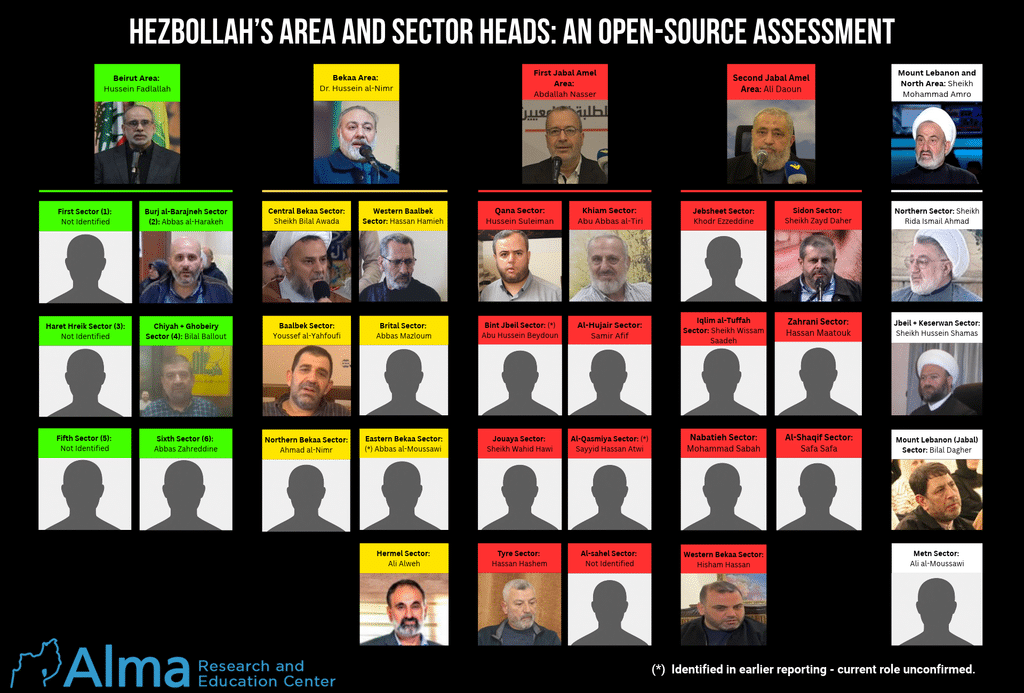
The mapping of these officials was compiled from local Arabic-language reports on their activities, including meetings with municipal leaders and mukhtars, visits to institutions, events held by various Lebanese political parties, social and welfare activities, and election campaigns. Within these reports, we sought explicit references combining an official’s name, title, and Area or Sector of responsibility, comparing publications from different dates. This also made it possible to identify officeholders for whom no formal appointment announcement had been published.
The Role of Hezbollah’s Area and Sector Heads in Local Politics:
The public activities of these officials connect Hezbollah’s ongoing operations with civilian life in local communities. The Area head helps shape an agenda affecting numerous authorities and institutions, while the Sector head frequently engages directly with local actors.
At the Area level, a prominent example is a meeting reported in October 2026 between Abdullah Nasser (عبد الله ناصر), Head of the ‘First Area’ of Jabal Amel, and the heads of 29 municipalities in the south. The meeting addressed work plans for 2027, including water, electricity, and road services, coordination with the municipal affairs apparatus, and assistance to displaced residents. This activity places the Area Head in a position of considerable standing vis-à-vis local and government authorities and makes him a full participant in discussions of the area’s needs. In effect, the Lebanese state cooperates with an officeholder whose position has no formal status within the state and who holds no legal authority under it.
At the Sector level, engagement is more local and focused. For example, in October 2026, Hussein Suleiman (حسين سليمان), Head of the Qana Sector, met with the municipality of Rshaf to discuss the needs of residents and displaced people. In January 2026, Sheikh Wahid Hawi (وحيد حاوي), Head of the Jouaya Sector, attended a meeting of the association of mukhtars of Jouaya and the surrounding villages. The agenda covered services and administrative issues, and Hawi called for closer coordination with village election committees. Both examples illustrate the interface between the officeholder and institutions that channel residents’ needs.
During election campaigns, these officials are visibly involved in forming electoral lists and negotiating local agreements. In May 2025, the Hadath-Baalbek municipal council published a message thanking Hassan Hamieh (حسن حمية) of the Western Baalbek Sector, along with Hezbollah and Amal, for their contribution to the agreement that enabled the council’s election. That same month, Abbas Mazloum (عباس مظلوم), Head of the Brital Sector, participated in the launch of a local electoral list. These are examples of the officials’ involvement in the local electoral arena.
The organization is also represented locally through ties with institutions serving the civilian population. In October 2026, Dr. Hussein al-Nimr (حسين النمر), Head of Hezbollah’s Bekaa Area, attended the opening of clinics at al-Batoul Hospital in Hermel and pledged to promote the hospital’s development.
The officials’ participation in social events also carries ideological significance. In January 2026, Hussein Fadlallah (حسين فضل الله), Head of Hezbollah’s Beirut Area, sponsored an event honoring the wounded, organized by the union of Dahieh municipalities. That same month, Ali Daoun (علي ضعون), Head of the ‘Second Area’ of Jabal Amel, addressed an organizational gathering of the Imam al-Mahdi Scouts and emphasized the movement’s contribution to religious and values-based education. Such events give public visibility to Hezbollah’s concept of resistance and integrate it into the activities of local institutions.
Sector Heads sometimes also participate in mediating disputes. In August 2026, Bilal Dagher (بلال داغر), Head of the al-Jabal Sector, was reported to have participated alongside an Amal representative in a reconciliation committee in Khaldeh. The committee presented an agreement between families to the Supreme Islamic Shiite Council.
This extensive and active civilian engagement with the population serves the organization’s efforts to consolidate its presence, create dependency, indoctrinate the population, and build support.
The importance of these officials extends beyond their organizational standing. They help maintain Hezbollah’s ties with its core constituency, and with the wider population of each area or sector more generally, strengthening the organization’s position as an actor involved in community life.
Through these ties, Hezbollah establishes itself as an almost exclusive point of contact for the civilian population’s needs. In this way, it sustains the “resistance society,” whose very existence also enables the organization’s military activity.
Case Study: Sheikh Zayd Daher, Head of Hezbollah’s Sidon Sector
Zayd Daher (زيد ضاهر), a native of Sidon, is a longstanding representative of the organization in the local arena. As early as July 2010, local media identified him as a senior Hezbollah official in Sidon, and he was documented in the same role in September 2026.
On November 21, 2024, the funeral of his son, Hadi Daher (هادي ضاهر), was held in Sidon. In May 2025, an event was held at the city’s “al-Sayyida al-Zahra” Hall to screen his recorded testament. Those attending included a member of Hezbollah’s Political Council and a member of Amal’s Political Bureau, representatives of Lebanese parties and Palestinian factions, mayors, mukhtars, heads of civil society organizations, and figures from education, the media, and culture. At the event, Daher declared his commitment “to continue on the path of jihad and resistance until all the land of Palestine is liberated, from the river to the sea,” while pledging to follow Hassan Nasrallah’s path, “no matter how high the price and no matter the scale of the sacrifices.”
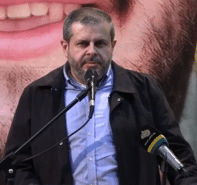
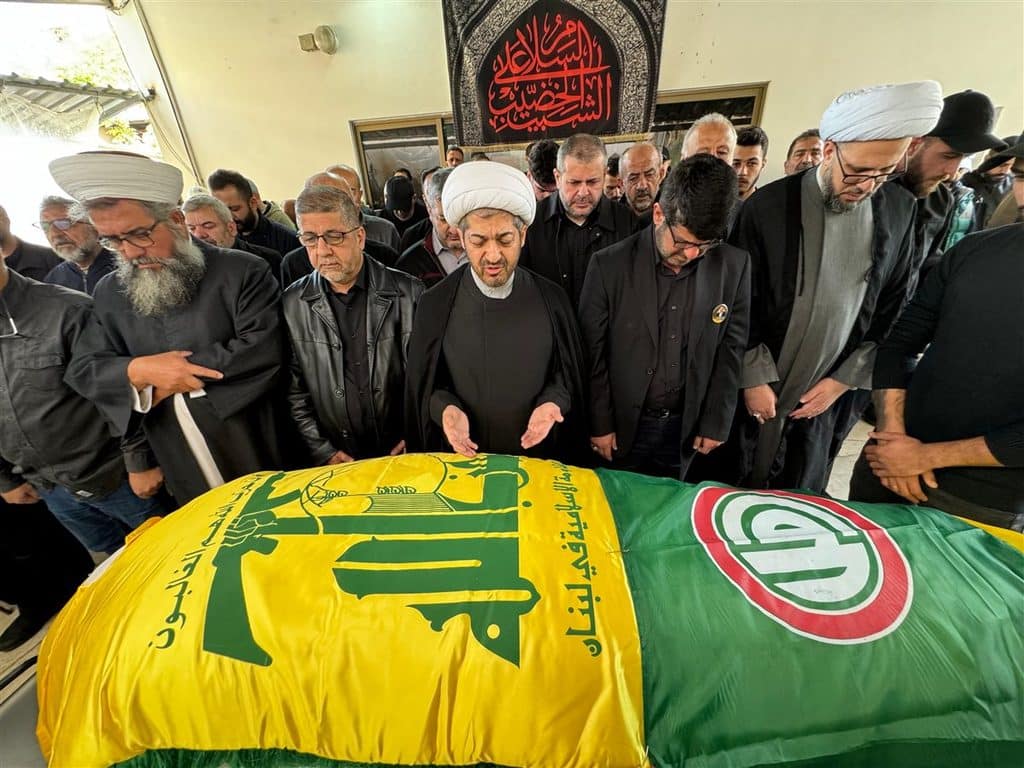
Zayd Daher’s activities illustrate how these organizational functions converge in a single individual. He engages with religious leaders, associations, and government offices while also presenting Hezbollah’s political positions to local audiences and allies.
In April 2024, Daher headed a delegation that visited Sunni Mufti Salim Soussane (سليم سوسان), Jaafari Mufti Mohammad Oseiran (محمد عسيران), and religious judge (qadi, قاضي) Jamal Faqih (جمال فقيه). Alongside Ramadan greetings, the discussions addressed economic hardship and the work of aid committees. These visits indicate channels of communication that cross sectarian boundaries.
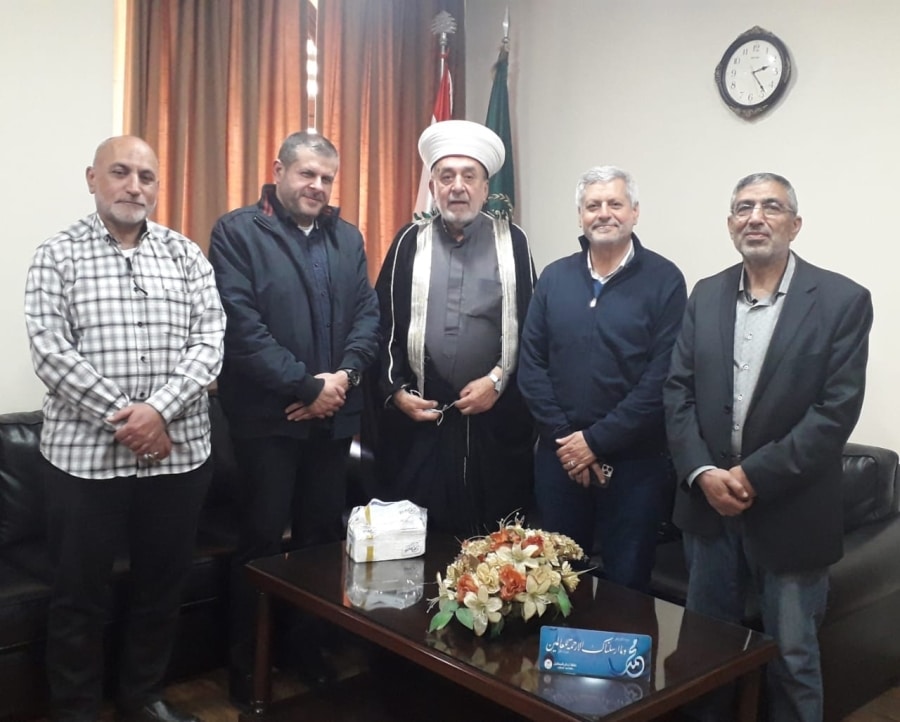
His ties with institutions involved in aiding were evident in September 2023, when he led a delegation to the offices of the heads of administrative units at the Government Serail in Sidon. These included officials responsible for land registration, education, the economy, agriculture, civil registration, and housing. The delegation also included the head of the Sidon Sector’s relations branch and members of its relations committee, indicating a local structure with additional officeholders working in coordination with the Sector head.
Institutional activity is combined with political representation. According to a November 2025 publication by the Syrian Social Nationalist Party, Daher addressed one of its events in the Sidon and al-Zahrani area, opposed the surrender of Hezbollah’s weapons, and described the struggle in political, economic, and social terms alongside its military dimension. In these remarks, he presented the organization’s position to a local audience and allies, linking activity in the civilian sphere to the concept of resistance.
Another arena of his activity is the close relationship he maintains with Palestinian factions in the Sidon area. Daher meets periodically with representatives of the various factions to discuss a range of social, security, political, and other issues.
Sources:
Hezbollah’s Geographical Division of Lebanon:
https://awraq.org/articles.php?id=21814
https://www.almanartv.com.lb/article/1260707
https://alahednews.news/news/330016
https://alahednews.news/post/82729/%D8%A7%D9%
https://amalbaladi.org.lb/details/2678
https://twitter.com/JamalCheaib/status/1873473105387204912/photo/1
The Organizational Structure of Hezbollah’s Area and Sector Heads:
Abdullah Nasser:
https://www.amalbaladi.org.lb/details/10234
https://mediarelations-lb.org/post.php?id=15780
https://mediarelations-lb.org/post.php?id=15488
Ali Daoun:
https://www.lebanondebate.com/article/880446
https://alahednews.news/article.php?id=46879&cid=113
https://archive.almanar.com.lb/9048954
Sheikh Zayd Daher:
Hassan Hashem:
Sayyid Hassan Atwi:
https://www.yasour.org/2018/ar/news/details/news-77270
Abu Hussein Beydoun:
https://nahar-ayta.blogspot.com/2019/04/blog-post_23.html
Hussein Suleiman:
https://www.amalbaladi.org.lb/details/10859
Sheikh Wahid Hawi:
https://www.amalbaladi.org.lb/details/4700
https://www.facebook.com/photo?fbid=809017985295337&set=pcb.809018001962002
Hassan Maatouk:
https://alahednews.news/article.php?id=39576&cid=113&st=%D9%83%D8%AA%D9%84%D8%A9
https://www.al-binaa.com/archives/426100
Sheikh Wissam Saadeh:
https://www.moph.gov.lb/ar/DynamicPages/view_page/80237/30
Mohammad Sabah:
https://alahednews.news/news/394496/%D9%84%D8%
Safa Safa:
https://khiyam.com/news/article.php?articleID=48589
https://khiyam.com/news/article.php?articleID=13225
https://www.yasour.org/2022/ar/news/details/news-134315#google_vignette
Khodr Ezzeddine:
https://almaaref.org.lb/post/20909/جهادنا-التبيين-وقدوتنا-الزهراء(عليها-السلام)
Abu Abbas al-Tiri:
https://amalbaladi.org.lb/details/2646/info%40amal-baladi.org
Samir Afif:
https://almarkazia.com/ar/%D8%A7%D8
Dr. Hussein al-Nimr:
https://www.almanartv.com.lb/article/1260707
https://awraq.org/articles.php?id=21336
Sheikh Bilal Awada:
https://almarkazia.com/ar/%D8%A7%
https://www.al-binaa.com/archives/381316
https://mediarelations-lb.org/post.php?id=15792
Hisham Hassan:
https://amalbaladi.org.lb/details/2678
https://alahednews.news/post/80484
https://alahednews.news/post/88706
https://alahednews.news/post/90222
Youssef al-Yahfoufi:
https://www.mtv.com.lb/News/%D9%85%D8%
https://alahednews.news/article.php?id=54603&cid=113&st=%D8%A7%
Hassan Hamieh:
https://almanartv.com.lb/article/1140552
https://amalbaladi.org.lb/details/2521
Abbas Mazloum:
https://alahednews.news/post/823269
Ahmad al-Nimr:
https://amalbaladi.org.lb/details/3148
https://ssnp.online/%D8%A7%D9%
Abbas al-Moussawi:
https://www.lebanondebate.com/article/774153-%D9%81%D8%
https://www.lbcgroup.tv/news/lebanon/898972/lbci-lebanon-articles/ar
Sheikh Mohammad Amro:
https://manartv.com.lb/article/473657
Bilal Dagher:
https://www.mtv.com.lb/news/%D9%85%
https://athabat.net/article/223757
https://alahednews.news/post/82942
https://archive.almanar.com.lb/4000944
Ali al-Moussawi:
https://alahednews.news/article.php?id=52107&cid=113&st=%D8%B9%D9%8A%D9%88%D9%86
https://athabat.net/article/303385
https://iconnews.net/post/64443
Sheikh Hussein Shamas:
https://www.alnadim.com/textarticle/77346
Sheikh Rida Ahmad:
https://alahednews.news/article.php?id=69203
https://www.alahednews.news/article.php?id=78277&cid=113
https://www.facebook.com/ramzinahra/posts/%D8%A7%D9%
Ali Alweh:
https://bawwababaalbeck.com/25-%D8%A7%D9%
https://almahdiscouts.org.lb/post/4413
https://www.instagram.com/p/Dd66lzulG2R
Hussein Fadlallah:
https://alahednews.news/post/80689
https://www.facebook.com/share/p/1GyU9FGKbo
Abbas al-Harakeh:
https://alahednews.news/post/94411
Bilal Ballout:
Abbas Zahreddine:
The Role of Hezbollah’s Area and Sector Heads in Local Politics:
Case Study: Sheikh Zayd Daher, Head of Hezbollah’s Sidon Sector: