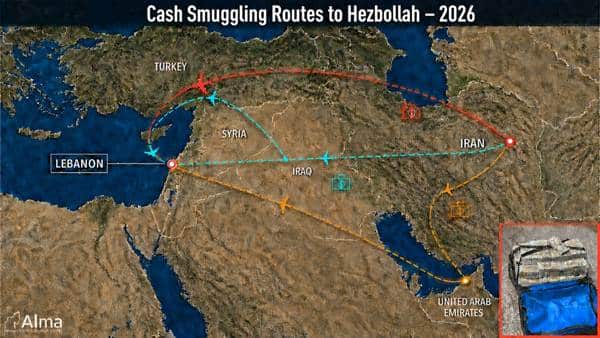
The sanctions imposed by the U.S. Department of the Treasury on August 20 against ten individuals exposed an infrastructure that operated to transfer hundreds of millions of dollars in cash to Hezbollah. According to OFAC’s announcement, the network used couriers traveling on commercial flights between Iran, Turkey, the United Arab Emirates, and Lebanon, thereby enabling Hezbollah to obtain foreign currency outside the banking system and circumvent sanctions.
It is important to emphasize that the use of cash couriers to transfer Iranian funding to Hezbollah is not a new phenomenon, but a longstanding method of operation that has been known for years. In our assessment, the scale of this activity has declined recently following the disruption of transfer networks and increased oversight. However, the route has not been closed and continues to serve Iran and Hezbollah.
According to the United States, the network was centered around Turkish businessman Yunus Alper Yilmaz. He managed the courier operation, used Turkey’s currency-exchange infrastructure as a front for his activities, and provided shell companies and bank accounts for transfers linked to the Quds Force. Three of his associates collected the funds and coordinated the logistical activity, while six additional couriers carried the cash on flights to Lebanon.
The exposure reinforces a pattern we have previously identified: following the disruption of direct transfer routes from Iran and the overland corridor through Syria, Turkey became a convenient alternative hub for Iran’s smuggling network. It offers extensive commercial air traffic, a broad currency-exchange infrastructure, and companies and accounts through which the origin and destination of the funds can be concealed. In January 2025, we also identified unusual activity by Mahan Air, which is affiliated with the Quds Force, along a route to Beirut through Turkish airspace.
Based on the commercial flight routes operating in the region, possible transfer routes include flights from Iran to Turkey and then to Lebanon; from Iran to the United Arab Emirates and then to Lebanon; and from Iran to Iraq, from where couriers can continue on a direct flight to Beirut or travel via Turkey and then to Lebanon. This does not establish that all these routes were used by the exposed network. However, the variety of routes and the possibility of traveling through several countries provide the courier network with flexibility, allow it to switch routes, and make it more difficult to identify the origin of the funds and track their movement.
Alongside the international transfer routes, Hezbollah also relies on local infrastructure that enables the receipt of funds and other materiel in Lebanon. As we previously reported, Hussein Ali Nasr, also known as “Abu Ali Hassan,” the deputy commander of Hezbollah’s Unit 4400, was responsible for smuggling weapons and funds into Lebanon as part of the organization’s reconstruction and military buildup efforts. Nasr, who was eliminated in an airstrike on April 20, 2025, worked in cooperation with the Quds Force, including through contacts with employees at Beirut International Airport who secretly assisted the smuggling activity. Around 30 airport employees, including cargo-handling personnel, were subsequently suspended on suspicion of assisting Hezbollah. This case demonstrates that commercial flights constitute only one part of the route: completing the transfer also requires local reception infrastructure inside the airport.
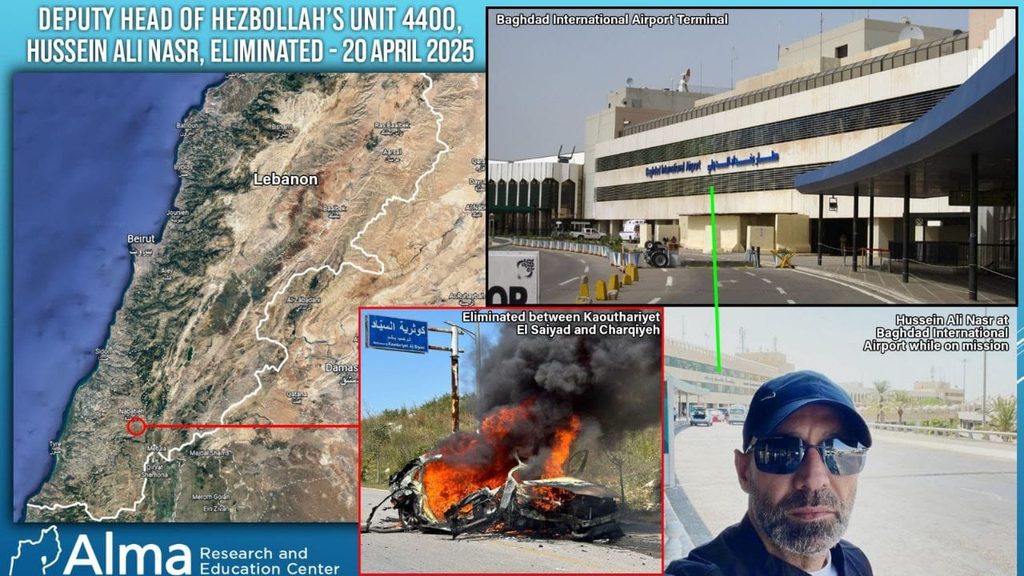
Hussein Ali Nasr at the entrance to the terminal of Baghdad International Airport, where he was photographed during one of his trips outside Lebanon.
This involves more than simply transporting suitcases filled with cash. As we explained in a report published in July 2025 on currency exchanges within Hezbollah’s financing network, the couriers are part of an integrated system. Cash delivered to a currency exchanger in Turkey can be physically transported to Lebanon, but it can also serve as the basis for settlement with a Lebanese currency exchanger through the hawala system. The combination of cash, currency-exchange infrastructure, shell companies, and informal transfers creates a flexible and decentralized system that is difficult to track and disrupt by targeting a single actor.
The network was linked to Behnam Shahriyari, a senior Quds Force official and commander of Unit 190 until his elimination in June 2025. The unit specialized in transferring funds, weapons, and operatives to Iran’s proxies through the use of front companies, couriers, and civilian infrastructure. The network’s continued activity after his death demonstrates that it is an institutional infrastructure with alternatives and the capacity to recover.
It is important to distinguish between the network’s activity on Turkish territory and the involvement of the Turkish state. The investigation was conducted in coordination with the authorities in Ankara, a fact that indicates Turkey’s willingness to act against the exposed network. Nevertheless, the scale of the activity and the amounts transferred point to significant oversight gaps.
For Hezbollah, Iranian funding is essential for paying salaries, rebuilding its military and civilian systems, procuring weapons, and preserving its Shiite support base. The exposure of the network is therefore an achievement but also a warning: as long as aviation and currency-exchange infrastructure, intermediary companies, and local facilitators continue to operate, Iran will be able to replace the couriers and continue transferring funds to Hezbollah.