Executive Summary
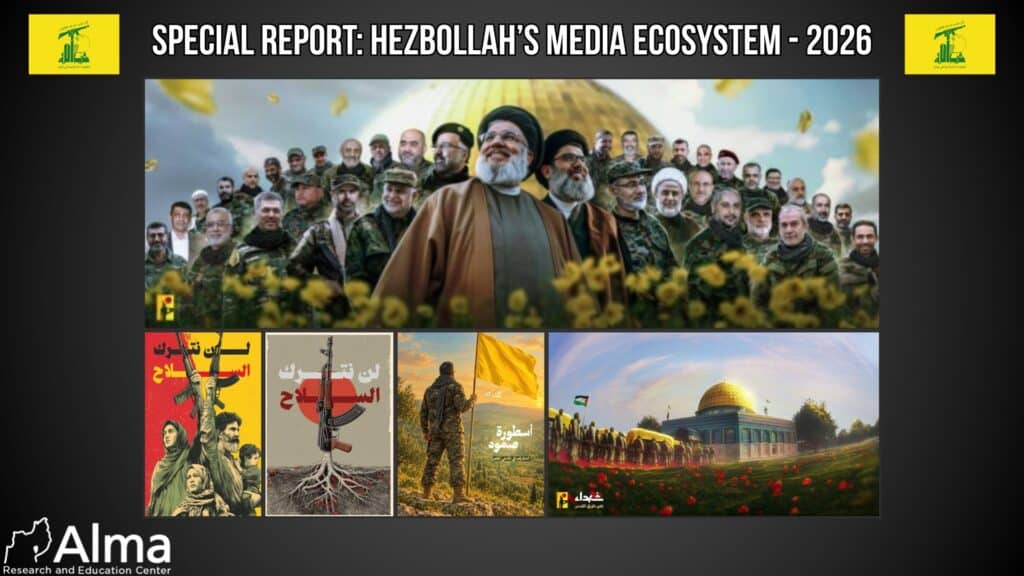
Hezbollah’s media ecosystem is a strategic component of the organization’s power, rather than a complementary layer surrounding its military and political activity. Its ability to control the interpretation of events, dictate the language in which they are described and connect speeches, media outlets, social networks, posters, ceremonies and community institutions allows it to shape an almost continuous narrative reality for its support base. Within this reality, the organization does not merely report on the military campaign, but determines what constitutes victory, how defeat should be understood and who is entitled to define the Lebanese interest.
Control of the narrative strengthens Hezbollah’s control over its support base and allows it to maintain cohesion over time. Through repetition of a consistent system of symbols, concepts and stories of sacrifice, the organization transforms religious and communal identity into political and organizational commitment. Support for it is presented not as a choice between political alternatives, but as loyalty to the community, the martyrs, Nasrallah and a historical struggle. This narrows the space in which internal criticism, erosion of support or demands for a change of course can develop, even when the price paid by the support base is high.
The importance of the media ecosystem is particularly evident in times of crisis. It enables Hezbollah to absorb severe blows, including the elimination of leaders, damage to infrastructure, extensive losses and destruction in its support base areas, without necessarily allowing these events to crystallize into a sense of defeat. By changing the yardstick for victory, the organization can present its very survival, continued fighting, community loyalty or the return to villages as achievements. When it cannot present a decisive military victory, it presents “steadfastness”; when deterrence is damaged, it emphasizes continuity; and when the scale of destruction does not permit a simple story of victory, it turns sacrifice and victimhood into a source of legitimacy.
The evolution of the narratives in 2021–2026 illustrates this adaptability. Before the war, Hezbollah presented itself as a strong organization that deterred Israel, determined the “equations” of the confrontation and provided solutions in place of the state. When Hezbollah initiated fighting along the Israel–Lebanon border in October 2023, the fighting was explained through the “support front” and “On the Road to Jerusalem”. After the organization’s leadership was struck, the emphasis shifted to “We Remain True to the Pledge” and the claim that “The Resistance Continues and Will Remain”. After the ceasefire, return and reconstruction became new expressions of victory.
The change between slogans does not indicate abandonment of the ideology, but its adaptation to a changing reality in order to preserve faith in the righteousness of the path and the necessity of the organization.
The commemoration ecosystem plays a central role in creating this resilience. Posters of the dead, testaments, funerals and ceremonies are not merely expressions of mourning, but a mechanism that turns personal loss into evidence of continuity. Those killed are incorporated into a collective story in which their deaths oblige the living to continue on their path. The participation of families and the younger generation in ceremonies transmits organizational identity from generation to generation, normalizes sacrifice and helps preserve a future reservoir of identification, commitment and recruitment. Thus, the media serve not only to justify Hezbollah’s current activity, but also to ensure its social continuity.
Civilian reconstruction is also integrated into this same ecosystem. Hezbollah seeks to present itself as accompanying the community from the fighting, through commemoration, to compensation and rebuilding. Control over the story of victimhood enables it to divert the discussion from responsibility for opening the front to the question of who assists those affected. Destruction is presented as evidence of the enemy’s cruelty, return as evidence of the community’s steadfastness and reconstruction as evidence of the necessity of the organization’s institutions. Thus, loss and damage are translated into renewed dependence on Hezbollah and a stronger bond between the organization and its support base.
All the narratives ultimately converge on the struggle over weapons. Loyalty to Nasrallah and the martyrs ostensibly requires continuing along their path; continuing along that path requires the existence of the resistance; and the existence of the resistance requires preserving its weapons. Through the term “the weapons of the resistance”, Hezbollah transforms an independent arsenal into a national asset and presents its dismantlement as a danger to Lebanon.
At the same time, it seeks to take control of the definition of sovereignty and the state’s identity: while the state and its critics define sovereignty as the monopoly of state institutions over weapons and the decision to go to war, Hezbollah defines it as the practical ability to employ force against Israel, even outside state control.
The discourse of betrayal is an essential part of maintaining this control. Opponents of the weapons or supporters of an arrangement with Israel are presented as serving foreign interests, submitting to American-Israeli dictates and, at times, as partners of the enemy. This framing is intended not merely to attack opponents, but to narrow the boundaries of legitimate debate and deter criticism within the support base. The question of whether Hezbollah’s policy serves Lebanon is replaced by the question of whether the critic is loyal to the Shiite base’s community, the martyrs and the homeland.
Hezbollah’s ability to adapt its message to different audiences adds to its resilience. Religious and Karbala-related messages are directed at the Shiite base; national defense and sovereignty are emphasized to the Lebanese public; messages of threat, surveillance, vulnerability, and attrition are directed at Israel; and in the international arena, the weapons are presented as an internal Lebanese issue. Adapting its language allows the organization to preserve simultaneously its Iranian-axis identity and its claim to be a Lebanese national force.
The main conclusion is that Hezbollah’s continued existence depends on its ability to produce meaning no less than on its ability to employ force. Its weapons enable it to fight, its political power enables it to influence the state, but its media ecosystem enables it to absorb losses, preserve its support base, present survival as victory and legitimize its continued activity.
Without the ability to control the narrative, military damage could become a crisis of confidence, destruction could provoke demands for accountability and the loss of leaders could lead to disintegration. Through control over perceptions, Hezbollah manages to convert military and organizational blows into loyalty, cohesion and continuity.
Hezbollah’s media ecosystem should therefore be viewed as one of the organization’s core infrastructures, alongside its military power, social institutions and political influence. Its resilience rests not only on the number of missiles, operatives or seats in parliament, but also on its ability to convince its audience that the price was necessary, that the sacrifice was not in vain and that its very continued existence is a victory. The struggle against Hezbollah is therefore also a struggle over the ability to interpret reality: whoever succeeds in defining the meaning of defeat may continue to exercise control even after losing a substantial portion of their power.
The report consists of three complementary parts:
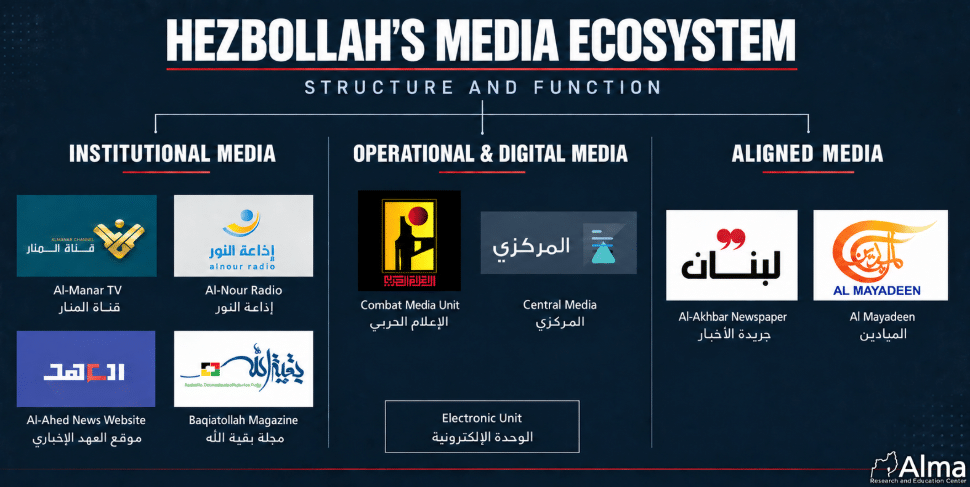
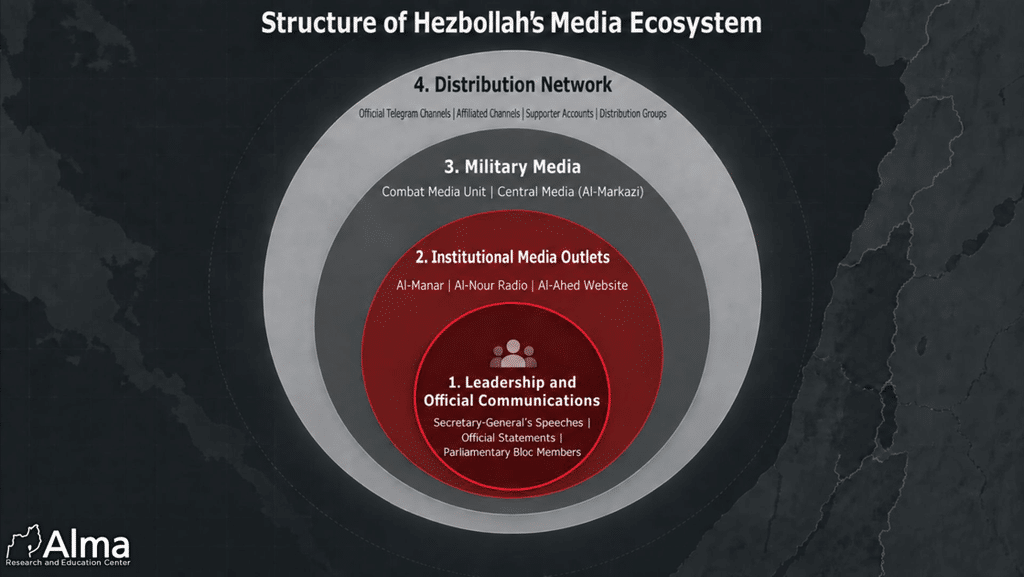
The first part maps the structure, development and methods of operation of Hezbollah’s media ecosystem, and examines the changes it has undergone since October 2023 including adaptations for digital distribution, real-time message management and the use of media to cope with the crisis that befell the organization.
The second part analyzes the evolution of Hezbollah’s narratives in 2021–2026 and the transition from projecting power and deterrence to messages of survival, loyalty, commemoration, reconstruction and defense of the organization’s weapons.
The third part is the appendix, which complements the analysis through a detailed review of Hezbollah’s principal media assets, their roles and how they fit into the overall media ecosystem.