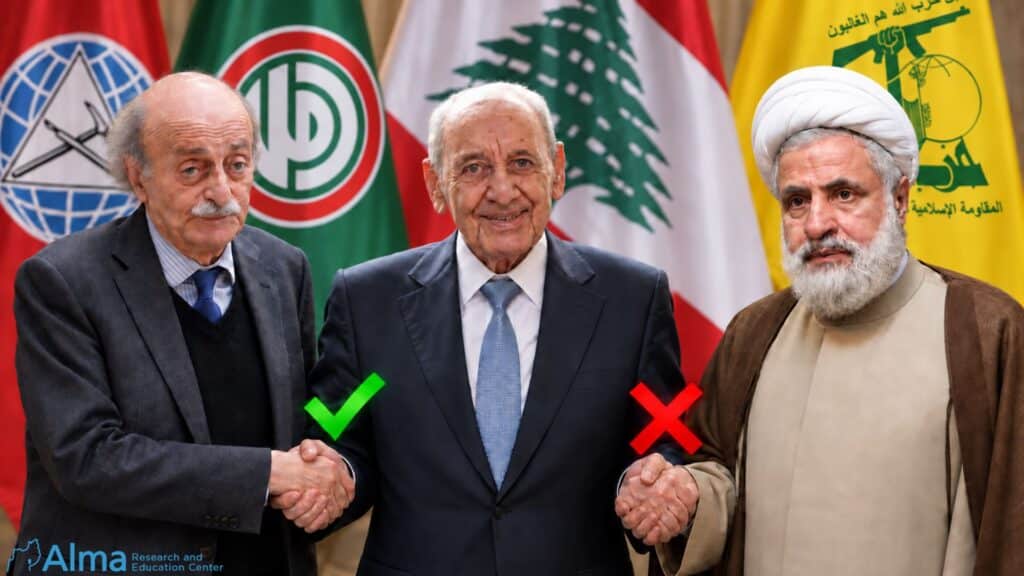
The “Shiite Duo,” representing the respective support bases of Hezbollah and Amal, rests on a shared sectarian identity and common political interests. But interests can change, particularly when the interests of one party, Hezbollah, begin to harm those of the other, Amal. Is the realization beginning to take hold among Nabih Berri and the Amal Movement that Hezbollah has become a liability rather than an asset?
Several recent statements have been attributed to Nabih Berri:
“The army is a red line.” The Amal Movement will stand alongside the Lebanese army even if it is required to carry out sensitive missions in southern Lebanon.
Relations between the Amal Movement and Hezbollah were closer during Hassan Nasrallah’s leadership.
Messages reportedly conveyed on Berri’s behalf also stated that the previous framework of coordination between the Amal Movement and Hezbollah has effectively come to an end. Amal is no longer willing to accept a situation in which Hezbollah makes decisions independently and then expects Amal to stand behind it and share the consequences.
At this stage, we do not identify significant indications that the “Shiite Duo” is breaking apart or that a political rupture is developing between Amal and Hezbollah. Berri continues to act as a mediator, seeking to prevent a direct confrontation between Hezbollah and state institutions. Nevertheless, under Lebanon’s current circumstances, the Amal Movement and Nabih Berri face a significant dilemma: whether to preserve the alliance with Hezbollah even at the cost of another war, or to widen their political distance from Hezbollah in order to protect the interests of Amal’s Shiite support base and forge a meaningful alternative alliance.
On October 25, it was reported that the positions of Berri and Druze leader Walid Jumblatt had moved closer on issues concerning the state’s monopoly on arms and the need to prevent Hezbollah from dragging Lebanon into another military confrontation. Could this be a new “duo”?