Since the fall of the Assad regime, particularly during 2026, Turkey’s involvement in Syria appears to have expanded through closer ties with the authorities in Damascus, increased security and economic cooperation, and participation in reconstruction efforts. Education is emerging as one of the main channels of this involvement.
This involvement in education has a long history. Educational assistance from Turkish sources to institutions linked to Ahmad al-Sharaa is not a new phenomenon. As we showed in our December 2025 article, even when Hayat Tahrir al-Sham (هيئة تحرير الشام) controlled the Idlib enclave, the funding model for the organization’s Dar al-Wahy al-Sharif (دار الوحي الشريف) schools relied primarily on donations and external funding originating in Turkey and physically brought in through the Bab al-Hawa (باب الهوى) border crossing.
Today, alongside existing institutions in northern Syria, Turkey is promoting the rehabilitation of schools and the establishment of new institutions in cooperation with the Syrian authorities. This activity meets educational needs and serves children from refugee families returning from Turkey, while also potentially creating long-term linguistic, cultural, and institutional ties.
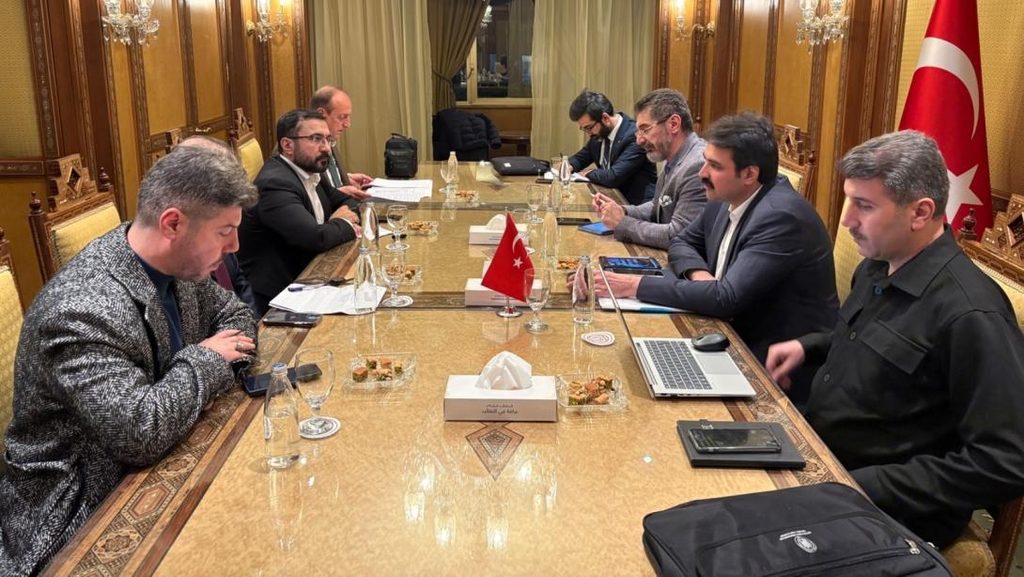
An April 4, 2026 publication by the Turkish Ministry of Education reported on a Turkish delegation’s visit to Syria, during which the establishment of international Turkish schools and the rehabilitation of damaged schools were discussed with senior Syrian officials.[1]
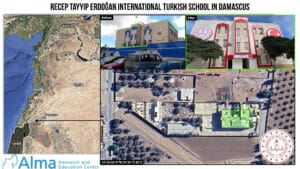
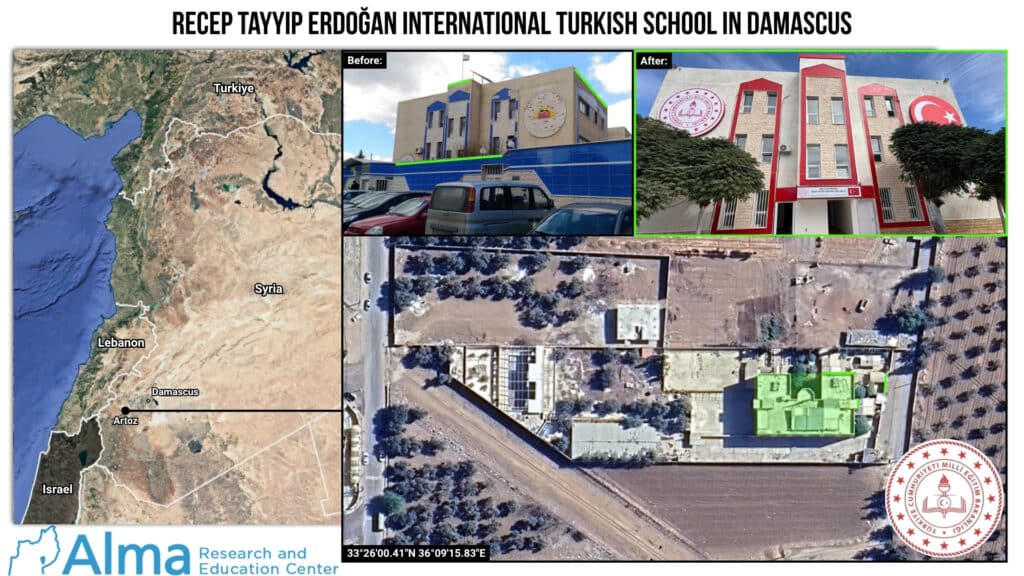
This trend recently took practical form with the opening of the Recep Tayyip Erdoğan International Turkish School (Turkish: Şam Uluslararası Recep Tayyip Erdoğan Türk Okulu; Arabic: مدرسة رجب طيب اردوغان التركية الدولية في دمشق) in the Artouz area of Damascus on October 4, 2026. On October 2, 2026, an official announcement stated that construction of the Recep Tayyip Erdoğan International Turkish School in Damascus had been completed using the infrastructure of an old school, as part of ongoing cooperation between Turkey and Syria. The school opened its doors on Sunday, October 4, 2026,[2] approximately four weeks after the official start of the Syrian school year on September 6, 2026.
According to the official announcement, the new educational institution will operate under the authority of Turkey’s Ministry of National Education, rather than Syria’s Ministry of Education. It aims to set a high standard of education and make Turkey’s accumulated knowledge and experience in the field available to students in the region. The announcement also states that the school will contribute to strengthening ties of friendship and brotherhood between the two countries.
The school comprises a kindergarten, an elementary school, a middle school, and a high school, with 36 classrooms and a capacity of approximately 1,000 students.
The project was initially publicized as the “International Turkish School in Damascus,” but Turkish President Erdoğan’s name was added in the announcement issued ahead of the entrance examinations held on August 29, 2026.
According to a SyriaTV report,[3] the entrance examinations were held at Damascus University’s Faculty of Humanities in al-Mezzeh. The applicants took tests in Turkish, following the examination format used in the Turkish education system. They were tested on Turkish language proficiency, mathematics, and science.
This raises the question: how do Syrian students in the Damascus area know Turkish?
In fact, what the families of the prospective students have in common is that their children previously attended Turkish schools in Turkey. Parents interviewed on the day of the entrance examinations explained that one of the main reasons they were considering enrolling their children at the new Turkish school in Artouz was their search for what they regarded as a higher standard of education than that currently available in Syria’s school system.
These Syrian families returned from Turkey following the fall of the Assad regime, after spending several years there. In some cases, family members had acquired Turkish citizenship.
The school’s educational adviser told the applicants’ parents that the school would not adopt the Syrian curriculum and would teach the Turkish curriculum in full. Students would also be required to wear uniforms provided by the school. According to the information given to parents, although the curriculum would be Turkish, school holidays would be aligned with those observed in Syria.
Parents will be required to pay a one-time registration fee of USD 1,000, in addition to annual tuition of USD 500 per academic year. Annual school transportation fees range from USD 600 to USD 800, depending on how far the student lives from the school.
[1] https://yyegm.meb.gov.tr/www/bakanligimizdan-suriye039de-egitimin-yeniden-insasina-destek/icerik/1145
[2] https://www.meb.gov.tr/sam-uluslararasi-recep-tayyip-erdogan-turk-okulu-4-ekimde-aciliyor/haber/42070/tr
[3] https://www.syria.tv/%D8%A7%D9