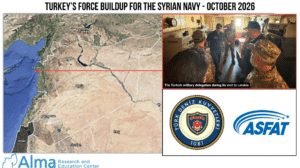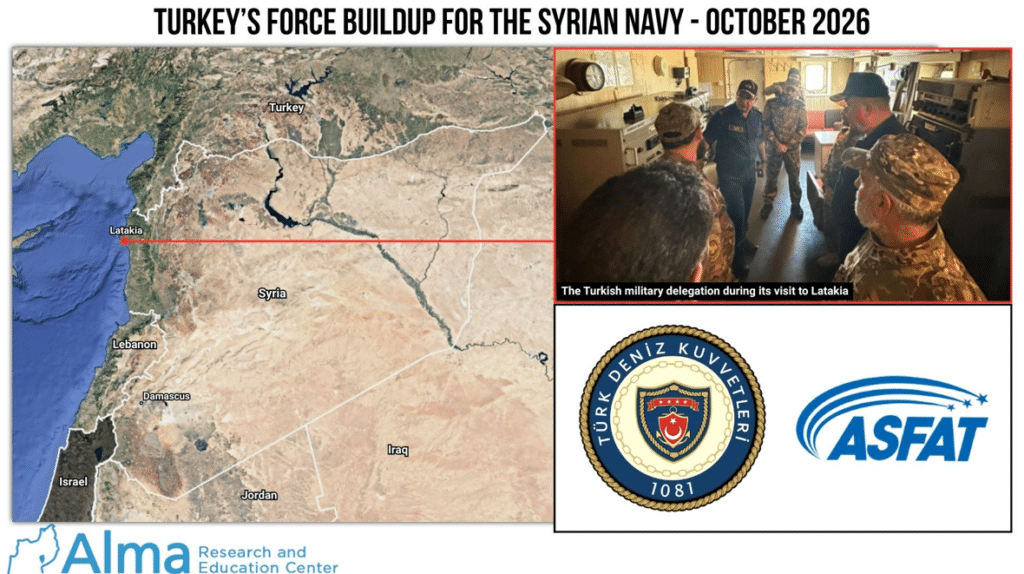
On October 23, 2026, the Turkish Ministry of Defense announced a force buildup program to develop Syria’s naval forces. Following meetings between commanders and ship visits, cooperation is now taking on a broad force buildup framework encompassing vessel maintenance, repair and upgrades, the construction of new vessels, personnel training, and the development of port infrastructure. This represents another layer of Turkish influence and involvement in Syria’s military force buildup.
A delegation of senior Turkish Navy officials and representatives of ASFAT, a company subordinate to the Turkish Ministry of Defense, visited Latakia and conducted technical assessments to advance the Syrian Navy’s capabilities. The delegation included Istanbul Naval Shipyard Commander Erdinç Yetkin, Turkish Navy Logistics Chief Timur Yılmaz, and Turkish Navy Training and Education Commander Yücel Darcan. Following the visit, a force buildup program was formulated covering the areas outlined above.
The latest move reflects the deepening of maritime cooperation that began in 2025. In September 2025, reports described a Syrian Navy delegation’s visit to Turkey and a meeting with the Turkish Navy commander to discuss the development of long-term mechanisms for coordination and cooperation in maritime defense. The Syrian delegation visited the Turkish Fleet headquarters in Kocaeli province and toured the frigate TCG KEMALREIS.
Visits by Turkish naval vessels to Syria have also been documented. The Turkish warship TCG Meltem visited the port of Latakia on May 11. The visit was presented as an expression of Turkey’s growing military presence in Syria and the deepening security ties between the two countries. On July 13, it was reported that the Turkish warship TCG Istanbul had docked in Latakia after its visit had been postponed by several weeks.
Syria’s reliance on Turkey for maintenance, training, upgrades, and construction will strengthen Turkish influence over the Syrian Navy’s professional priorities and operational practices, while increasing Syrian dependence on Turkey. The participation of ASFAT representatives also adds an industrial dimension: a link between Syria’s reconstruction needs and Turkey’s defense industries.