By: Tal Beeri and Dvir Peri
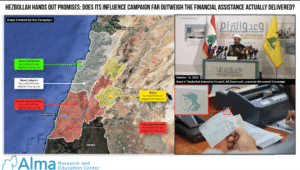
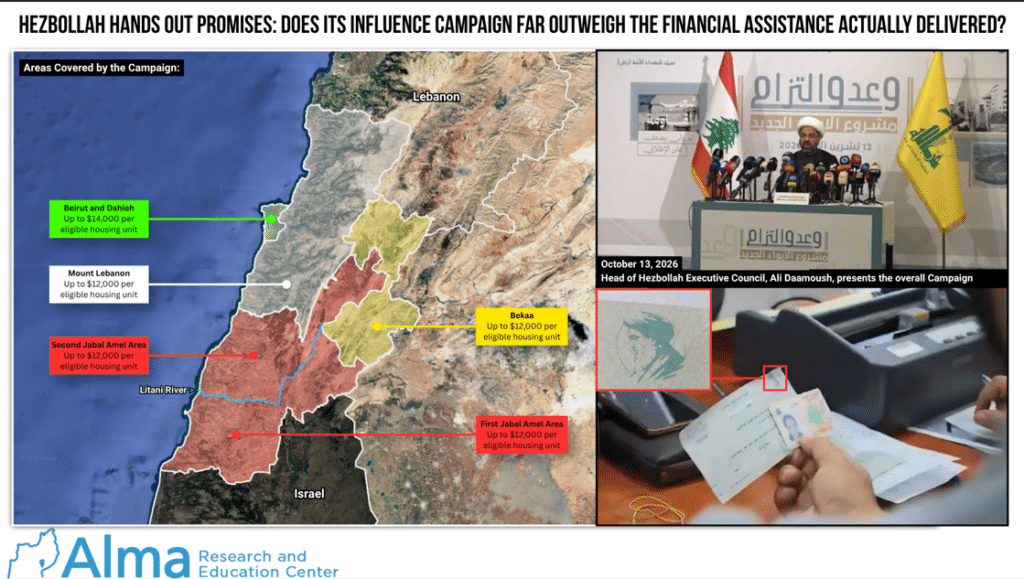
On November 4, 2026, Hezbollah announced the first phase of its “Waad wa Iltizam” – “Promise and Commitment” (وعد والتزام) – campaign in the First Jabal Amel Area, south of the Litani River. Salman Harb (سلمان حرب), the area’s media official, said that professional committees had surveyed the damage and classified those eligible for assistance covering household contents and alternative accommodation.
Four centers were announced for distributing payment vouchers to eligible recipients: in Selaa (سلعا) for the Bint Jbeil Sector, in Qana (قانا) for the Qana Sector, in al-Abbassiyeh (العباسية) for the Coastal Sector, and in Maaroub (معروب) for the al-Hujair Sector. Harb claimed that the campaign covers tens of thousands of housing units and accused the authorities of neglecting those affected.
The announcement follows the start of implementation in additional sectors. On November 2, reports citing a Hezbollah statement indicated that payment vouchers were being distributed in the Nabatieh Sector, within the Second Jabal Amel Area, and that operations had also expanded to a center in al-Sharqiyah (الشرقية). Hezbollah’s statement presented the distribution as an expression of its commitment to owners of damaged homes and to those who had borne the cost of supporting the “resistance.” Implementation also began in Beirut, Dahieh, and the Mount Lebanon area on October 26.
Head of Hezbollah Executive Council, Ali Daamoush (علي دعموش), presented the overall campaign on October 13. The full assistance package announced amounts to $14,000 per eligible housing unit in Beirut and Dahieh, and $12,000 elsewhere outside Beirut and its suburbs. This comprises $8,000 for household contents, plus $6,000 or $4,000 for alternative accommodation, depending on the property’s location. The amounts are to be paid in four installments over one year, with an initial installment of $3,500 in Beirut and Dahieh and $3,000 elsewhere. The assistance covers household contents and alternative accommodation, rather than reconstruction. Eligibility also extends to displaced residents of communities along the confrontation line in southern Lebanon who cannot return home. Under the campaign’s criteria, those who own an alternative home are not eligible for the accommodation component.
Daamoush accused the government of failing to provide a direct assistance campaign, while emphasizing that Hezbollah’s initiative does not replace the state’s responsibility for reconstruction and housing arrangements.
In our assessment, Hezbollah is conducting a major influence campaign. The campaign seeks to sustain a central narrative that blames the state and government for failing to address social and economic needs, while presenting Hezbollah as working to support displaced residents, provide housing assistance, and advance reconstruction.
We do not know the actual scale of the assistance, either in terms of the amount each eligible recipient receives or the number of eligible recipients who will ultimately receive payments.
Against the backdrop of Hezbollah’s financial difficulties – and the particularly significant challenges involved in transferring funds to the organization in Lebanon – two competing priorities are at play. Hezbollah clearly prioritizes allocating resources to its military rehabilitation over providing financial assistance to its support base. At the same time, it has a clear interest in restoring its position as a direct source of funding for that base.
As we assessed in previous publications, Hezbollah is attempting to bridge the gap between these priorities by providing some financial assistance while surrounding it with a large and prominent publicity and influencecampaign. The campaign’s scale does not necessarily reflect the amount of money actually being distributed, which we assess to be limited.