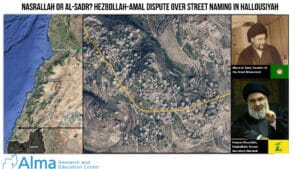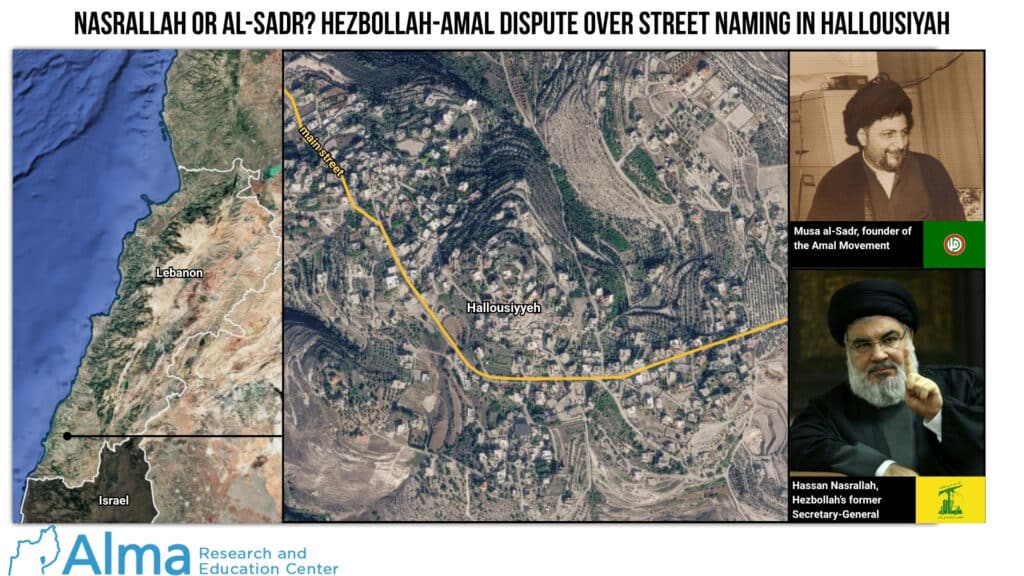
On October 27, 2026, it was reported that Amal representatives on the municipal council of Hallousiyah (الحلوسية), in the Tyre district, had threatened to resign following a dispute with Hezbollah representatives over the naming of the village’s main street.
Amal representatives proposed naming the street jointly after Musa al-Sadr, founder of the Amal Movement, along with Hassan Nasrallah.
The Hezbollah representatives insisted on commemorating Nasrallah alone. Amal representatives opposed putting the matter to a vote, called for a consensus, and accused the council chairman of undermining their partnership and turning the council into a partisan instrument. We note that before Hezbollah’s establishment, Nasrallah himself had been shaped by Musa al-Sadr’s worldview and admired him, leading him to join the Amal Movement in his youth.
This was not the first dispute in Hallousiyah. In January 2021, five council members affiliated with Amal, including the deputy chairman, held a boycott of the council meetings which lasted more than three months. According to these members, one reason for the boycott was the placement of Hezbollah’s Islamic Health Organization emblem on an ambulance registered as council property. Amal representatives demanded the emblem’s removal, arguing that public property should not be used to serve partisan interests.
The current dispute reflects the ongoing competition between Hezbollah and Amal over influence, resources, and their presence in Shiite public life. Alongside their political alliance, the two sides engage in local struggles over the management of public institutions, service provision, and at times, military activity near residential areas, shown in several recent incidents. At this stage, these events alone do not indicate a significant rift between the two organizations.
They do, however, demonstrate that their interests do not always align, raising the question of what costs Amal’s support base is now willing to bear as a result of Hezbollah’s conduct.