Executive Summary
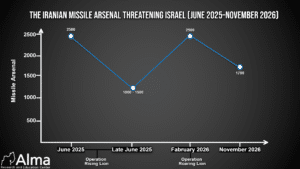
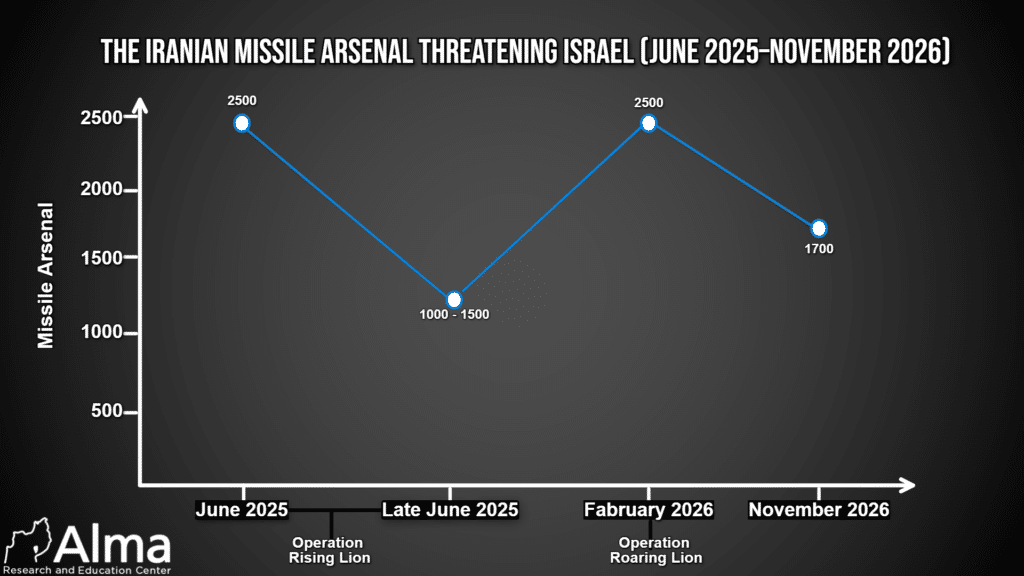
On November 3, 2026, an assessment attributed to an Israeli security source was published, according to which Iran currently holds more than 1,700 ballistic missiles capable of reaching Israel. This is roughly 800 missiles fewer than the estimate of about 2,500 missiles on the eve of Operation “Roaring Lion,” which began on February 28, 2026.
However, the decline in the stockpile does not necessarily reflect the full extent of missile destruction during “Roaring Lion,” since during that period Iran fired about 650 ballistic missiles at Israel, and in the months that followed it apparently continued assembling and producing a limited number of additional missiles.
An examination of the quantitative development of Iran’s missile arsenal points to three main periods:
The first period – up to June 2025: On the eve of Operation “Rising Lion” (June 13, 2025), Iran held, according to the updated Israeli assessment, about 2,500 ballistic missiles capable of reaching Israel. During the war it fired about 550 ballistic missiles at Israel, and Israel destroyed, according to published estimates, about 1,000 more. At the end of the war, the remaining stockpile was estimated at about 1,000–1,500 missiles.
The second period – June 2025 to February 2026: Iran worked to rapidly rebuild its missile arsenal. On the eve of Operation “Roaring Lion” (February 28, 2026), the stockpile was estimated at about 2,500 missiles. Assuming the stockpile at the start of the rebuilding period stood at about 1,500 missiles, this represents a net addition of about 1,000 missiles in eight months, equivalent to an average addition of about 125 missiles per month. This is not necessarily the actual production rate, but rather a calculation based on the change in the estimated stockpile.
The third period – February to November 2026: Operation “Roaring Lion” struck Iran’s missile arsenal and production infrastructure once again. As of early November 2026, the estimated stockpile stands at more than 1,700 missiles capable of reaching Israel. At the same time, there are indications of a resumption of limited assembly and production, though at a lower rate than before the war.
Operations “Rising Lion” (June 2025) and “Roaring Lion” (February 2026) significantly damaged Iran’s missile arsenal, its production infrastructure, and its launcher array as well. Nevertheless, Iran still holds a significant arsenal of ballistic missiles. The ballistic threat to Israel, and Iran’s ability to rebuild it, have not been eliminated.
The central strategic question is not only how many missiles Iran has left today, but at what pace it will succeed in restoring its full production chain and expanding its arsenal once again.
According to IDF data, there are significant gaps between final assembly capabilities, which have remained at a high level, and the earlier stages of the production chain – particularly raw materials, engine components, and warheads – whose level of functioning was defined as low.
Accordingly, open-source information makes it possible to identify the direction of the rebuilding effort, but not to reliably determine the current monthly production rate.
The Development of Iran’s Missile Arsenal – A Chronological Picture
The data published over the past two and a half years sometimes refer to different categories: all ballistic missiles, missiles capable of reaching Israel, stockpiles available for operational use, and missiles actually launched.
Therefore, not all of the estimates can be compared directly, and a distinction must be made between physical changes in the stockpile and updates to intelligence assessments.
Timeline – Key Changes in the Stockpile
| Date | Estimated missile stockpile | Key event or change |
| 2022 | More than 3,000 | Estimate by former CENTCOM commander Kenneth McKenzie regarding all Iranian ballistic missiles, of all ranges. |
| June 2025 – eve of “Rising Lion” | About 2,500 | Updated Israeli assessment of missiles capable of reaching Israel. |
| June 2025 – after “Rising Lion” | About 1,000–1,500 | After the launch of about 550 missiles at Israel and the destruction of about 1,000 more, according to published estimates. |
| February 2026 – eve of “Roaring Lion” | About 2,500 | Rapid rebuilding of the arsenal over about eight months. |
| February–March 2026 | — | The Second Iran War, during which about 650 ballistic missiles were fired at Israel and production and storage infrastructure was struck. |
| November 2026 | More than 1,700 | Assessment by an Israeli security source, published on November 3. |
Methodological note: The figures in the table are estimates published at different times. Some refer to the total stockpile and some to missiles capable of reaching Israel. In addition, updates to intelligence assessments must be taken into account, and therefore no numerical change should be regarded as direct proof of missile production or destruction.
The Starting Point: Iran’s Missile Arsenal and the 2024 Confrontations
In 2022, former CENTCOM commander General Kenneth McKenzie estimated that Iran held more than 3,000 ballistic missiles. Iran Watch cited this estimate and clarified that it referred to ballistic missiles only, alongside a separate array of cruise missiles.
This estimate refers to missiles of various ranges, and should therefore not be interpreted as meaning that Iran held more than 3,000 missiles capable of reaching Israel.
During 2024, Iran carried out two direct missile attacks against Israel.
According to the IDF Spokesperson, on the night of April 13–14, 2024, Iran launched more than 120 ballistic missiles, more than 30 cruise missiles, and about 170 UAVs.
On October 1, 2024, Iran carried out another attack, during which more than 180 ballistic missiles were fired at Israel.
The Israeli strike in Iran on October 26, 2024, marked a further stage in confronting the threat, as alongside damage to military capabilities, infrastructure linked to missile production was also attacked.
On October 27, 2024, Reuters published satellite imagery analyses by David Albright, president of the Institute for Science and International Security (ISIS), and by Decker Eveleth, an analyst at CNA. The analyses pointed to damage to buildings associated with solid-fuel mixing at the Parchin and Khojir facilities.
The same report cited an Axios assessment, based on three Israeli sources, according to which 12 planetary mixers used to mix solid fuel for missiles were hit.
The significance was damage to the future production capacity for solid-fuel-engine missiles, and not necessarily direct damage to the existing missile stockpile already in Iran’s possession.
This distinction is important for understanding how the threat developed in the following years: damage to the missile stockpile and damage to production infrastructure are two actions with different effects on Iran’s capacity for military buildup.
“Rising Lion” (the “First Iran War”) – June 2025: A Decline from About 2,500 to About 1,000–1,500 Missiles
On the eve of Operation “Rising Lion,” which began on June 13, 2025, Iran held a significant arsenal of ballistic missiles capable of reaching Israel.
On June 16, three days after the operation began, JINSA published an analysis based on an Israeli assessment of about 2,000 ballistic missiles capable of reaching Israel at the start of the war.
Ten days later, on June 26, JINSA published an update based on IDF assessments. This time, an opening stockpile of about 2,500 missiles was presented, and the document explicitly stated that this was an update of the previous estimate.
In other words, the increase from 2,000 to 2,500 missiles does not reflect the production of 500 missiles in ten days, but rather a change in the estimate of the opening stockpile.
According to published estimates, during Operation “Rising Lion”:
- Iran fired about 550 ballistic missiles at Israel, alongside about 1,000 UAVs.
- Israel destroyed about 1,000 medium-range ballistic missiles.
- The number of Iranian launchers fell from about 350 to about 100.
- At the end of the war, Iran was left with about 1,000–1,500 ballistic missiles capable of reaching Israel.
The significance: the June 2025 war caused significant erosion to Iran’s missile arsenal and launcher array, but did not deprive Iran of its ability to continue maintaining a significant ballistic threat or to work toward rebuilding it.
The Eight Months of Rebuilding – June 2025 to February 2026: A Return to About 2,500 Missiles
After Operation “Rising Lion,” Iran worked to rapidly rebuild its ballistic missile arsenal.
According to Israeli intelligence assessments, the Iranian regime set a goal of expanding the arsenal to about 8,000 missiles – a goal perceived in Israel as a conventional existential threat, separate from the Iranian nuclear program, which was significantly damaged in the war.
In February 2026, on the eve of Operation “Roaring Lion,” the stockpile of ballistic missiles capable of reaching Israel was estimated at about 2,500.
How many missiles were added during the eight months of rebuilding?
Assuming that at the end of June 2025 the stockpile stood at about 1,500 missiles, and that by February 2026 it had reached about 2,500, this represents a net addition of about 1,000 missiles over about eight months.
The significance of the arithmetic:
1,000 missiles ÷ 8 months = an average addition of about 125 missiles per month.
However, it is important to emphasize that this is not necessarily the actual monthly production rate.
The growth in the stockpile may reflect a combination of the production of new missiles, the assembly of missiles from existing components, the return of missiles to operational readiness, and changes in intelligence assessments.
In addition, the starting point itself – the number of missiles in the stockpile at the end of the war – is uncertain. If the stockpile at the end of the war stood at only about 1,000 missiles (rather than about 1,500), the net addition was higher.
Therefore, an addition of about 125 missiles per month is a comparative estimate based on a particular scenario, and not a verified figure on the output of Iran’s missile industry.
On March 1, 2026, a day after the start of Operation “Roaring Lion,” the IDF announced that Iran had held about 2,500 missiles on the eve of the First Iran War (June 2025), and that during the eight months of rebuilding, up to “Roaring Lion,” Iran had been producing dozens of missiles per month, while setting a goal of about 8,000 missiles by 2027.
According to the same announcement, the strikes carried out by the Air Force as part of “Rising Lion” in June 2025 prevented the production of at least 1,500 additional missiles.
The gap between the description of producing dozens of missiles per month and the calculation of net stockpile growth highlights the limits of drawing inferences from public data, and the possibility that they refer to different metrics or periods.
“Roaring Lion” (the “Second Iran War”) – February 2026: Renewed Damage to the Arsenal and to Production Capacity
Operation “Roaring Lion” began on February 28, 2026.
On the eve of the war, the Iranian stockpile was estimated at about 2,500 ballistic missiles capable of reaching Israel.
During the war, Iran fired about 650 ballistic missiles at Israel. At the same time, Israeli and American strikes hit military infrastructure and the missile production array.
As of November 3, 2026, according to a published assessment attributed to an Israeli security source, Iran holds more than 1,700 ballistic missiles capable of reaching Israel.
How should the change from 2,500 to more than 1,700 missiles be interpreted?
In a simple numerical comparison, this is a gap of just under 800 missiles between the two stockpile estimates.
However, this gap should not be interpreted as the number of missiles destroyed in the war.
The reason is that since February 2026, several processes have taken place in parallel:
- The launch of about 650 ballistic missiles during the war.
- The destruction of missiles and storage facilities in strikes.
- Continued limited assembly and production after the war.
- Possible updates to intelligence assessments.
Therefore, the latest figure reflects the estimated remaining stockpile after the sum of all these processes, and not the extent of destruction alone.
The main conclusion is that despite the two wars and the damage to production infrastructure, Iran still holds a significant arsenal of ballistic missiles capable of reaching Israel.
November 2026 – Is Iran Succeeding in Rebuilding Its Missile Industry?
The central question today is not only how many missiles Iran has left, but what its ability is to replenish the stockpile over time.
Various public assessments point to a limited return to the assembly of liquid- and solid-fuel missiles.
However, it is unclear to what extent this involves the production of new missiles across the entire production chain, and to what extent it involves the final assembly of components manufactured before Operation “Roaring Lion.”
Status of the Iranian Production Chain
IDF data published after the “Second Iran War” / “Roaring Lion” present an uneven picture of Iran’s remaining production capabilities.
Low level of Iranian functioning:
- Production and processing of raw materials for basic components.
- Production of explosives.
- Warhead casting.
- Warhead production.
- Supply of raw materials for engines.
- Production of engine casings.
Medium–high level of functioning:
- Engine mixing and casting.
High level of functioning:
- Final assembly of the ballistic missiles.
The Significance
The gaps between the production stages may indicate that Iran has preserved the ability to assemble missiles from existing components, but finds it harder to produce all the components needed for a new missile, starting from raw materials.
This situation allows continued limited assembly, but could create production bottlenecks over time, particularly if the stock of existing components steadily shrinks.
On October 10, 2026, Bloomberg reported that Iran had preserved factories and capabilities enabling it to replenish its missile and UAV stockpiles.
The article also mentioned a Western assessment from June 2026, according to which Iran retained about 75% of the munitions stockpile it had held before Operation “Roaring Lion.”
However, this assessment does not necessarily refer to the same category of ballistic missiles capable of reaching Israel, and therefore should not be compared directly with the figure of more than 1,700 missiles.
On November 7, the Islamic Revolutionary Guard Corps claimed that Iran is building underground complexes that enable the production and storage of munitions even under bombardment.
The following day, November 8, it was reported that Iran had resumed missile production, but at a lower rate than before Operation “Roaring Lion.”
These reports reinforce the assessment that Iran continues to work to rebuild its capabilities, but do not make it possible to determine the scale of monthly production.
Situation Assessment – What Can Be Concluded About the Pace of Iran’s Rebuilding?
An examination of the data points to a significant difference between Iran’s two rebuilding periods. In the first, after June 2025, Iran succeeded, according to published stockpile estimates, in increasing its missile stockpile at a very rapid pace; but the second, after Operation “Roaring Lion,” in April 2026, is different. Iran continues to work to rebuild its capabilities, but according to recent reports, the production rate is lower than before the war, and significant parts of the production chain are still functioning at a low level.
However, there is currently no sufficient public basis for a reliable calculation of the number of missiles Iran produces each month.
This would require additional data, including the missile stockpile immediately after the war, the quantity of remaining components, the production capacity for engines and warheads, the availability of raw materials, the number of operational launchers, and the ability to restore production infrastructure to full activity.
A distinction must also be made between the ability to increase the number of missiles in the stockpile and the ability to employ them operationally, which depends, among other things, on the number of launchers, their readiness, and command-and-control systems.
Summary
As of November 2026, Iran holds a significant arsenal, even after two wars in which Iran’s missile stockpile, launcher array, and production infrastructure were damaged.
The data indicate that Iran has not given up on rebuilding its ballistic capabilities, but its ability to replenish the arsenal at the pace that characterized the period between the two wars is unclear.
The main gap today is between the final assembly capability, which has remained relatively high, and the ability to produce all of the missile’s components along the production chain.
This gap may limit the pace of military buildup in the short and medium term, but it does not eliminate the existing threat or the potential for future rebuilding.
The two wars significantly damaged Iran’s missile arsenal and its production infrastructure, but did not eliminate the ballistic threat to Israel.
Sources:
- https://www.israelhayom.co.il/news/world-news/middle-east/article/21766857
- https://jinsa.org/wp-content/uploads/2025/06/Iranian-Ballistic-Missile-Estimates-6-16-2025-1.pdf
- https://jinsa.org/wp-content/uploads/2025/06/Iranian-Ballistic-Missile-Estimates-6-26-2025-6.pdf
- https://www.mako.co.il/news-world/2026_q4/Article-efbf0239e3ab1a1026.htm
- https://israel-alma.org/iran-types-of-ballistic-missiles-overview/
- https://www.iranwatch.org/our-publications/weapon-program-background-report/table-irans-missile-arsenal
- https://www.wsj.com/world/middle-east/iran-tries-to-calibrate-response-against-israel-after-deadly-bombing-abb38b57
- https://www.reuters.com/world/middle-east/iranian-missile-strike-israel-shows-capability-greater-scale-complexity-2024-10-02/
- https://www.washingtonpost.com/world/2024/10/01/iran-attack-israel-ballistic-missiles/
- https://tribune.com.pk/story/2505611/israeli-airstrike-struck-former-iranian-nuclear-site-missile-fuel-facilities-us-researchers
- https://israel-alma.org/iran-situation-assessment-february-2026-the-race-to-rebuild-the-nuclear-and-missile-array-casual-terror-and-the-crink/
- https://www.jns.org/world/idf-2025-strikes-prevented-at-least-1500-iranian-missiles
- https://israel-alma.org/the-iranian-arena-monthly-review-august-september-2026/
- https://www.mako.co.il/news-world/2026_q4/Article-92cafa0168421a1026.htm
- https://www.kikar.co.il/strategy-and-defense/us-iran-military-buildup-middle-east
- https://uk.news.yahoo.com/iran-irgc-says-building-underground-153458057.html