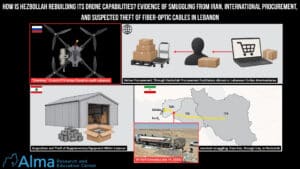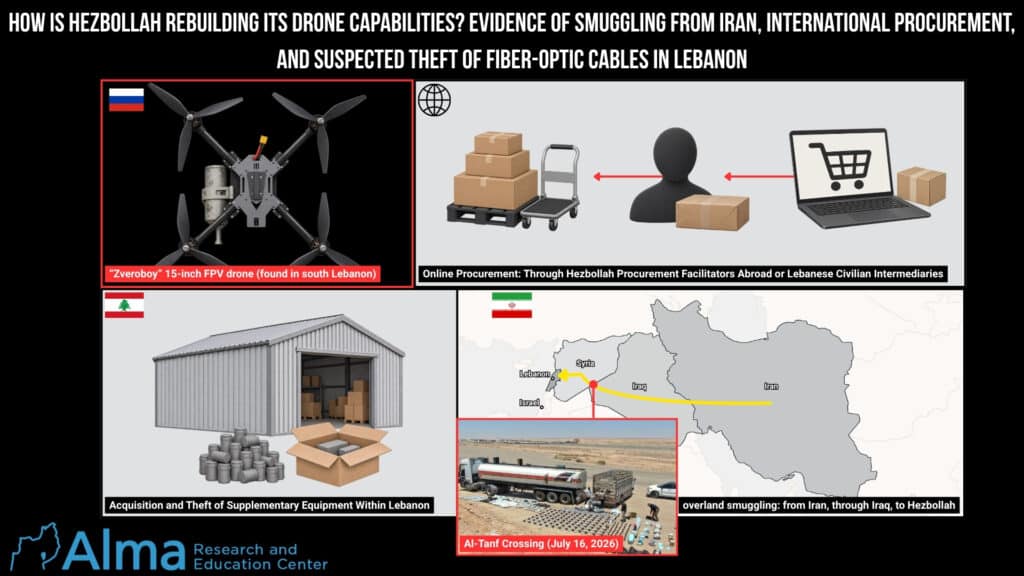
Several incidents in recent months may shed light on the drone supply chain Hezbollah is utilizing as part of its efforts to rebuild and strengthen its capabilities: overland smuggling from Iran through Syria, procurement by Iran or Hezbollah via the internet, and the acquisition or theft of supplementary equipment within Lebanon.
The first publicly available indication of overland drone smuggling from Iran, through Iraq, to Hezbollah emerged on July 16, 2026, when Syrian security forces intercepted a shipment of approximately 100 FPV drones equipped with specialized warhead-mounting mechanisms and fiber-optic guidance systems at the Al-Tanf border crossing (western Iraq/southeastern Syria).
The weapons were concealed inside an oil tanker truck allegedly heading toward the city of Baniyas in northwestern Syria, along a route passing near Lebanon’s eastern border.
Alongside the drones, RPG warheads were also being smuggled. These warheads had been preconfigured for mounting on the drones using an electrical mechanism and specialized bolts, rather than the improvised solutions observed in the past.
The specialized mounting mechanisms were most likely manufactured in Iran, although Hezbollah is also known to manufacture such devices independently.
We assess that a significant proportion of the drones reached Iran from Russia and China, possibly also through orders placed under civilian cover, including through online platforms.
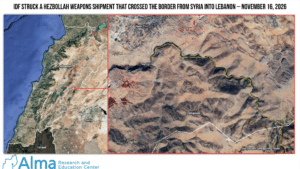
On November 16, the IDF struck a weapons shipment entering Lebanon through the Janta area in the Beqaa Valley, eastern Lebanon. The shipment entered Lebanon via a known overland smuggling route from Syria.
According to various reports, the weapons shipment included drones (As of this writing, we are unable to verify this.)
It is possible that this shipment successfully crossed the Iraq–Syria border at Al-Tanf, reached Lebanese territory in the Janta area, and was intercepted there.
Clear Evidence of the Use of Russian-Made Drones
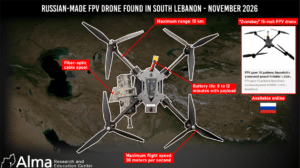
Recently, a Russian-made Hezbollah FPV drone designed to carry a warhead and equipped with a fiber-optic guidance system was discovered in the Bint Jbeil sector of southern Lebanon.
The drone was identified as a Russian-made Zveroboy FPV drone, capable of carrying a payload of up to 8 kg over a range of up to 10 km, with a flight endurance of 8–12 minutes. Its maximum speed reaches approximately 108 km/h.
The drone model identified is commercially available for purchase online through international e-commerce platforms, sometimes for as little as several hundred dollars.
It is possible that the drone reached Lebanon through overland smuggling from Iran. Alternatively, it may have been purchased online by Hezbollah.
Online Procurement: Through Hezbollah Procurement Facilitators Abroad or Lebanese Civilian Intermediaries
Hezbollah’s procurement operatives can acquire equipment through intermediaries within Lebanon, including individuals acting in good faith, Without knowing or understanding what the equipment is intended for.
These are civilian actors who, by virtue of their professional activities, possess the knowledge and ability to order the required equipment, including through online platforms.
In addition, Hezbollah’s procurement operatives can employ procurement facilitators based outside Lebanon to place online orders on their behalf.
These facilitators generally reside in Western countries, purchase the equipment from their countries of residence, and arrange for its shipment to the intended destination.
This modus operandi is well documented. In recent years, several such procurement facilitators have been arrested in the United States, Spain, and other countries.
Acquisition and Theft of Supplementary Equipment Within Lebanon
A fire that broke out on June 23, 2026, at a warehouse in the Dekwaneh (الدكوانة) area, east of Beirut, raised suspicions regarding the theft of fiber-optic cables belonging to the Lebanese telecommunications company OGERO.
Media reports linked the suspected theft of fiber-optic cables to the possibility that they were intended for use in drone production. Source
According to the reports, the warehouse fire was suspected of having been deliberately set to conceal the theft.
Additional reports indicated that three days before the fire, OGERO management had ordered an inventory count at the Dekwaneh warehouse, where the fiber-optic cables were stored.
This raised suspicions that the fire had been deliberately set to conceal the thefts before the inventory count could take place. Source.
Assuming Hezbollah was indeed involved, it appears that the organization is stealing relevant equipment within Lebanon in response to the challenges it faces in maintaining its supply chain through Iran and through its independent procurement activities.
Conclusion
The sequence of incidents described above indicates that Hezbollah is working to rebuild and strengthen its drone capabilities through a diversified supply chain combining several parallel channels: overland smuggling from Iran through Iraq and Syria, international commercial procurement via the internet and procurement facilitators, and potentially the acquisition of components and supplementary equipment within Lebanon, including through theft.
The use of Russian-made drones, commercially available components, and fiber-optic guidance systems demonstrates Hezbollah’s ability to exploit commercial technologies for military purposes.
In our assessment, diversifying its supply channels is intended to reduce Hezbollah’s dependence on any single smuggling route and overcome the difficulties resulting from damage to its logistical infrastructure.
However, insufficient information is currently available to determine the scale of procurement and smuggling activities or to verify Hezbollah’s involvement in the theft of fiber-optic cables in Lebanon.
The key implication is that intercepting individual smuggling shipments, even those containing dozens of drones, does not guarantee that the rebuilding of Hezbollah’s drone capabilities will be halted. The challenge lies in disrupting the entire supply chain, including procurement networks, facilitators, smuggling routes, and civilian sources of equipment that Hezbollah exploits for military purposes.