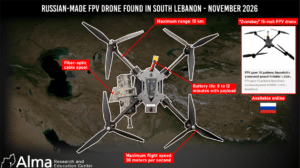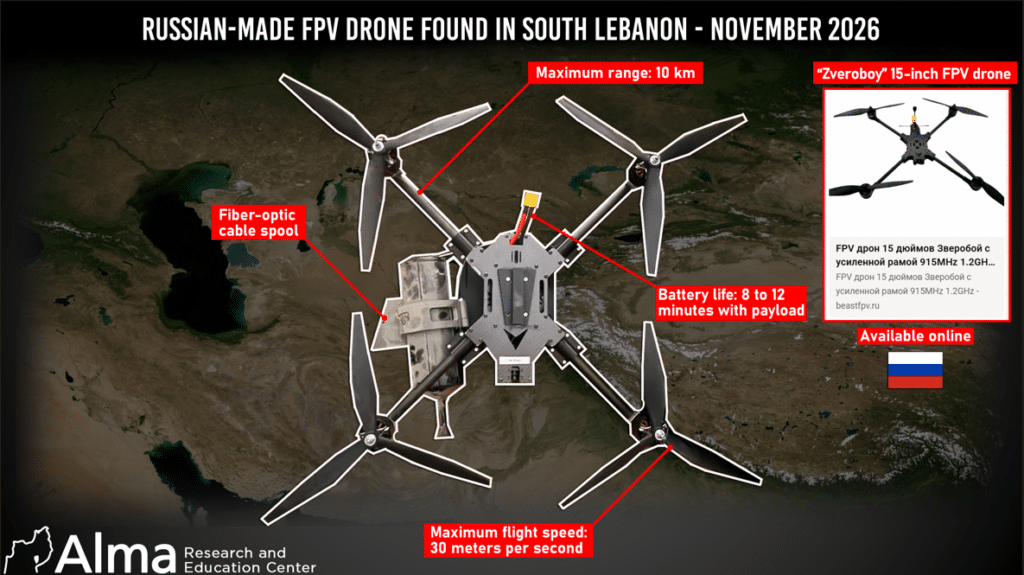
A Russian-made Hezbollah FPV drone, designed to carry a warhead and equipped with a fiber-optic guidance system, was discovered in the Bint Jbeil sector of southern Lebanon.
The drone was identified as the Russian-made Zveroboy FPV, capable of carrying a payload of up to 8 kg over a distance of up to 10 km, with a flight time of 8–12 minutes. Its maximum speed reaches approximately 108 km/h.
This type of drone is commercially available for purchase online through international e-commerce platforms, sometimes for as little as a few hundred dollars.
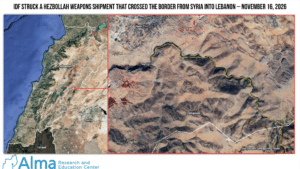
The accessibility of civilian equipment, such as drones and fiber-optic components, enables relatively easy and low-cost procurement. The specialized warhead mounting mechanism was manufactured in-house and adapted to the drone. A notable example of Hezbollah’s procurement efforts occurred on July 16, 2026, when Syrian authorities intercepted an attempted weapons shipment destined for Hezbollah at the al-Tanf crossing on the Iraq–Syria border. The shipment included drones and fiber-optic components concealed inside an oil tanker truck.
FPV drones enable operators to identify, track, and engage targets in real time with relatively high precision. The use of fiber-optic technology enables continuous communication with the operator without relying on radio transmissions, making these drones resistant to jamming and electronic warfare countermeasures.
During the most recent conflict, FPV drones played a significant role in Hezbollah’s attacks, particularly against IDF personnel, military vehicles, and engineering equipment. Their ability to strike moving targets on the battlefield, combined with the difficulty of detecting and intercepting them, has made them one of Hezbollah’s most significant attack capabilities.
Today, one of Hezbollah’s primary military buildup priorities is its FPV drone arsenal, with particular emphasis on building a very large inventory of fiber-optic-controlled drones and training operators to deploy them. This trend reflects both the operational successes Hezbollah achieved with drones during the most recent conflict and the shift in its military doctrine following the severe losses it sustained: a transition from a large-scale terrorist army model toward guerrilla warfare tactics based on small cells, decentralized operations, and targeted attacks.
In this context, we assess that Hezbollah is also preparing for the possibility of resuming attacks against IDF forces operating in the security zone in southern Lebanon (the “Yellow Line”), with FPV drones expected to play a central role in guerrilla operations targeting these forces.