The Aqaba Equestrian Club: Establishing Covert Hezbollah Infrastructure Under Business Cover
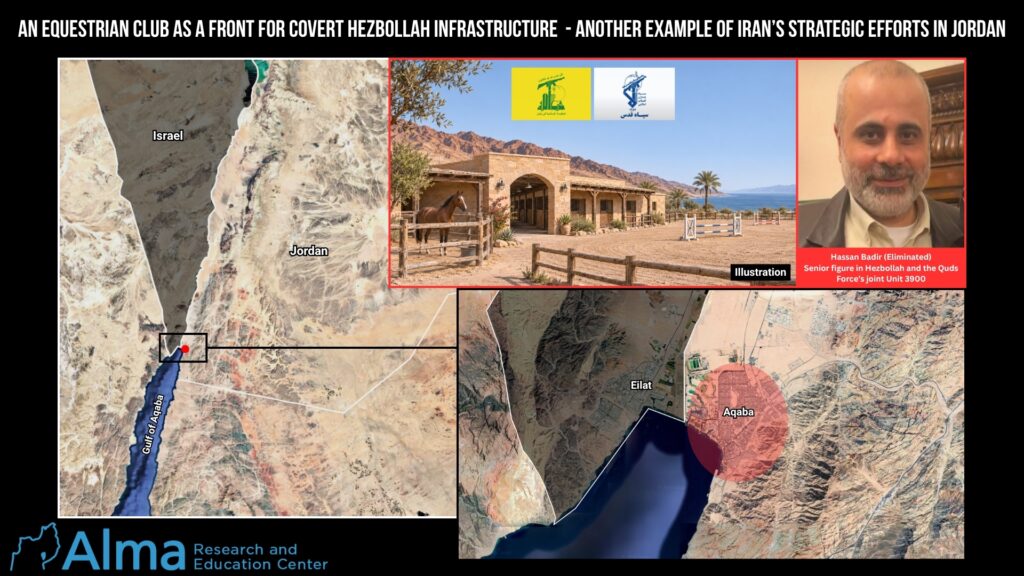
This week, Jordan’s Court of Cassation issued a final ruling that exposed an attempt to establish covert Hezbollah infrastructure in the kingdom under the guise of an investment project to build an equestrian club and academy in the city of Aqaba, with approximately $430,000 in funding.
The court convicted Yasser Marji, a dual Lebanese-French citizen, of acts that undermine public order and endanger public safety, sentencing him to six years of hard labor.
According to the court’s findings, Marji had been connected to Hezbollah operatives for several years, underwent security and military training in Lebanon, and was involved in security activities on Hezbollah’s behalf both inside and outside Lebanon.
In late 2023, Hassan Bdeir tasked Marji with establishing a business venture in Aqaba. As part of this effort, Marji established a commercial company, signed partnership agreements with Jordanian citizens, and worked to establish an equestrian club and academy.
However, according to the court’s ruling, the venture’s true purpose was to provide cover for Hezbollah’s covert and illegal activities in the kingdom. As part of his activities, Marji was also instructed to locate a storage facility and gather security-related information in Jordan. Marji was arrested in June 2025.
The case illustrates Hezbollah’s alleged use of business and civilian cover to establish covert infrastructure in foreign countries, while creating a local presence presented as legitimate commercial activity.
Following the ruling, Hezbollah issued a statement denying the allegations, describing them as “false and entirely baseless.” The organization called on the Jordanian authorities not to be drawn into what it described as a “smear campaign” intended to tarnish its reputation and portray it as an organization seeking to undermine Arab regimes.
Hassan Badir and Unit 3900: The Link Between Hezbollah and the Quds Force
The central figure in the case, who according to the court ruling was responsible for directing Marji to establish the venture in Aqaba, is Hassan Badir.
In our assessment, Badir was a senior figure in Unit 3900, also known as “Haj Rabih.”
Badir was eliminated in an IDF airstrike in Beirut’s Dahieh district on April 1, 2025. According to the IDF Spokesperson, Badir was a senior operative in Hezbollah’s Unit 3900. At the time of his elimination, he was directing Hamas operatives and assisting them in an attempt to advance a serious attack against Israeli civilians in the immediate term. The location of the planned attack was not disclosed.
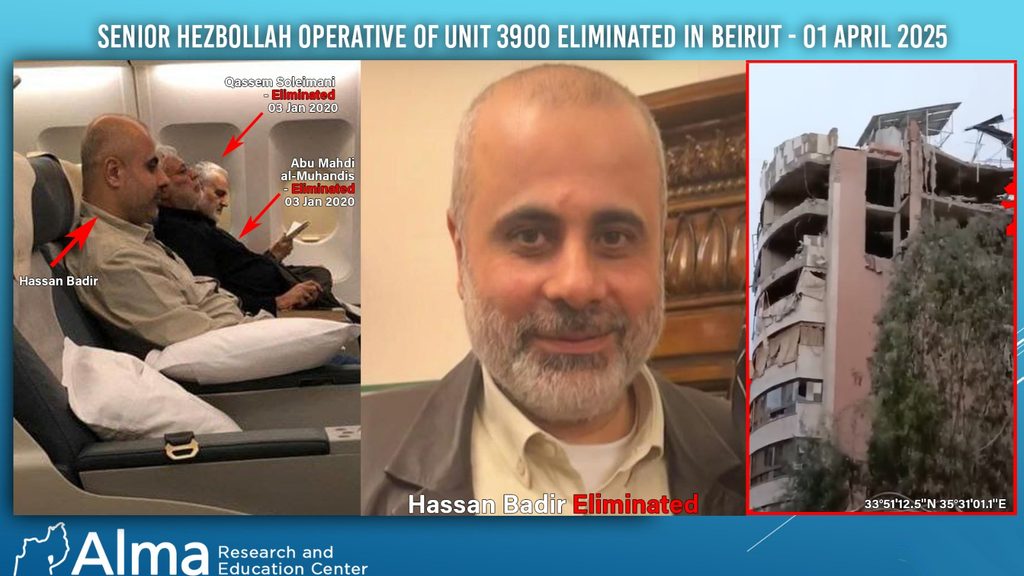
Unit 3900 is a joint Hezbollah and Islamic Revolutionary Guard Corps Quds Force unit. In our assessment, the Quds Force’s Palestine Branch is a key partner in its operation.
Unit 3900’s primary mission is to cooperate with Palestinian terrorist organizations in advancing terrorist activity against Israeli targets and interests in Israel and around the world, while providing these organizations with financial support, professional expertise, and equipment.
One of the unit’s principal arenas of operation is Judea and Samaria, where Iran is conducting an effort to support Palestinian terrorist organizations. The Quds Force’s Unit 840 and the Special Operations Division, Division 4000, of the IRGC Intelligence Organization are also involved in the Iranian effort in this arena.
Badir’s involvement in the Aqaba case, as indicated by the Jordanian court ruling, constitutes a significant indication of Unit 3900’s activity in the Jordanian arena and of Jordan’s place within Iran and Hezbollah’s regional operational network.
The Aqaba case is not an isolated incident within the broader range of efforts attributed to Iran and Hezbollah in the Jordanian arena.
On April 15, 2025, approximately two weeks after Hassan Badir’s elimination, it was reported that Jordanian intelligence had uncovered and thwarted a significant terrorist network whose activities began in 2021. Sixteen operatives were arrested in connection with the case.
The network’s operatives, who were apparently affiliated with Jordan’s Muslim Brotherhood movement, underwent training in Lebanon and received financial support and professional expertise from Hamas operatives in Lebanon. According to a report in Asharq Al-Awsat, Hezbollah operatives were also involved in training members of the network.
The network consisted of four principal cells engaged in smuggling weapons and explosives, manufacturing rockets, developing UAVs, and recruiting and training operatives.
The characteristics of the activity, particularly the reported involvement of Hamas and Hezbollah operatives in Lebanon, raise the possibility that the Quds Force’s Palestine Branch and Hezbollah’s Unit 3900 were also behind this activity.
The Jordanian Arena in Iran and Hezbollah’s Strategic Outlook
Iran and Hezbollah’s effort to establish terrorist and influence infrastructure in the Jordanian arena has continued for more than 25 years and received particular emphasis following the IDF’s withdrawal from the security zone in southern Lebanon in May 2000.
This effort has two principal strategic objectives:
The first is to undermine Jordan’s internal stability: weakening the rule of the Hashemite Kingdom and expanding the Iranian axis’s potential influence and foothold in the country, including through the establishment of covert infrastructure and the advancement of terrorist activity.
The second is to turn Jordan into an arena for operations against Israel and a transit corridor for supporting terrorism in Judea and Samaria: this activity is also intended to damage the strategic relationship between Israel and Jordan and undermine security stability along their shared border.
As part of these efforts, Iran and Hezbollah work to establish ties with local actors in Jordan, including elements affiliated with the Muslim Brotherhood movement, as well as through Palestinian terrorist organizations operating in Lebanon.
The exposure of the Aqaba case illustrates another dimension of this effort: the attempt to establish an independent covert Hezbollah presence on Jordanian territory through ostensibly legitimate business activity, rather than relying solely on local actors or Palestinian terrorist organizations.
Jordan’s Growing Importance Following the Collapse of the Assad Regime and the Outcome of the War in Lebanon
The Jordanian arena has always been considered significant from an Iranian strategic perspective. However, regional developments in recent years have given it renewed and even greater importance.
In the Syrian context, the collapse of the Assad regime in December 2024 resulted, at least temporarily, in the loss of a major strategic asset for Iran and of its ability to maintain a direct geographical front against Israel from Syrian territory, as it had sought to do for years.
In the Lebanese context, the significant damage to Hezbollah’s military infrastructure and command structures requires Iran to invest considerable effort in rebuilding the organization and restoring its military capabilities while contending with constraints and challenges that did not exist to the same extent before the war.
Against this backdrop, Iran may view the Jordanian arena as an alternative and complementary arena for some of the activities it previously advanced through Syria and Lebanon. This applies both to creating a direct threat to Israel and to supporting terrorist activity in Judea and Samaria.
However, it is important to emphasize that the attempt to establish the infrastructure in Aqaba began in late 2023, before the collapse of the Assad regime. The activities of the network exposed in April 2025 also began several years earlier.
The Iranian effort in the Jordanian arena is therefore not a product of recent regional developments, but rather an ongoing strategic effort whose importance may grow in light of the changes in Iran’s regional position..
Conclusion
The Aqaba equestrian club case and the exposure of the terrorist network in Jordan in April 2025 illustrate the threat posed to the Hashemite Kingdom by the ongoing efforts of Iran, Hezbollah, and Palestinian terrorist organizations to establish operations on its territory.
Hassan Badir’s involvement in the Aqaba network, according to the findings of the Jordanian court, sheds further light on Unit 3900’s activities and the operational interface between Hezbollah, the Quds Force, and Palestinian terrorist organizations in the Jordanian arena.
In our assessment, Iran will not abandon its efforts to establish influence and terrorist infrastructure in Jordan. The loss of its strategic assets in Syria and the significant damage inflicted on Hezbollah in Lebanon may further increase Iran’s motivation to expand its activities in the kingdom.
From Iran’s perspective, Jordan is not merely a transit state for supporting terrorist activity in Judea and Samaria, but a strategic target arena in its own right, through which it can threaten Israel, undermine the stability of the Hashemite Kingdom, and damage relations between the two countries.