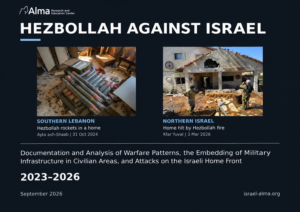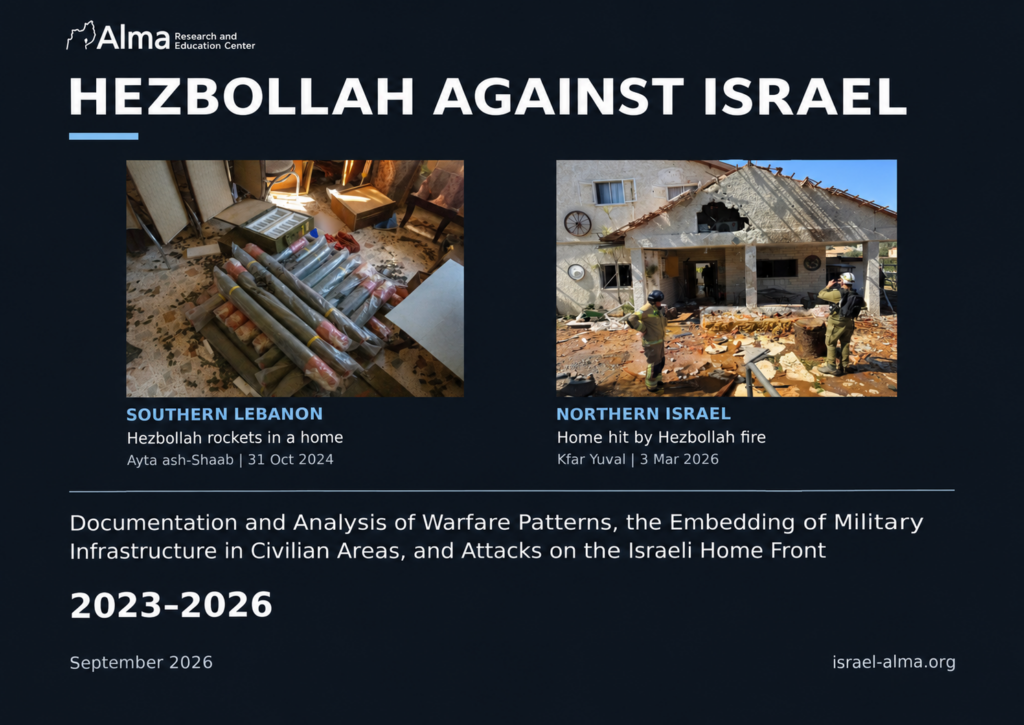
Documentation and Analysis of Warfare Patterns, the Embedding of Military Infrastructure in Civilian Areas, and Attacks on the Israeli Home Front
2023–2026
In the summer of 2026, the United Nations Office of the High Commissioner for Human Rights (OHCHR) contacted us, requesting additional information, data, and documentation regarding Hezbollah’s attacks against Israel, the harm inflicted on Israel’s civilian population, and Hezbollah’s use of civilian areas in Lebanon for military purposes.
We made it clear to the OHCHR that the story did not begin in 2026, but much earlier. Accordingly, we provided extensive materials covering the period from October 2023 to the present, including a report of approximately 60 pages.
The information in the report is based on the Alma Center’s ongoing monitoring and research into Hezbollah’s military terrorist activity, including a database documenting the organization’s attacks against Israel.
The information presented in this document is based on the collection, documentation, and cross-referencing of a variety of open sources. These include, among others, warnings from the Home Front Command in Israel; media reports; information and documentation from open sources and on social media in a variety of languages; as well as announcements, statements, and documentation published by Hezbollah itself regarding its military terrorist activity and claims of responsibility for attacks.
The document is divided into few parts:
- Hezbollah’s human shield tactics: Hezbollah’s activities, personnel, and military infrastructure among the civilian population and around civilian objects.
- Hezbollah statements: declared targets and information regarding attacks against civilians and populated areas in Israel.
- Hezbollah attacks against Israel: statistics 2023-2026.
- Casualties in Israeli territory and damage to civilian property as a result of Hezbollah attacks
- The weapons used by Hezbollah against Israel.
- Appendix A: Alma Center’s statistical data collection methodology and quantitative data on Hezbollah attacks.
- Appendix B: Human shield map database.
- Appendix C: Timeline.
Although the Commission requested an examination of events since March 2026, it is impossible to disregard the fact that Hezbollah initiated hostilities against Israel on October 8, 2023. The two periods cannot be viewed in isolation, as Hezbollah continued to manufacture and smuggle weapons in the intervening period. This is in violation of international resolutions, the decisions of the Lebanese government, and international law.
UNSC Resolution 1559 of 2004 stipulated that Hezbollah would disarm, UNSC Resolution 1701 of 2006 stipulated that the Lebanese government would disarm Hezbollah south of the Litani. The 2024 ceasefire agreement stipulated that the Lebanese government would disarm Hezbollah. None of these things happened, despite the spirit of the Lebanese army’s declarations at the end of 2025 that it had completed the mission.
Therefore, Hezbollah not only violated these resolutions, but it also continued to prepare for a campaign against Israel and yet initiated it for the third time in a row in March 2026.
The events of 2026 cannot be separated from the twenty years that preceded it. From Hezbollah’s refusal to disarm and from the preparations it made for war and attacks against Israel. We will also expand on all of this in the current report.
The damage from the war in Israel cannot be isolated to March 2026 alone, as this is an area that was partially evacuated during the war in 2023-2024 for a year and a half – and about a year after the residents returned, they were again under fire. This fact has psychological, economic, and social implications for the residents of northern Israel for years ahead.
In addition to the report and following the Commission request, we provided testimonies of Israelis and Lebanese published in the past few years. See below.
Testimonies from Lebanon on the Use of the Civilian Population as Shields and Hezbollah’s
Responsibility for the Escalation
Alongside the operational findings, visual documentation, and information collected regarding the location of Hezbollah’s military infrastructure within civilian areas, public testimonies from within Lebanon itself have also been collected. These include filmed accounts by residents, religious figures, journalists, and public figures who criticize the manner in which Hezbollah operates.
These testimonies do not replace the factual findings already presented by us, but they add an important layer, as they reflect how segments of the Lebanese population experience and interpret Hezbollah’s activity from within civilian areas.1
In several testimonies, Lebanese individuals explicitly describe how Hezbollah’s activity from within and near populated communities brings the fighting into civilian areas and endangers their residents.
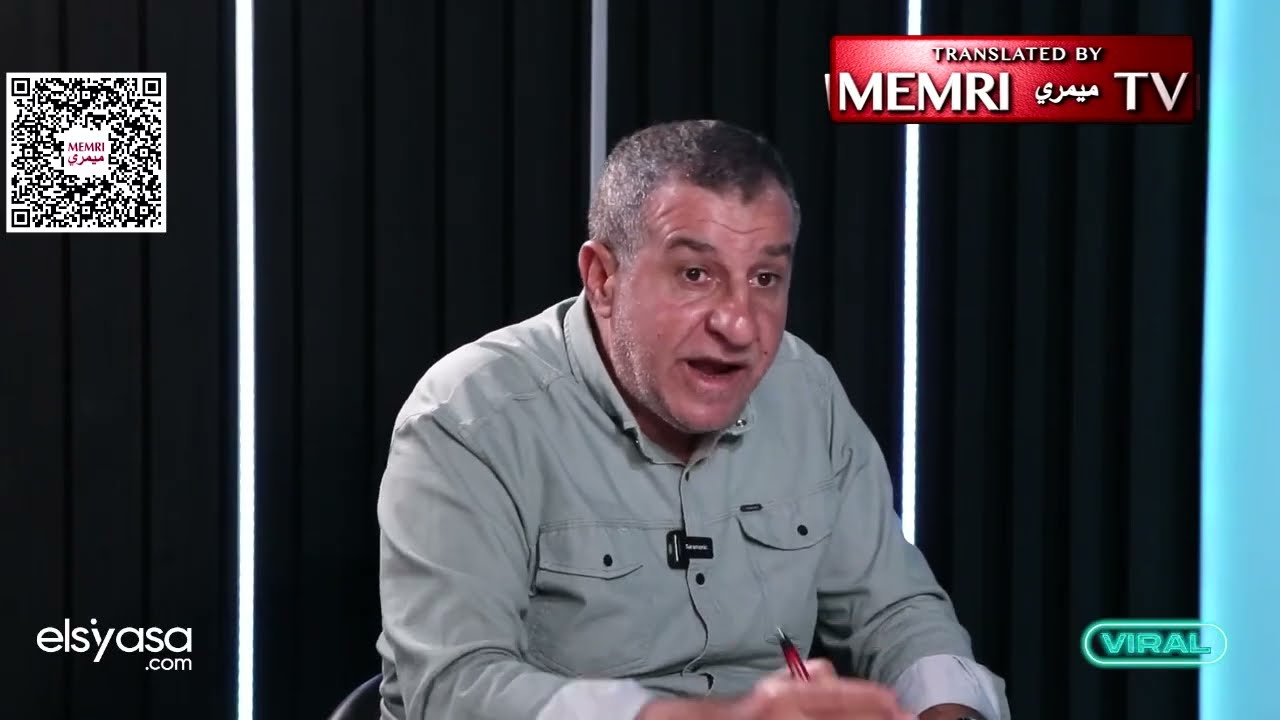
For example, in June 2026, Mahmoud Shuaib, a Shiite activist from southern Lebanon, claimed that residents remain in their villages in order to prevent Hezbollah operatives from taking over their homes and using them as hiding places, which could turn those homes into targets for attack.
Father Tony Hani expressed similar criticism when he called on Hezbollah operatives not to launch rockets from residents’ homes: “Launch your missiles from your own homes, not from ours.”
The danger to the Lebanese population does not stem solely from attacks against Hezbollah infrastructure. During the war, there were also documented cases in which rockets launched by Hezbollah hit inside Lebanese villages and struck civilian areas themselves.
In May 2026, after rockets launched by Hezbollah toward Israel hit inside the Christian village of Debel, Father Fadi Felfela accused Hezbollah of endangering the village’s residents by launching rockets from within and near civilian areas. He called for Hezbollah’s military activity to be kept away from the village and from residents’ homes, thereby making clear that, from the perspective of local residents, the very deployment of Hezbollah’s firing systems within a residential environment directly exposes the civilian population to the dangers of the fighting.
In June 2026, the head of the Ain Ebel municipality, Ayoub Harish, stated that approximately 14 rockets fired from Lebanon landed among the village’s homes, causing extensive damage and injuring a resident. In another interview, he explicitly stated that Hezbollah had fired the rockets from the direction of Srifa and that they had struck Ain Ebel. These incidents illustrate that the deployment and operation of firing systems from areas populated by Lebanese civilians endanger them not only because of the possibility of an Israeli response, but also as a direct result of Hezbollah’s own fire.
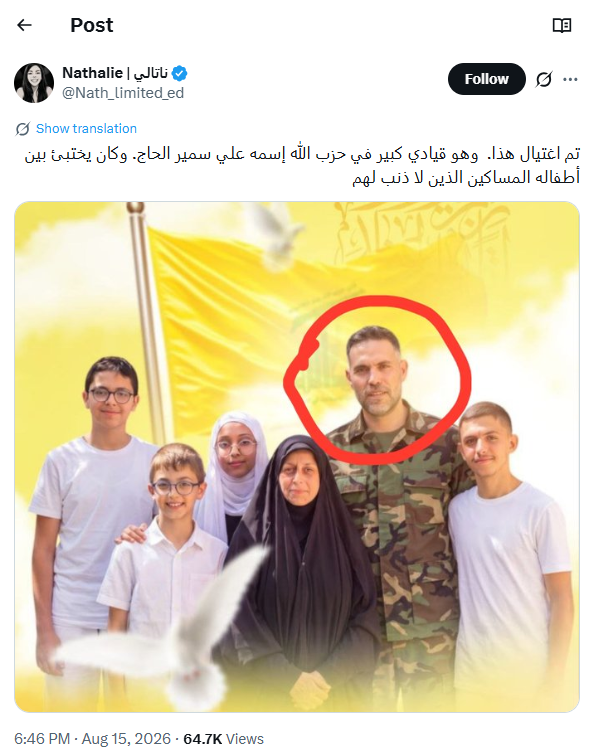
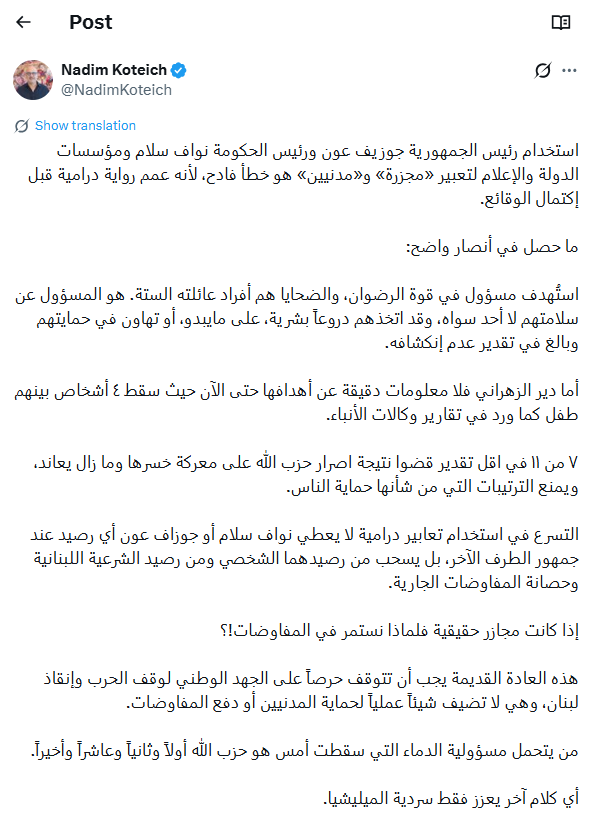
Particularly sharp criticism of Hezbollah was voiced following the strike in Ansar in August 2026, in which senior Radwan Force commander Ali Samir al-Hajj Hassan was killed.
Nathalie, apparently an independent Lebanese Christian journalist, stated that the same senior commander who was eliminated “was hiding among his innocent children.”
Shiite journalist Nadim Koteich addressed the death of Hassan, who was eliminated while residing with his wife and four children in a structure used for his military activity. Koteich placed responsibility for the deaths of the family members on al-Hajj Hassan and Hezbollah itself, arguing that a Radwan commander who placed his family alongside him at a location from which he conducted military activity had in fact exploited them as human shields, or at the very least had knowingly chosen to expose them to the risk created by his activity. According to Koteich, presenting the incident solely as the deaths of civilians obscures the fact that a senior Hezbollah commander was operating from the same location in which he was residing with his family.
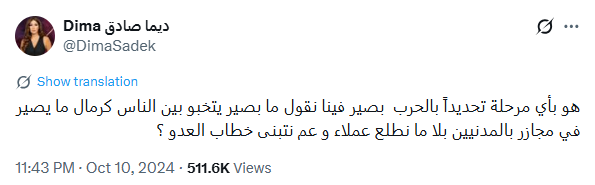
In October 2024, Shiite journalist Dima Sadek raised a similar question asking, when it would become possible to publicly say that Hezbollah operatives should not hide among civilians without those making such a claim being accused of adopting the Israeli narrative.
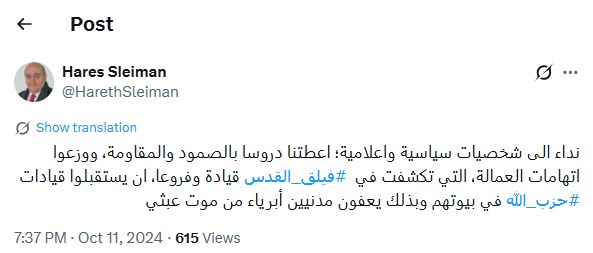
Hareth Sleiman, a Shiite politician, directed similar criticism at the organization’s supporters and called on political and media figures who support Hezbollah to host the organization’s leadership in their own homes, rather than having other civilians bear the risks resulting from its presence.
Alongside criticism of the tactic of embedding military activity within civilian areas, some of the testimonies also place broader responsibility on Hezbollah for the continuation of the war and the price paid by the Lebanese population.
Shiite writer Hassan Merhi described Hezbollah’s leadership in July 2026 as sacrificing the residents and young people of southern Lebanon while its own leadership remained protected, stating that the organization’s actions had led to the loss of the south.
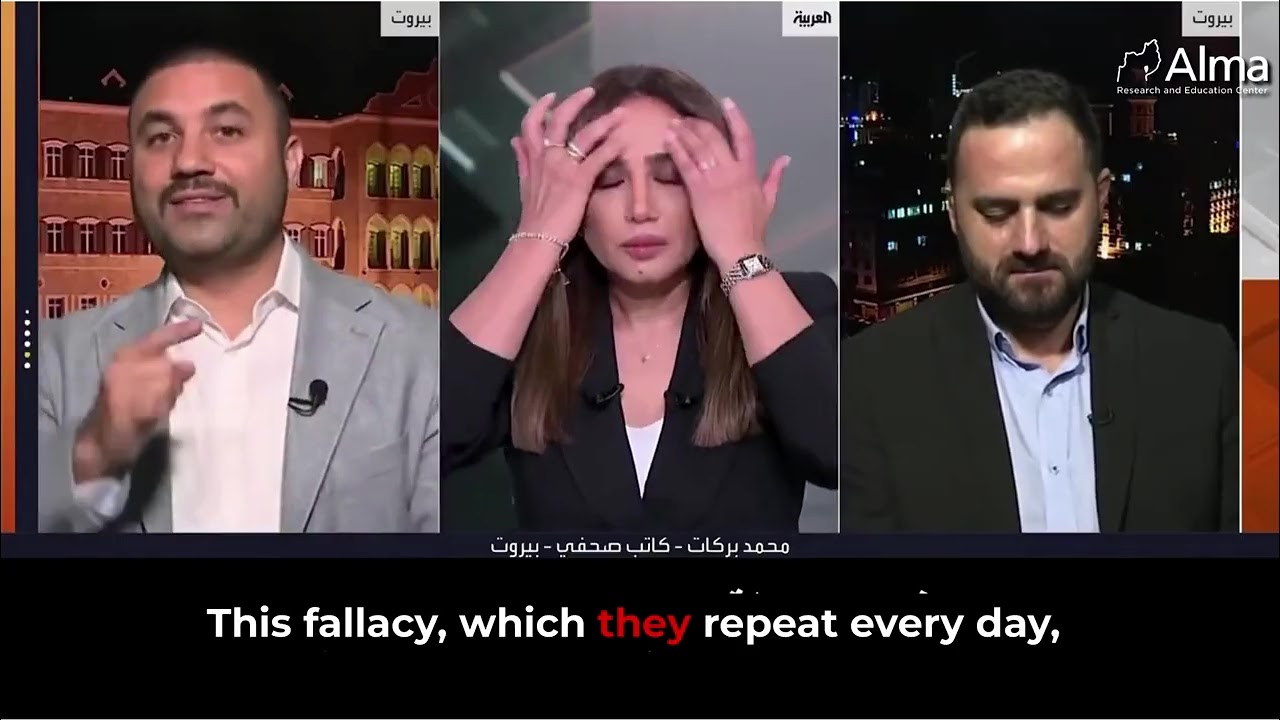
Shiite journalist Mohammad Barakat has also argued on several occasions that Hezbollah does not protect civilians and that the continuation of its military activity is what is bringing destruction to the area.
During a session of the Lebanese Parliament on September 12, 2026, a heated confrontation erupted between Hezbollah MPs Ibrahim al-Moussawi and Ali Ammar and Lebanese MP Ashraf Rifi, former Director General of Lebanon’s Internal Security Forces. In response to alMoussawi’s declaration that the “resistance” would remain in Lebanon, Rifi called on Hezbollah members to take their “resistance” to Iran and accused them of destroying the country and even their own families’ homes. In the footage released from the parliamentary session, Ashraf Rifi’s face is not visible, but his voice can be clearly heard. The incident drew attention on social media in Lebanon.
These testimonies represent parts of the Lebanese public opinion. Their significance lies in the fact that they come from within the communities and areas affected by the fighting, and in some cases from within the Shiite population of southern Lebanon itself. They add an independent evidentiary layer to the findings regarding Hezbollah’s military activity in Lebanon, as they describe, from within Lebanon itself, Hezbollah’s use of civilian areas, its exposure of the population to danger, and the harm caused to civilians as a result of its activity. In this sense, the testimonies are not merely expressions of political or public criticism but also provide further factual support regarding Hezbollah’s systematic use of the civilian population and civilian areas for its military activity.
See below few videos with additional testimonies. The full list of testimonies is attached in the table below.
All videos mentioned in this report are attached in the folder. The links to the videos can be found in the
attached excel table.

| Notes / Additional Link | Link | Publication / Event Date | Speaker’s Name | Sect and Place of Origin | Location | Category / Role |
| Translated by the Middle East Media Research Institute (MEMRI) | https://x.com/MEMRIReports/status/2068974587291861200?s=20 | June 22, 2026 | Mahmoud Shuaib | Shia from South Lebanon | Political activist | |
| https://www.youtube.com/watch?v=DNKFg5-NGaw | July 14, 2026 | Hassan Marahi | Shia from South Lebanon | Author | ||
| https://x.com/waqa2e3/status/2077788438695223794?s=20 | July 16, 2026 | Serge Dagher | Christian (Lebanese Kataeb Party) | Politician | ||
| https://x.com/NewsNow4world1/status/2088231717454663686?s=20 | August 14, 2026 | Michel Issa | Christian from Mount Lebanon | Politician – U.S. Ambassador to Lebanon | ||
| https://eliasbejjaninews.com/2026/04/153527/ | April 7, 2026 | Father Tony Hani | Christian | Qouzah, a Maronite Christian village in the Bint Jbeil District, Southern Lebanon | priest | |
| https://www.mtv.com.lb/Programs/Midday_News/2025/videos/21_May_2026/%D8%A7%D9%84%D8%A7%D8%A8_%D9%81%D8%A7%D8%AF%D9%8A_%D9%81%D9%84%D9%81%D9%84%D8%A9 | May 21, 2026 | Father Fadi Falafla | Christian | Debel, a Maronite village in the Bint Jbeil District, Southern Lebanon | priest | |
| https://www.vdl.me/news/%D8%A7%D9%8A%D9%88%D8%A8-%D8%AE%D8%B1%D9%8A%D8%B4-%D9%84%D8%B5%D9%88%D8%AA-%D9%84%D8%A8%D9%86%D8%A7%D9%86-%D9%88%D8%B4%D8%A7%D8%B4%D8%A9-vdl24-%D8%B9%D9%8A%D9%86-%D8%A7%D8%A8%D9%84-%D8%AA%D8%B9/ | June 8, 2026 | Ayoub Khriesh | Christian (Apparently) | Ain Ebel, a Christian village in the Bint Jbeil District, Southern Lebanon | Politician, Mayor of Ain Ebel | |
| https://x.com/allouush/status/2092601083612803390?s=20 | August 26, 2026 | Michel Issa | Christian from Mount Lebanon | Politician – U.S. Ambassador to Lebanon | ||
| September 15, 2026 | Ibrahim al-Moussawi and Ali Ammar (Hezbollah), Ashraf Rifi | Politicians, members of parliament | ||||
| https://x.com/mdbarakat/status/2085061937612702082?s=20 | August 5, 2026 | Mohammad Barakat | Shia originally from South Lebanon | Journalist | ||
| https://x.com/mdbarakat/status/2093754558379897201?s=20 | August 29, 2026 | Mohammad Barakat | Shia originally from South Lebanon | Journalist | ||
| https://x.com/JossyHa | https://x.com/Yassine_Ahmad1/status/2060457699221946456?s=20 | May, 2026 | Christian | Marjayoun, a christian town in thethe Nabatieh Governorate in southern Lebanon | civilians | |
| https://x.com/YoussefRaggi/status/2102068653453623384?s=20 | September 21, 2026 | Youssef Rajji | Maronite Christian | Minister of Foreign Affairs of Lebanon | ||
| https://www.youtube.com/watch?v=-yEKgvY2kDE&t=55s | September 26, 2026 | Rasha, a civilian from South Lebanon | Southern Lebanon | Tyre, Southern Lebanon. | civilian |
Personal Testimonies of Israelis Living under Rocket/UAV Fire of Hezbollah
See below a table containing links to approximately 60 testimonies published in the Israeli media, mostly in real time, documenting strikes and damage across northern Israel since 2024. All testimonies include names and descriptions of what was hit.
Some of the testimonies were published in international media and include English translations. Due to time constraints, we have not translated the remaining testimonies. We can do so upon request.
See below a video testimony recounting Alma’s founder and president, Sarit Zehavi, personal experience of living under fire, including some footage she recorded of interception attempts and Hezbollah rocket and UAV fire overhead while she was at home or at the office. In some cases, members of her family were with her, and their voices can be heard in the videos.

Additional testimonies about life under Hezbollah fire can be found on the social media accounts of correspondents covering northern Israel for Israeli television channels. Below are a few links from their accounts:
Rubi Hammerschlag:
https://x.com/rubih67/status/2066046664977088802?a=ZBayankqJJjgYqRywgc&s=20
https://x.com/rubih67/status/2064723754593169811?a=3yL0l11xUDm820-3oTQ&s=20
https://x.com/rubih67/status/2062210367116185750?a=4L1fWIw0hMUzdUGPfzY&s=20
https://x.com/rubih67/status/2056731770159087656?a=88PpqLRzKdGvCYzMAas&s=20
https://x.com/rubih67/status/2049862866266693715?a=II98AjlGuIqfHUOVMMo&s=20
Guy Varon:
https://www.instagram.com/guyvaron/reel/DYMeh0ssIin/
https://www.instagram.com/guyvaron/reel/DXysp3XujOW/
https://www.instagram.com/reel/DDJix2Nt4Qy/?utm_source=ig_web_copy_link&dlrf=MzRlODBiNWFlZA==&srtk=MzRlODBiNWFlZA==
https://www.instagram.com/reel/DC1VI1wIWqL/?utm_source=ig_web_copy_link&vrfl=MzRlODBiNWFlZA==&srtk=MzRlODBiNWFlZA==
Doron Shnaper, spokesperson for the city of Kiryat Shmona, also published firsthand accounts from the field documenting life in the city during the war. Here are several examples:
https://www.facebook.com/share/p/1E2rRbAu33/
https://www.facebook.com/share/r/19oR3HWcyt/
The videos below were taken by Sarit Zehavi.