Executive summary
Between October 1 and November 25, 2026, Turkey deepened its security and diplomatic involvement across three arenas simultaneously: On November 12, the Lebanese Parliament approved a five-year military cooperation and training agreement with Ankara, valued at approximately $3 million; on November 16, Turkey’s Ambassador to the UN, Ahmet Yıldız, stated that the pace of dismantling and integrating the Syrian Democratic Forces (SDF) into the Syrian army “falls short of expectations”; and on November 21, the head of Turkey’s National Intelligence Organization (MİT), İbrahim Kalın, met with a delegation of senior Hamas officials headed by Khalil al-Hayya in Istanbul to discuss the ceasefire in Gaza.
Syria: Ankara views the Kurdish People’s Protection Units (YPG) and the Kurdistan Workers’ Party (PKK) as a direct threat to its national security along the border, and demands from Damascus their disarmament and the full merger of the Syrian Democratic Forces (SDF) into state institutions. The end of 2026 was set as an updated target deadline for completing the disarmament and redeployment of the Syrian Democratic Forces and the People’s Protection Units. On November 18, increased Turkish pressure to accelerate implementation was reported.
Lebanon: Alongside the approval of the military agreement in Beirut on November 12, Bilal Erdoğan, son of the President of Turkey, visited Lebanon between November 12 and 14 and met with Lebanese President Joseph Aoun, Prime Minister Nawaf Salam, and Parliament Speaker Nabih Berri. Ankara is preparing to deepen its security influence in the country ahead of the end of UNIFIL’s mandate and its planned withdrawal during 2027.
Hamas: Hosting the organization’s leadership in Turkey, which constitutes a longstanding policy of Ankara, escalated during this period into direct intelligence and diplomatic coordination surrounding the ceasefire in Gaza, day-after arrangements, and diplomatic maneuvering vis-à-vis the United States. This is occurring despite existing American sanctions against the terror organization’s representatives in the country, including Musa Akari.
Israel: Defense Minister Israel Katz declared that the security zones in Gaza, Lebanon, and Syria will remain in Israel’s hands indefinitely, while Turkish Foreign Minister Hakan Fidan accused Israel on November 17 of destabilizing Syria.
Syria: Integration of Kurdish forces, security partnership, and friction with Israel
Following the announcement by the former commander of the Syrian Democratic Forces (SDF), Mazloum Abdi, in late August 2026 regarding the dissolution of the organization and the integration of its forces into state institutions, former local Kurdish fighters from the Afrin region (in northwestern Syria, near the Turkish border) and from the Sheikh Maqsoud neighborhood (a predominantly Kurdish neighborhood in the northern Syrian city of Aleppo) underwent retraining in November.
According to the report, the training was intended to assimilate them into the official Syrian security apparatuses and army. The end of 2026 was set as an updated target deadline for completing the full dismantling of the Kurdish forces and their redeployment under the supervision of Damascus and Ankara. Different sources present different dates for completing the dismantling of the organization.
Ankara does not accept Abdi’s version and demands substantive disarmament rather than a cosmetic process. On November 16, Turkey’s Ambassador and Permanent Representative to the UN, Ahmet Yıldız, declared that the integration of the forces must go beyond changing names and unit patches and that the current situation “falls short of expectations.” Two days later, the news site Al-Monitor reported that Turkey is exerting increased pressure on Damascus to accelerate the implementation of the agreement.
Concurrently, security and diplomatic coordination between Ankara and Damascus is tightening:
October 8: The head of Turkey’s National Intelligence Organization (MİT) and close advisor to President Erdoğan, İbrahim Kalın, met in Ankara with Syrian Foreign Minister Asaad al-Shaibani. According to the Turkish newspaper Daily Sabah, the two discussed the integration of Syrian Democratic Forces (SDF) fighters, the fight against the Islamic State organization, and Israeli military activity in southern Syria.
November 17: The foreign and defense ministers of Turkey and Syria met in Ankara and laid the groundwork for establishing a High-Level Coordination Council responsible for coordinating political, security, and economic policy between Turkey and Syria. During the meeting, Turkish Foreign Minister Hakan Fidan accused Israel of attempting to destabilize Syria and called on it to respect the 1974 Separation of Forces Agreement.
Lebanon: A Turkish channel vis-à-vis Hezbollah and a military agreement with Beirut
On November 16, the news site Middle East Eye quoted a senior Turkish official, who claimed that disarming Hezbollah is possible only if Israel ends its military presence on Lebanese territory. According to that same official, involving Syria in the effort to disarm Hezbollah could ignite another civil war in Lebanon, and Ankara even conveyed a message to Washington that its plan for Lebanon will fail if the United States does not restrain Israel.
In the diplomatic arena, Bilal Erdoğan, son of the President of Turkey, visited Lebanon between November 12 and 14, and met with President Joseph Aoun, Prime Minister Nawaf Salam, and Parliament Speaker Nabih Berri. Israeli Turkey researcher Dr. Hay Eytan Cohen Yanarocak assessed that Ankara aspires to turn Lebanon into a “second Syria” by proposing projects in the fields of infrastructure, logistics, and construction, and requesting to deploy a Turkish “peacekeeping” force on the border with Israel.
On the military front, based on the framework agreement signed between Ankara and Beirut in 2010, Turkey provides the Lebanese army with training, technical equipment, medical equipment, and pharmaceuticals. On November 12, the Lebanese Parliament approved a five-year military cooperation and training agreement valued at approximately $3 million. At the same time, President Erdoğan expresses willingness to participate in security initiatives and deploy Turkish forces following the end of UNIFIL’s mandate and its planned withdrawal during 2027.
While Ankara officially frames its policy solely as assistance to strengthen the Lebanese army and regional stability, various researchers, including those from the FDD institute, assess that Turkey views Hezbollah as a geopolitical counterweight against Israel, granting it leverage and influence as a mediator vis-à-vis Beirut and Washington.
Hamas: Istanbul as a political, financial, and intelligence Hub
On November 21, a delegation of Hamas’s leadership headed by Khalil al-Hayya (head of Hamas’s Political Bureau) and with the participation of Khaled Mashal (head of Hamas overseas bureau), Zaher Jabarin (head of Hamas in Judea and Samaria), Basem Naim (head of Arab and Islamic Relations for Hamas), and Musa Akari (Hamas’s representative in Turkey), met in Istanbul with the head of Turkey’s National Intelligence Organization (MİT), İbrahim Kalın. The talks dealt with the ceasefire in Gaza and its implementation. According to Hamas’s statement, the discussions also addressed Judea and Samaria, Jerusalem, and the intra-Palestinian dialogue.
On the financial and infrastructural front, a publication by the research institute Middle East Forum (MEF) points to the activity in Turkey of the Turkish real estate company “Trend GYO,” which the U.S. Department of the Treasury designated as 75 percent owned by Hamas. According to that same publication, an FBI affidavit from March 2025 traced cryptocurrency donations totaling more than one million dollars that were transferred to the Izz ad-Din al-Qassam Brigades, Hamas’s military wing, through accounts in Turkey. Meanwhile, on November 4, the Austrian Documentation Centre Political Islam published a 94-page study; according to a report by The Jerusalem Post. The study determines that Turkey has abandoned most of its alliance with the Muslim Brotherhood movement, yet remains a “supportive and active patron” of Hamas.
Somaliland
On November 18, the site Business Insider Africa reported that Ankara condemned Israel’s plan to open an embassy in Somaliland, and warned Washington against the continued Israeli military presence in Lebanon and Syria.
Summary
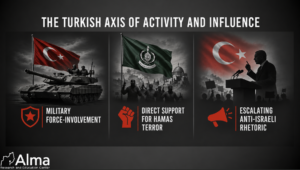
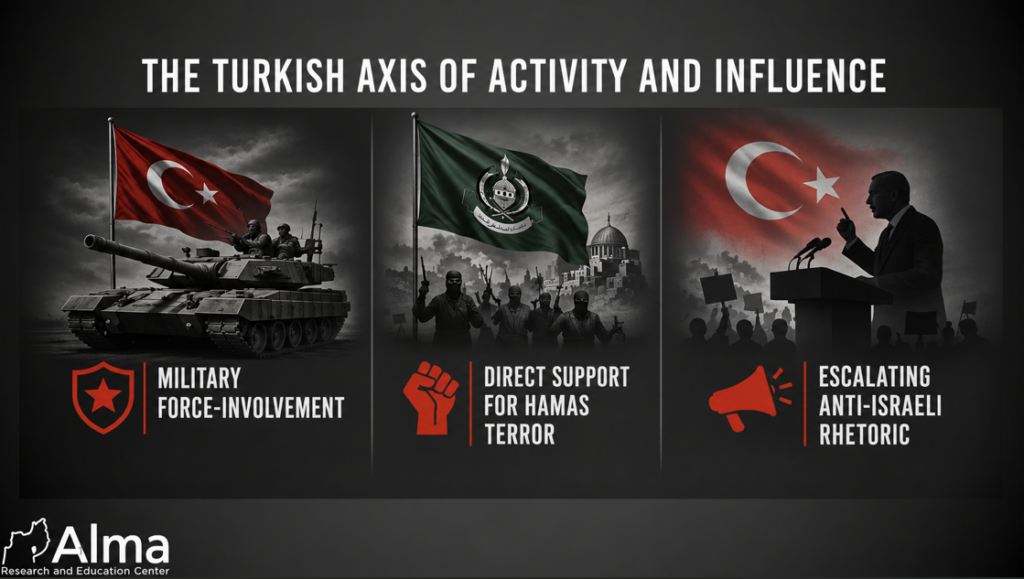
Turkey’s moves between October and November 2026 illustrate a systematic effort to establish a contiguous belt of strategic influence across three fronts surrounding Israel: in Syria, Ankara is acting to institutionalize high-level security and diplomatic coordination with the Damascus government while demanding the completion of the dismantling of the Syrian Democratic Forces by the end of 2026; in Lebanon, it is preparing an effort to fill the security vacuum expected with the end of UNIFIL’s mandate in 2027 through military training agreements, direct diplomatic contacts in Beirut, and proposing a military presence in the south of the country; and in the Palestinian arena, it is upgrading its status from a host of Hamas’s leadership to a direct intelligence and diplomatic coordinating actor surrounding the ceasefire and day-after arrangements in Gaza.
On the one hand, Turkey is engaged in building institutional leverage vis-à-vis states (Syria and Lebanon) and dialogue vis-à-vis Washington. On the other hand, it preserves non-state assets, including Hamas’s leadership in Istanbul, and apparently does not oppose the continued existence of Hezbollah as an armed force serving as a regional counterweight against Israel.
In the coming months, two decisive questions will be put to the test: whether Ankara will succeed in translating its diplomatic presence in Lebanon into an actual military role during 2027, and whether continued Turkish entrenchment in Syria and Lebanon, alongside the security zones held by Israel, will lead to direct escalation that will test the deconfliction mechanism between Jerusalem and Ankara.
Sources