By: Tal Beeri and Dvir Peri
Ali Shoeib functioned as both an intelligence asset and operative for Hezbollah during the intelligence preparations for a planned invasion of the Galilee between 2020 and 2023 and later continued to provide real-time intelligence throughout the 2023–2024 war, the subsequent ceasefire, and the renewed phase of fighting in March 2026.
A thorough analysis of Hezbollah’s communications apparatus, both official and unofficial, reveals that it does not function as a conventional journalistic system, but rather as a coordinated and structured cognitive system operating as an integral component of the organization’s force-building efforts. Hezbollah’s official media outlets, together with platforms affiliated with it to varying degrees, serve as key instruments for propagating the “resistance” narrative, shaping public opinion, and securing cognitive advantages across the Lebanese, regional, and international arenas.
Accordingly, many media personnel operating within these frameworks do not function as neutral journalists, but rather as “Cognitive Assets,” propaganda mouthpieces, facilitators, and de facto Hezbollah operatives—who contribute to advancing the organization’s missions and objectives while carrying out operational activity on its behalf.
Within Hezbollah’s media system (see appendix), there is a distortion between official and unofficial bodies. This distortion naturally contributes to obscuring the identity of the “journalist” as a full-fledged Hezbollah operative and creates the appearance of a legitimate media professional performing journalistic work.
Hezbollah’s media system includes two central bodies: the Al-Manar television channel and Al-Nour radio, both defined by the U.S. Treasury as Hezbollah media arms, noting that they are fully owned and controlled by Hezbollah and assist its activities.
The media personnel of Al-Manar and Al-Nour belong to Hezbollah, receive salaries from the organization, and are effectively considered Hezbollah operatives.
It should be noted that not all Hezbollah operatives wear uniforms. Moreover, in recent years Hezbollah operatives have avoided wearing uniforms during operational activity in order to maintain secrecy and a low signature. As of this writing, many Hezbollah operatives in general, and Radwan Unit operatives in particular, who are attempting to fight IDF forces in southern Lebanon, do not wear uniforms but rather civilian clothing.
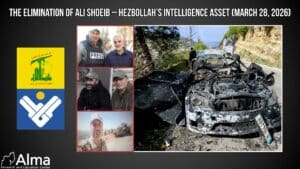
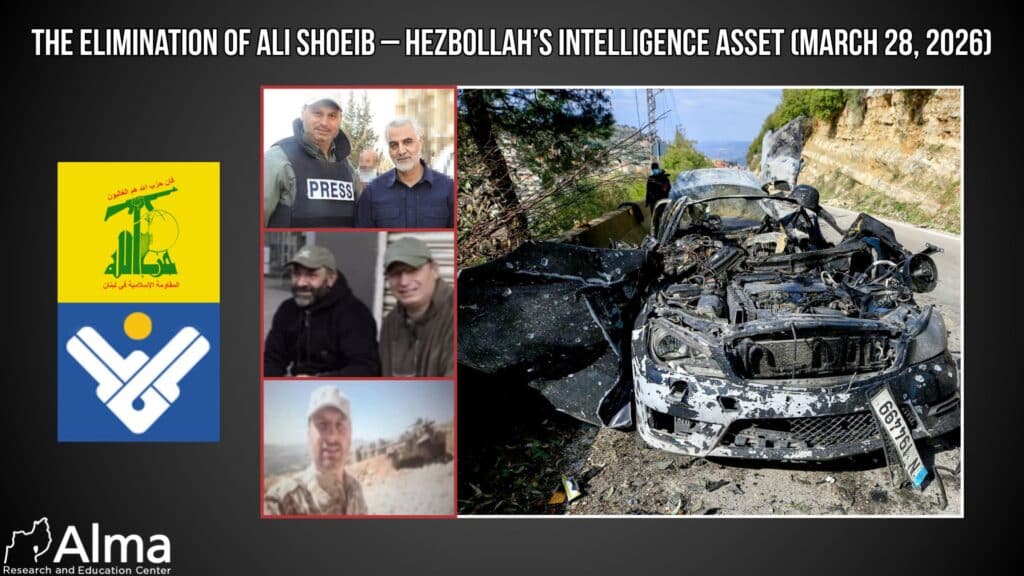
The most prominent example of a propaganda mouthpiece, cognitive provocateur, and Hezbollah intelligence operative is Ali Shoeib, a correspondent for Al-Manar and Al-Nour, who was eliminated on March 28, 2026, while traveling in his vehicle in the Jezzine area in southern Lebanon, together with Al-Mayadeen reporter Fatima Fattouni and an Al-Mayadeen cameraman (her brother).
Ali Shoeib was born on September 8, 1970, in the town of Al-Sharqiyah near Nabatiyeh. The Shoeib family is the largest family in the town, numbering hundreds of people. Professionally, Ali Shoeib was a field correspondent in southern Lebanon for Al-Manar television and also worked for Al-Nour radio.
Shoeib was considered Hezbollah’s “house correspondent” in southern Lebanon for at least 25 years. Over the years, he became a social media figure through his accounts, primarily on Twitter (which was frequently shut down), thanks to his reports and coverage of events and clashes along the Israel–Lebanon border, reporting in very close proximity to IDF forces.
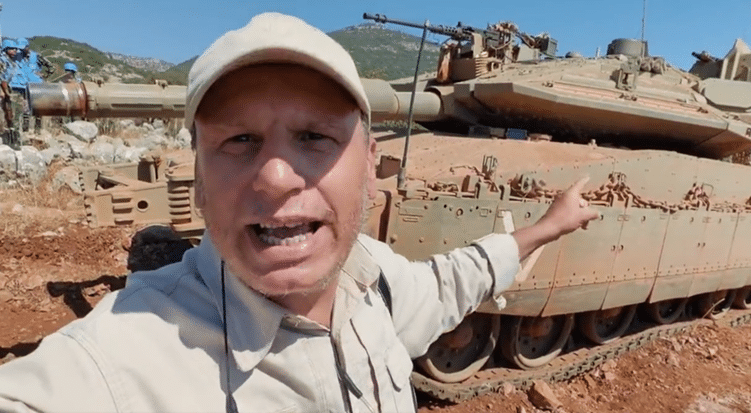
One notable example was on September 26, 2023, when he filmed himself within touching distance of an Israeli Merkava tank in the Shebaa Farms – Mount Dov area.
Shoeib also reported extensively from Syria during the civil war and enjoyed high access to Hezbollah activity on Syrian soil and was even photographed there wearing Hezbollah military uniforms.
Ali Shoeib was not a regular journalist. He was an important “mouthpiece” in the service of Hezbollah’s cognitive apparatus, inciting against IDF forces and Israeli civilians and significantly influencing Hezbollah’s propaganda system. On his Twitter page, he directly published announcements and documentation of Hezbollah terrorist operations against Israeli civilians.
Moreover, Ali Shoeib served for many years as a Hezbollah facilitator, mainly in the intelligence field. In 2020, Shoeib was formally recruited as an operative in Hezbollah’s military wing. However, Shoeib had been collecting intelligence in the border area for many years even prior to his formal recruitment. He also served as a contact point for individuals interested in cooperating with Hezbollah against Israel.
We assess that his formal recruitment in 2020 was not coincidental. This was the year in which Hezbollah, particularly the Radwan Unit, began significant operational preparations for an invasion of the Galilee following the return of its operatives from Syria and their deployment in southern Lebanon.
Shoeib’s physical access, intimate familiarity, and activity in the border area constituted a very significant intelligence asset for Hezbollah’s intelligence preparations in general, and for the Radwan Unit in particular, for the invasion. Many Radwan Unit operatives, despite being deployed in southern Lebanon, were not familiar with the terrain, especially the contact line and border area, as Shoeib was.
This intimate familiarity with the area was critical for planning the invasion of the Galilee.
Shoeib was frequently present and toured the border area with Israel, reporting, photographing, and collecting intelligence on developments in general and on IDF activity in particular. The information, which included images and videos of high operational/intelligence value for Hezbollah, was transferred to the organization’s intelligence apparatus and to the Radwan Unit, which was operationally preparing to carry out the invasion of the Galilee.
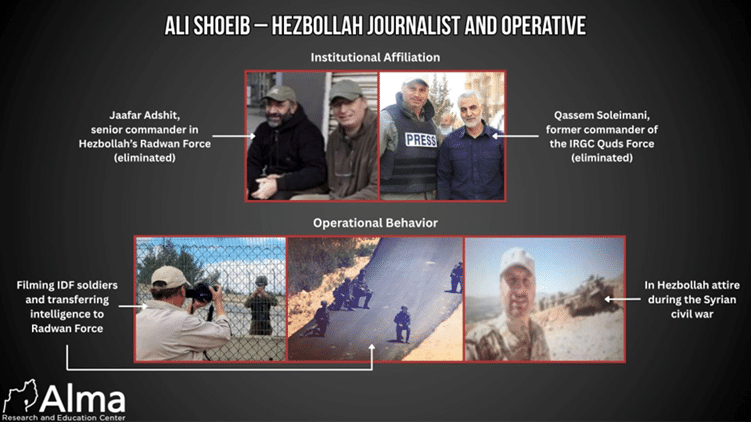
Within the framework of the 2023–2024 war, the ceasefire, and the renewal of the current campaign (March 2026), Shoeib continued to be of intelligence value while maintaining his access to southern Lebanon and the contact line. Ali Shoeib continued to provide Hezbollah with visual intelligence, exposed the locations of IDF soldiers in southern Lebanon and along the border, maintaining continuous contact with Hezbollah forces fighting on the ground.
Ali Shoeib also functioned as an intermediary in Hezbollah’s efforts to recruit collaborators inside Israel. For instance, in 2006, an indictment was filed in an Israeli court against a Ghajar resident, Mahmoud Shaaban Mohammed Khatib, for providing information on IDF training and operational plans to Ali Shoeib, who subsequently linked him to a Hezbollah handler known as “Abu-Mohammed,” who maintained telephone contact with him to obtain the intelligence.
Additionally, in March 2019, an indictment was filed against an Israeli citizen from Umm al-Fahm named Mahmoud Jabran, who initiated contact with Ali Shoeib in order to assist Hezbollah against Israel.
We assess that Hezbollah’s Unit 1800 was behind this activity, and that Shoeib served as one of its facilitators. Unit 1800, also known as the “Lebanon-Palestine Operations Unit,” was involved in planning and carrying out attacks inside Israel using Palestinians and Arab citizens of Israel. Among other things, the unit is responsible for recruiting agents from among Israeli Arabs.
On March 30, 2026, the IDF carried out a strike in Beirut eliminating Hamza Ibrahim Rakin, the deputy commander and operations officer of Unit 1800. The unit is currently tasked with coordinating Hezbollah’s activities with Palestinian terrorist organizations across Lebanon, Gaza, Syria, and Judea and Samaria. It has also been responsible for facilitating the deployment of Palestinian operatives from these groups to engage IDF forces in southern Lebanon.
Appendix – Hezbollah’s Media System:
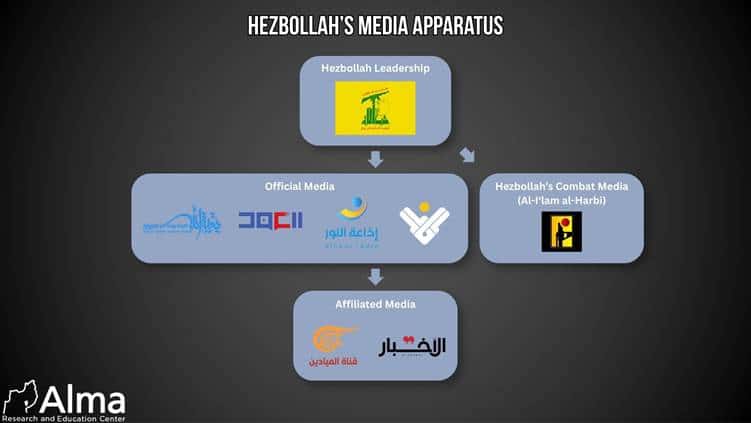
Official Hezbollah Media Outlets:
Al-Manar (قناة المنار) – This is Hezbollah’s official television mouthpiece, founded in 1990, and as noted, under U.S. sanctions since 2006. Among the various media platforms, it maintains the closest direct ties to Hezbollah. On Al-Manar’s homepage, the central and constant theme is Hezbollah, alongside ongoing coverage of the “resistance axis” under unequivocally pro-Hezbollah branding.
Al-Nour (اذاعة النور) – Hezbollah’s official radio station, founded in 1988, with some of its broadcasts shared with Al-Manar, as both operate under the “Lebanese Media Group” (المجموعة اللبنانية للاعلام ش.م.ل). Alongside Al-Manar, its affiliation with Hezbollah is very direct. Al-Nour presents a full news-political-religious broadcasting system, and its schedule includes several daily live broadcasts of Al-Manar’s news editions, as well as live broadcasts of speeches by Hezbollah leadership, including direct content from the Secretary-General and senior leadership. Al-Nour is not merely another pro-Hezbollah media outlet, but a force multiplier, alongside Al-Manar, continuously disseminating the organization’s messaging line.
Al-Ahed (العهد الاخباري) – Presents itself as a “reliable” news website covering Lebanese, regional, and international news, but in practice its content reflects an ideological line aligned with Hezbollah. Even if not formally part of the organization, the outlet, founded in 1984 and now operating solely as a website, regularly publishes direct Hezbollah statements, and its opinion section features articles that justify and praise Hezbollah’s strategy and positions. Al-Ahed is actually a cognitive and propaganda platform supportive of Hezbollah, in which some senior writers function as “mouthpieces” of the organization, even if formal affiliation cannot always be proven.
Baqiatollah (مجلة بقية اللة) – Hezbollah’s ideological-educational magazine, founded in 1991. It primarily deals with creating religious, cultural, and educational legitimacy for Hezbollah’s value system, such as martyrdom (shahada) and jihad, alongside glorifying the organization’s leadership. It publishes content on “Wilayat al-Faqih” (rule of the jurist) and interviews with senior clerics aligned with the Iranian–Hezbollah Shiite line. This is a distinctly ideological Hezbollah platform; beyond disseminating values rather than reporting news, it integrates justification for religious armed struggle, thereby creating a cognitive infrastructure, particularly within the Shiite community.
Hezbollah’s Combat Media:
Hezbollah’s Combat Media unit (“Al-I’lam al-Harbi”) is responsible for media documentation of Hezbollah’s military activity. It is directly subordinate to Hezbollah’s military wing.
Combat Media operatives are an integral part of Hezbollah’s military activity and are responsible for publishing images and videos from this activity. As a result, they are partners throughout the entire operational planning process.
The combat Media unit publishes Hezbollah’s formal statements claiming responsibility after operations.
Media Outlets Affiliated with Hezbollah:
Al-Akhbar Newspaper (جريدة الاخبار), established in 2006, is one of the most popular newspapers in Lebanon. Although it presents itself as an independent media outlet with a pan-Arab leftist orientation, analysis of its content indicates that its coverage consistently aligns with the Iranian axis and Hezbollah. The newspaper provides extensive coverage of Hezbollah’s activities and frequently uses terminology associated with the “resistance” narrative, framing Hezbollah as a legitimate actor in the Lebanese and regional arenas.
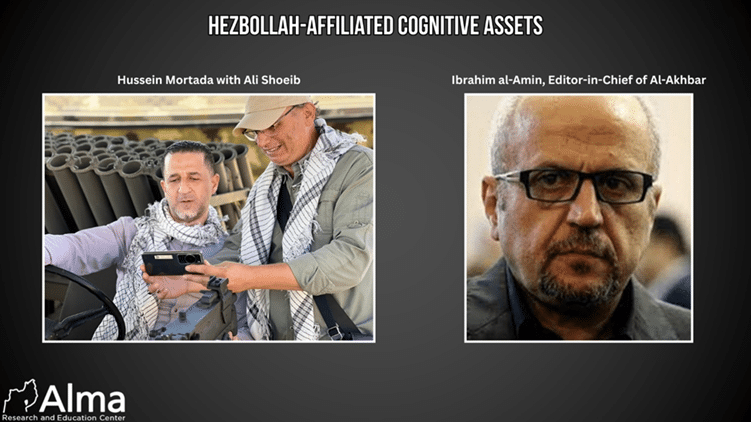
Its editor-in-chief, CEO, and founder, Ibrahim al-Amin, is closely connected to senior figures in the organization, and the newspaper effectively serves as an additional media arm of Hezbollah. Al-Akhbar articles and al-Amin’s columns on current affairs in Lebanon and the region are considered a “mouthpiece” for Hezbollah’s official positions, making the organization’s narrative accessible to the Lebanese public; for this reason, he is referred to as an “agent of Wilayat al-Faqih.”
Al-Mayadeen (الميادين), founded in 2012, is a news channel often viewed as having succeeded the Iranian Al-Alam network. While it presents itself as an independent pan-Arab outlet, in practice it consistently aligns with the Iran–Hezbollah axis and promotes the “resistance” narrative. The channel delivers extensive, continuous, and sympathetic coverage of Hezbollah’s activities, leadership, and military structure, employing ideological language akin to that used by Al-Manar. It regularly features commentators, spokespersons, and Hezbollah figures associated with this axis, and frames regional geopolitical developments—particularly conflicts involving Israel and the United States—in line with Hezbollah’s strategic perspective.
Unlike Al-Manar, Al-Mayadeen is not perceived as an official Hezbollah outlet but operates as a sophisticated external “mouthpiece”—one that expands Hezbollah’s messaging reach to broader audiences than Al-Manar, in the Arab and international spheres. In this way, Al-Mayadeen fulfills a complementary role in Hezbollah’s cognitive system—not as a direct organizational mechanism, but as an ideologically aligned platform assisting in disseminating its narrative at the regional level.
Among the founders of Al-Alam was Hussein Mortada. Mortada is a Lebanese journalist who has operated throughout his career in close alignment with the Shiite axis of Iran and Hezbollah. He began his career at the “Voice of the Oppressed” station and later was among the founders of the Iranian Al-Alam channel and even managed its Damascus bureau—roles that placed him at the heart of the Shiite axis media system. During the Syrian civil war, Mortada closely accompanied Assad regime forces, which he admired, as well as pro-Iranian militias and Hezbollah.
Hussein Mortada has also been documented directly taking part in combat in Syria, dressed in uniform and bearing arms. Despite presenting himself today as an “independent journalist,” his output is marked by incitement, provocation, and sectarian rhetoric, and has served as part of the cognitive warfare efforts supporting the Shiite axis and Hezbollah. Mortada has garnered considerable popularity among Hezbollah supporters, while also attracting strong criticism from his critics, and in practice has continued over the years to function as an unofficial mouthpiece for Hezbollah.
Sources:
https://home.treasury.gov/news/press-releases/js4134
https://x.com/LTC_Shoshani/status/2038263185883492856?s=20
https://x.com/sahar_ghaddar/status/2037918341969420630?s=20
https://x.com/AlahedAr/status/2038370722481934725?s=20
https://israel-alma.org/ibrahim-al-amin-the-unofficial-spokesman-for-the-hezbollah-leadership/
https://lebanon.mom-gmr.org/en/owners/individual-owners/detail/owner/owner/show/ibrahim-al-amine-5/
https://x.com/cheib1970?s=20
https://alahednews.news/post/95376/%D9%87%D9%8A%D8%A6%D8%A9-%D8%A7%D9%84%D8%A5%D8%B9%D9%84%D8%A7%D9%85-%D9%81%D9%8A-%D8%AD%D8%B2%D8%A8-%D8%A7%D9%84%D9%84%D9%87-%D8%AA%D9%86%D8%B9%D9%89-%D8%B4%D9%87%D9%8A%D8%AF-%D8%A7%D9%84%D8%A5%D8%B9%D9%84%D8%A7%D9%85-%D8%A7%D9%84%D9%85%D9%82%D8%A7%D9%88%D9%85-%D8%A7%D9%84%D8%AD%D8%A7%D8%AC-%D9%85%D8%AD%D9%85%D8%AF-%D8%B4%D8%B1%D9%8A
https://x.com/mortadapress?s=20
https://www.almayadeen.net/
https://www.al-akhbar.com/
https://baqiatollah.net/
https://alahednews.news/
https://www.almanar.com.lb/
https://x.com/alnourradio?s=20
https://x.com/NewpressPs/status/1706637984726921236?s=20