The Iranian Arena
In the past 24 hours, extensive strikes were reported across Iran, focusing on regime infrastructure and sites used for the research, development, and production of weapons. In Tehran, several targets were struck, including a site for the development of critical components for ballistic missiles, a facility for the production of engines for unmanned aerial vehicles, as well as a complex belonging to the military industries of the Islamic Revolutionary Guard Corps, which was used for research and development of ballistic missile systems and satellite launchers.
In addition, a building belonging to SA-Iran (Iran Electronics Industries), which operates under the Iranian Ministry of Defense, was also struck.
Earlier today, the Imam Hussein University complex, the main military academic institution of the Islamic Revolutionary Guard Corps, which also serves as an emergency asset for the regime’s military bodies, was also struck.
In other areas, strikes were reported in Tabriz, where a petrochemical plant was hit, as well as in Karaj, Yazd, Qom, the Kurdistan region, Bandar Abbas, Parchin, and Kish Island. Alongside this, widespread power outages were reported following damage to electrical facilities in Tehran and Alborz provinces.
Iranian opposition sources claimed that during the night, several bank branches across Tehran were struck, as well as the offices of the Qatari television network Al-Araby in the city.
At the same time, according to a report in The New York Times, more than 50,000 American special forces have entered the Middle East region.
Elimination
Iranian opposition sources reported the elimination of Hassan Hassanzadeh, commander of the Rasul-Allah Corps—the security unit of the Islamic Revolutionary Guard Corps in Tehran.
In addition, Iranian media reported that General Majid Zakariaei, commander of Iran’s Natural Resources Protection Forces, who was injured in a strike on March 28, died of his wounds.
Iranian Activity in the Region:
Kuwait – A missile attack on a military base was reported, in which ten soldiers from the Kuwaiti army were injured. In addition, an Indian worker was killed in a strike on a desalination facility and a power plant in the country.
Bahrain – Interceptions were reported in the country’s airspace.
United Arab Emirates – A UAV strike was reported. The UAE Ministry of Defense stated that in the past 24 hours, 11 missiles and 27 UAVs launched from Iran were intercepted. Since the beginning of the war, 425 ballistic missiles, 15 cruise missiles, and 1,941 UAVs have been launched toward the UAE.
The Iranian news agency “Fars” published a list of 23 universities in Israel, Lebanon, Iraq, Qatar, the United Arab Emirates, and Kuwait that may serve as potential targets for attack, following strikes carried out against academic institutions in Iran.
Iraq
It was reported that convoys of Iraqi Shiite militias from the Popular Mobilization Forces entered the city of Abadan in western Iran, opposite the Iraqi city of Basra, in order to assist the Iranian regime in consolidating its power. In addition, it was reported that the organization has begun transferring large sums of money to Iran, along with quantities of gold.
A strike using an Iranian suicide UAV against Victoria Base in Baghdad was reported, which resulted in damage to an Antonov 132 aircraft of the Iraqi Air Force.
The Israeli Arena
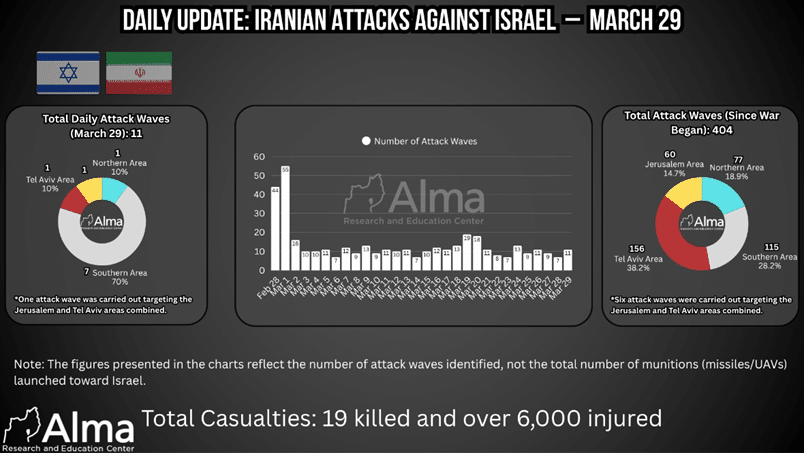
On March 29, 11 Iranian attack waves against Israel were identified, carried out using ballistic missiles. This figure reflects a continued steady pace of attacks.
Geographically, the attacks were distributed across several key areas:
7 attack waves (approximately 70%) were directed at southern Israel,
one attack wave (approximately 10%) targeted the Tel Aviv area,
and one additional attack wave (approximately 10%) targeted the northern region.
In addition, one attack wave was jointly directed at both the Tel Aviv and Jerusalem areas.
During the attacks, impacts were recorded in the civilian sphere, including damage to a factory in southern Israel belonging to a company specializing in the production and development of plant protection solutions. This strike highlights the impact on economic and civilian infrastructure as well.
Since the beginning of the campaign, a total of 404 Iranian attack waves against Israel have been identified. In cumulative distribution, the central region—particularly the Tel Aviv metropolitan area—continues to be the primary target, alongside a significant focus on southern Israel.
An examination of the trend indicates a continued consistent pattern of operation, combining a focus on central areas with broad geographic dispersion, as part of an ongoing effort to exert pressure on the Israeli home front.
Since the beginning of the war, 19 civilians have been killed in Israel as a result of Iranian fire, and more than 6,000 people have been injured to varying degrees due to direct hits, falling interception debris, and secondary damage. In addition, more than 6,000 Israelis have been evacuated from their homes due to damage to residential buildings caused by missile impacts.
The continued fire is causing extensive damage to residential buildings, civilian infrastructure, and daily life in Israel.
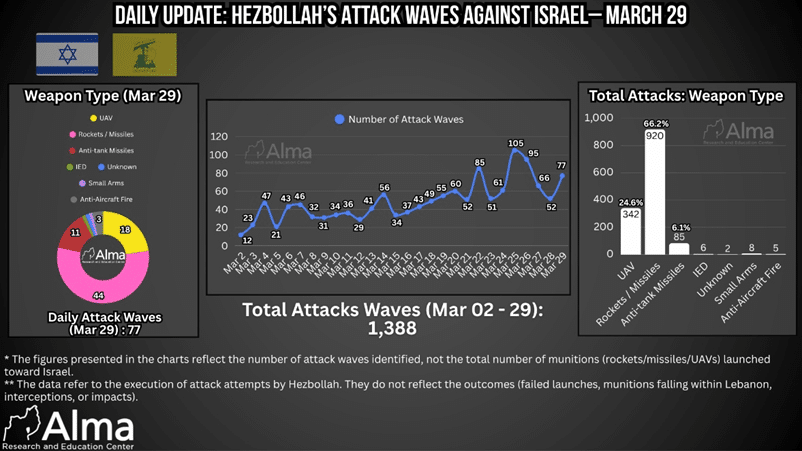
On March 29, 77 Hezbollah attack waves against Israel were identified, indicating continued high-intensity activity.
In terms of the types of weapons used, most of the attacks were carried out using rockets and missiles (44 waves), alongside 18 attack waves using UAVs, as well as the use of additional means including anti-tank missiles, anti-aircraft missile fire, explosive devices, small arms fire, and unidentified means.
Geographic distribution of the attacks:
24 attacks (approximately 31%) were directed at border communities within a range of 0–5 km.
3 attacks (approximately 3.9%) were directed at a range of 5–10 km—Nahariya and the Upper Galilee.
5 attacks (approximately 6.5%) were directed at a range of 10–30 km—Safed, Rosh Pina, Tiberias, the Lower Galilee, and the Golan.
One attack (approximately 1.3%) was directed at a range of 60–70 km—the Sharon area.
In addition, 44 of the attacks were carried out within Lebanon against IDF forces operating against Hezbollah, for which the organization claimed responsibility. These attacks were conducted using a combination of indirect fire (rockets), anti-tank missiles, UAVs, an anti-aircraft missile, and explosive devices.
Hezbollah continues to combine attacks toward the civilian rear in Israel with a focused effort to target IDF forces in Lebanon. However, even when the organization presents the attacks as directed at military targets, in practice they are often imprecise and also hit civilian communities.
Since Hezbollah joined the fighting on March 2, a total of 1,388 attack waves against Israel have been identified, with the trend indicating continued intensive offensive activity and sustained pressure on the Israeli home front.
So far, 6 soldiers and 2 civilians have been killed as a result of Hezbollah fire.
Lebanon and Hezbollah
In the political arena, Agence France-Presse reported, citing an Iranian diplomatic source, that Iran’s ambassador to Beirut, Mohammad Reza Shibani, is expected to remain in Lebanon despite instructions from the Lebanese Ministry of Foreign Affairs to leave the country following the cancellation of his appointment. According to the source, his decision to remain, and effectively entrench himself in the embassy, was made in response to the request of Parliament Speaker Nabih Berri and Hezbollah, who called on Lebanese authorities to reverse their decision.
In this context, former Lebanese ambassador to Washington Antoine Chedid argued that since the ambassador did not comply with the Lebanese government’s request to leave, his diplomatic status as a “persona non grata” effectively nullifies his personal immunity. According to him, the ambassador remains inside the Iranian embassy, which enjoys diplomatic immunity, but that immunity does not apply to him personally. In contrast, a spokesperson for the Iranian Ministry of Foreign Affairs stated that the embassy in Lebanon continues to operate as usual and that the ambassador will continue in his role in accordance with understandings reached with relevant Lebanese actors.
Lebanese Foreign Minister Youssef Raji participated in a meeting of the Arab League Council, which addressed Iranian violations of the sovereignty and territorial integrity of Arab states. In his remarks, Raji emphasized Lebanon’s condemnation of Iranian violations and stated that such conduct exceeds accepted international norms and requires unequivocal condemnation. He also expressed Lebanon’s support for Arab states and their citizens in light of the developments.
Mohammad Raad, head of the “Loyalty to the Resistance” bloc, published a condolence letter following the deaths of Ali Shuaib, Fatima Fattouni, and Mohammad Fattouni. In his letter, he described their deaths as a sacrifice in exposing the “truth” and Israel’s crimes, and praised media outlets identified with Hezbollah, including Al-Mayadeen, Al-Manar, and Radio Al-Nour. According to him, their deaths are part of a broader struggle whose outcomes will be reflected in the future.
In Baalbek, a rally of solidarity and condemnation was held, organized by Hezbollah’s media department in the Beqaa region, alongside the funerals of the dead. The event was attended by Member of Parliament Ibrahim al-Moussawi, local officials, and media personnel. In his speech, al-Moussawi argued that condemnations alone are insufficient and directed criticism toward international institutions, the European Union, and Western states for failing to act against Israel. He also criticized Lebanese figures who have criticized Hezbollah and called on state authorities to avoid concessions, not to negotiate under fire, and to demand the implementation of existing agreements.
In additional speeches at the rally, Deputy Mayor of Baalbek Abd al-Rahim Shalha described the strike as part of Israeli aggression against civilians, while the head of the “Baalbek Media Forum,” Hikmat Sharif, claimed that Israel targets journalists in order to obscure the truth.
UNIFIL confirmed that a soldier of Indonesian origin was killed and another seriously wounded in an explosion at a position near the village of Adshit al-Qusayr in southern Lebanon, during heavy exchanges of fire between the IDF and Hezbollah. UN Secretary-General António Guterres condemned the incident, stating that he is shocked by the harm to those serving the cause of peace. At this stage, the circumstances of the incident remain under investigation.
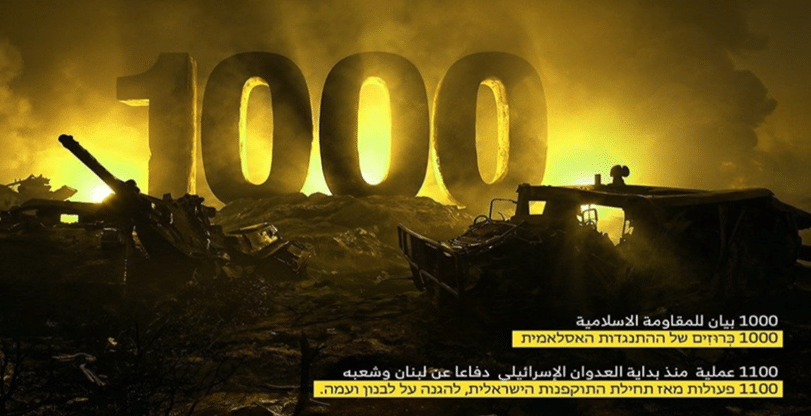
In the public sphere Hezbollah published a visual featuring the number “1000,” intended to highlight a cumulative achievement and emphasize the scope of the organization’s activity during the fighting. The number refers to one thousand official statements issued by the organization regarding attacks, alongside a reference to more than 1,100 operations carried out since the beginning of the war.
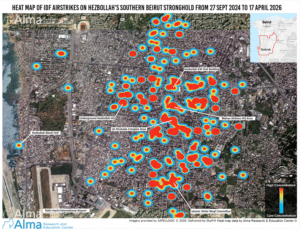
During March 30, Israeli military activity in Lebanon continued, both in the southern suburb of Beirut (Dahieh) and in southern Lebanon. It was reported that IDF forces reached the Litani River.
Syria
Over the past 24 hours, the Syrian army located two cross-border tunnels along the Syria–Lebanon border that were used by Hezbollah for smuggling.
The Syrian army issued a statement saying that in the early morning hours, several UAVs were launched toward its bases along the border with Iraq, most of which were intercepted.
The International Arena
Dr. Anwar Gargash, advisor to the ruler of the United Arab Emirates, called for guarantees and compensation from Iran for the damage caused by the war. According to him, any political solution addressing Iranian aggression toward the Gulf states must include clear mechanisms to prevent the recurrence of future aggression, alongside the anchoring of the principle of non-aggression. He further emphasized that any future arrangement must include compensation from Iran for damage to civilian facilities, critical infrastructure, and civilians.
Gargash added that Iran misled its neighbors prior to the war regarding its intentions and ultimately revealed premeditated aggression, despite the sincere efforts of Gulf states to avoid escalation. According to him, this reality necessitates reliance on guarantees and compensation as an integral part of dealing with a regime perceived as the primary threat to Gulf security.
Saudi Arabia strongly condemned the Iranian attack on a military camp belonging to the Kuwaiti armed forces, as well as on a power station and a desalination facility in Kuwait.
In addition, it was reported that Spain decided to close its airspace to American aircraft participating in strikes on Iran.