The Iranian Arena
Over the past 24 hours, widespread waves of strikes have been reported across Iran, with a focus on the Tehran area. The strikes targeted headquarters, sites related to the ballistic missile array, and additional regime infrastructure. The IDF also struck positions of the Basij unit and a maintenance center belonging to the General Logistics and Support Department of the Internal Security Forces. In addition, damage to air defense systems was reported.
Earlier today, a strike was carried out on four sites at the “Asaluyeh” gas facilities in the Bushehr area. The target was only partially hit, and the strike was conducted in coordination with the United States. The strike disabled most of Iran’s gas production. Following the strike, the flow of gas from Iran to Iraq was halted.
At the same time, strikes were also reported in the cities of Shiraz and Karaj.
According to a report by the International Atomic Energy Agency (IAEA), a missile struck near the nuclear power plant in Bushehr; however, no damage was caused to the facility.
The United States military struck missile sites near the Strait of Hormuz using bunker-busting bombs weighing approximately 2.5 tons.
Targeted Eliminations
As part of the strikes, the Minister of Intelligence of the Islamic Republic, Esmail Khatib, was eliminated.
According to reports, in the strike in which Ali Larijani was eliminated (March 17), his son Morteza Larijani was also eliminated, along with his head of security, Vahid Fateminia.
In addition, it was reported that Qasem Karishi, Deputy Commander of the Basij of the Islamic Republic, was eliminated in strikes carried out earlier this week.
Iran Attacks Targets in the Middle East
Over the past 24 hours, a series of attacks and threats by Iran against Gulf states have been reported, alongside defensive responses and interceptions.
In the United Arab Emirates, attacks were recorded in Dubai. The UAE Ministry of Defense reported that since the beginning of the conflict, more than 2,000 weapons have been launched at the country from Iran, including approximately 1,700 UAVs.
In Saudi Arabia, additional attacks were reported, and according to reports, the United States embassy was targeted.
In Qatar, attacks were reported in Doha.
In Bahrain, attacks were reported against U.S. military bases.
Following the strike on gas infrastructure in “Asaluyeh,” Iran is issuing threats and warnings of intent to target energy infrastructure in Qatar, Saudi Arabia, and the United Arab Emirates.
Iraq
Another attack was carried out against the United States embassy in Baghdad. According to reports, a fire broke out within the embassy compound.
The Israeli Arena
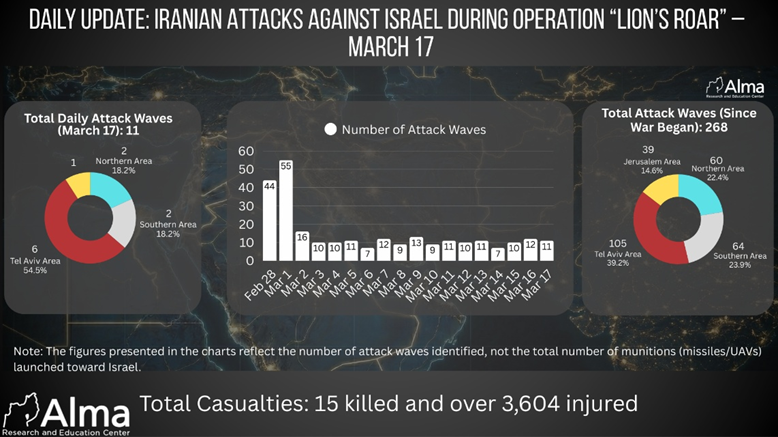
On March 17, 11 waves of Iranian attacks against Israel were identified, using ballistic missiles. Geographically, most of the attacks were directed at the Tel Aviv area, which sustained 6 waves of attacks (54.5%). In addition, 2 waves were recorded in the north (18.2%), 2 waves in the south (18.2%), and one wave (9.1%) in the Jerusalem area.
Since the beginning of the campaign, a total of 268 Iranian attack waves against Israel have been identified. In the cumulative geographic distribution of all attacks, the central region—particularly the Tel Aviv metropolitan area—continues to be the primary target, with 105 attack waves (39.2%). This is followed by the southern region with 64 attack waves (23.9%), the northern region with 60 waves (22.4%), and the Jerusalem area with 39 attack waves (14.6%).
An analysis of the daily trend indicates that after the peak recorded at the beginning of the campaign (44 attack waves on February 28 and 55 waves on March 1), there has been relative stabilization in the rate of attacks, averaging approximately 10–11 attack waves per day. This pattern reflects a shift from high-intensity activity at the outset of the campaign to a sustained rate of attacks characterized by a war of attrition.
Since the beginning of the war, 15 civilians in Israel have been killed, and more than 3,604 people have been injured to varying degrees as a result of direct hits, interception debris, and secondary damage. In addition, significant damage has been caused to residential buildings and civilian infrastructure.
The data indicates that Iran continues to combine a focus on central Israel with a broad geographic dispersion of attacks, including the south, north, and the Jerusalem area, with the aim of expanding the threat space, complicating a return to routine, and maintaining sustained pressure across all parts of the country. This pattern suggests that at the current stage, Iran is operating within an attrition strategy based on a sustained rate of attacks over time.
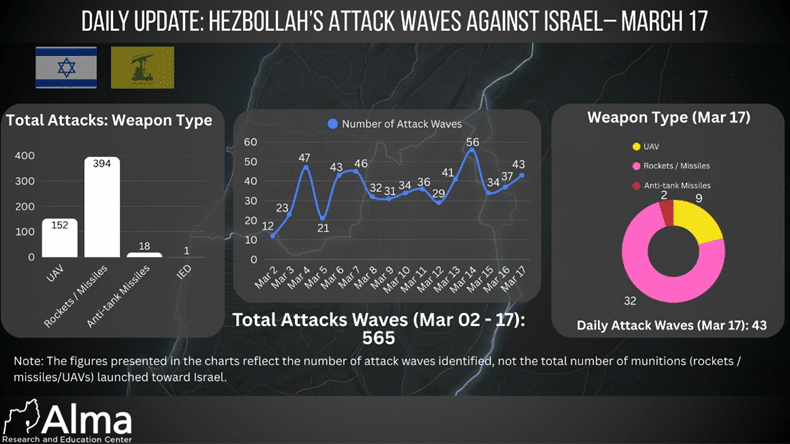
On March 17, 43 Hezbollah attack waves against Israel were identified. In terms of types of weaponry, 32 attack waves (approximately 74.4%) were carried out using rockets and missiles, 9 attack waves (approximately 20.9%) using UAVs, and 2 attack waves (approximately 4.7%) using anti-tank missiles.
The data refers to the number of identified attack waves, not to the total number of munitions actually launched.
Most of the attacks were directed at border communities and the Galilee. In addition, 17 of the attacks during the day were directed against IDF forces operating in southern Lebanon, a figure indicating a significant Hezbollah effort in this arena. These attacks were carried out using a combination of indirect fire, anti-tank missiles, and UAVs, and are based on Hezbollah’s claims of responsibility.
It should also be noted that last night Hezbollah carried out a significant barrage toward northern communities and even south of Haifa, which included dozens of rockets and missiles alongside several UAVs.
Since Hezbollah joined the fighting on March 2, a total of 565 attack waves against Israel have been identified. An analysis of the types of weaponry indicates that rockets and missiles continue to be the primary means of attack, with 394 attack waves, alongside 152 attack waves using UAVs, 18 attacks using anti-tank missiles, and one IED attack (an event based on Hezbollah’s claim of responsibility).
An analysis of the daily trend indicates a renewed increase in the scope of attacks. Following a peak in activity recorded on March 14 (56 attack waves), and a decrease to 34 attack waves on March 15, the number rose again to 43 attack waves on March 17.
The daily trend reflects fluctuations in the volume of attacks, with shifts between high-intensity days and more moderate ones. However, from a cumulative perspective, a relatively stable rate of activity is maintained, converging around an average of approximately 35 attack waves per day.
Lebanon and Hezbollah
Lebanese President Joseph Aoun held a security meeting today (March 18) at Baabda Palace, attended by the Minister of Defense, the Minister of Interior, the Army Commander, and the heads of all security agencies. During the meeting, situation assessments were presented regarding the expansion of Israeli strikes from southern Lebanon to the Beqaa, Beirut, and the Dahieh, along with their implications—casualties, injuries, damage to infrastructure, and continued population displacement.
In addition, the situation along the Lebanon–Syria border, coordination with the Syrian regime, and the issue of Syrian refugees were discussed, with approximately 100,000 reportedly having returned to Syria.
The Political Arena:
Within Lebanon’s political system, a deep disagreement is emerging regarding President Aoun’s initiative to promote negotiations with Israel. Parliament Speaker Nabih Berri continues to oppose the move in practice, primarily over the issue of Shiite representation in the delegation. At the same time, there are broad disagreements over whether negotiations should be conducted under fire or conditioned on a prior ceasefire. Some actors also express a preference for a military solution over a diplomatic track.
Government Measures Against Hezbollah:The Lebanese government is working to advance legal measures against Hezbollah, including opening legal cases against the organization’s operatives. There is a noticeable trend toward a tougher policy by the military prosecution, alongside attempts to expand investigations to reach decision-makers. In parallel, according to reports, activities are (allegedly) being carried out to locate and seize rockets and weapons.
Hezbollah – Internal Messaging and Escalation of Rhetoric: Hezbollah Secretary-General Naim Qassem published a letter to the organization’s commanders and operatives, containing messages of encouragement and morale-boosting. The letter emphasized the organization’s “righteous path” in the confrontation with Israel, using familiar slogans such as “victory or martyrdom” and “honor over humiliation.”
The struggle against Israel and the United States was presented as a moral and necessary act to defend freedom and dignity, and the organization was described as being in a “legitimate defensive position.” Operatives were portrayed as people of faith and courage, with an emphasis on readiness for sacrifice up to “victory or martyrdom.” Qassem also stressed continued loyalty to Iran and its Supreme Leader, as well as the continuation of the path of the organization’s past leaders.
At the same time, there has been an escalation in Hezbollah’s threatening rhetoric toward political opponents. Figures within the organization, led by Mahmoud Qamati, Deputy Head of Hezbollah’s Political Council, have issued direct threats against government figures. There is an increasing use of language involving “treason” and intimidation, alongside reports of internal activity that includes attempts to deter media outlets and the collection of resources on the ground.
Hezbollah Civilian Activity:
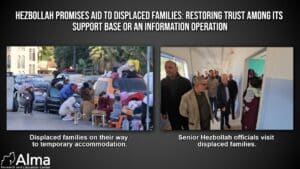
Hezbollah is increasing its civilian activity, with an emphasis on assistance to displaced persons: regular food distribution, operation of kitchens providing daily meals, the opening of designated pharmacies, and free distribution of baby food for infants up to one and a half years old.
IDF Activity:
The IDF continues extensive waves of strikes in Beirut, southern Lebanon, and the Beqaa. Targets include weapons depots, launchers and launch sites, terrorist operatives, and structures used by the organization. In Beirut, assets of the “Al-Qard al-Hassan” association were also targeted, as well as several gas stations belonging to the Hezbollah-controlled Al-Amana company.
In addition, the IDF struck road infrastructure, including the Al-Qinayat bridge over the Litani River in the Al-Qasmiya area, and another crossing in the Burj Rahhal area in southern Lebanon.
According to the IDF Spokesperson, more than 80 Hezbollah terror infrastructures were targeted over the past week.
It was also reported that the IDF eliminated in Sidon Wissam Mustafa Hussein Taha, a senior figure in Hamas’ financial recruitment network.
Additional Events:
Following this, three Lebanese Army soldiers were killed in the strikes. In Lebanon, it is assessed that these were deliberate strikes, raising concerns that they were intended as a message to weaken the army in the south of the country.
The Lebanese Army and its soldiers are not considered a target for Israeli strikes, as long as no threat is identified from their side. The question arises as to what those soldiers were doing in the area of the targeted strikes in which they were harmed.
It should be noted that, in practice, there are a significant number of officers and soldiers in the Lebanese Army who cooperate with Hezbollah.
The International Arena
In Germany, Foreign Minister Johann Wadephul stated that a military solution is not the only realistic solution to the Iranian issue. At the same time, the German Chancellor addressed President Trump’s initiative to secure the Strait of Hormuz and emphasized that NATO is a defensive, not an offensive, alliance.
At a meeting held in Brussels, European Union foreign ministers discussed ways in which member states could assist in reopening the Strait of Hormuz. However, all countries noted a lack of willingness to take action that could lead to direct confrontation with Iranian forces.
EU foreign ministers strongly criticized Trump’s demand, with Luxembourg’s Foreign Minister, Xavier Bettel, describing his approach as “blackmail.”
French President Emmanuel Macron stated that France would be prepared to take responsibility for escorting ships in the Strait of Hormuz only after the war ends. According to him, any such mission would require coordination with Iran. Macron emphasized that France is not a party to the conflict, did not initiate the war, and will not take part in actions to reopen the strait at this stage.
Qatar condemned the strike on gas facilities in Iran, claiming it is a dangerous step.
Ukrainian President Volodymyr Zelensky announced that approximately 200 Ukrainian military experts are currently operating in the Middle East.
Russia condemned the elimination of Iranian leadership figures. At the same time, the Kremlin denied reports that Russia is sharing satellite imagery and drone technology with Iran.
IAEA Director General Grossi reported the discovery of a new underground nuclear complex in Isfahan. According to him, the status of the facility is unknown, as inspectors have not been able to visit it.