The Iranian Arena
Over the past 24 hours, strikes across Iran continued. According to the IDF Spokesperson, dozens of Israeli Air Force fighter jets completed additional waves of strikes in Tehran and western Iran. As part of the attacks, various military sites in Tehran were targeted, including headquarters and command centers used by the Air Force of the Islamic Revolutionary Guard Corps (IRGC). A complex established in the heart of the IRGC’s central military university (“Imam Hussein”) was also struck; the facility had been used by regime forces to manage the campaign and hold operational gatherings.
In addition, storage and production sites for ballistic missiles were targeted, including missiles prepared for launch and missiles intended to strike aircraft. Headquarters and military bases of the internal security forces and the Basij organization were also attacked, as well as an intelligence headquarters of the Iranian regime. More than 250 unmanned aerial vehicles, launchers, and dozens of launch sites were targeted.
At the same time, strikes were reported against several additional targets across the country, including an oil depot in the Aqdasiyeh area of Tehran, an air base in Bushehr, a naval base in Sirik, and a military base on Hormuz Island. A strike was also reported in the area of the refinery in Abadan and a large-scale attack near the airport in the city of Kerman. Among the targets struck were also the radar systems of the Iranian Air Force at the port of Bandar Abbas, a police station, and the headquarters of the special forces in the city of Borujerd.
In addition, a strike was reported on a building belonging to Bank Sepah, a financial institution used, among other purposes, to transfer salaries to the security forces and the IRGC.
According to an analysis of satellite imagery from March 11, 2026, conducted by the Institute for Science and International Security (ISIS), the Taleqan-2 facility in the Parchin military complex, considered one of the key components of Iran’s nuclear program, was struck.
According to data from the United States Central Command (CENTCOM), since the beginning of the campaign the United States has struck approximately 5,500 targets and sunk 60 vessels of the Iranian navy.
Eliminations
It was reported that Mohsen Darbagi, the Iranian Deputy Chief of Staff for Logistics, was eliminated in a joint strike by Israel and the United States.
The Iranian Fars News Agency reported that the commander of the Aerospace Force of the Islamic Revolutionary Guard Corps, Esmail Dehghan, was eliminated in the city of Arak in central Iran.
Iran Attacks Targets in the Middle East
Iran continues to carry out attacks against various targets across the Middle East. As part of these attacks, Iranian UAVs were launched toward fuel storage facilities at the port of Salalah in southern Oman. Following the incidents, Oman evacuated all vessels from the main oil export terminal at the port of Al-Fahal, located outside the Strait of Hormuz.
In addition, a strike was reported against fuel storage facilities in the Al-Muharraq area of Bahrain. In the United Arab Emirates, an Iranian UAV struck a residential building in the Creek Harbour area of Dubai.
In Saudi Arabia, it was reported that air defense systems intercepted an Iranian UAV that was on its way toward the diplomatic quarter in the capital, Riyadh.
At the same time, Kuwait’s Ministry of Energy announced that six electricity transmission lines were disabled after being hit by debris that fell during attempts to intercept UAVs.
Iraq
During the night, oil storage tanks in southern Iraq were hit as a result of an Iranian attack. According to Agence France-Presse, two foreign oil tankers carrying oil from Iraq were attacked in the Persian Gulf near the Iraqi coast, within the country’s territorial waters, and both vessels caught fire.
According to the Al Arabiya Al Hadath channel, Brigade 15 of the Popular Mobilization Forces (al-Hashd al-Shaabi), which are aligned with Iran, was attacked in Kirkuk.
The Israeli Arena
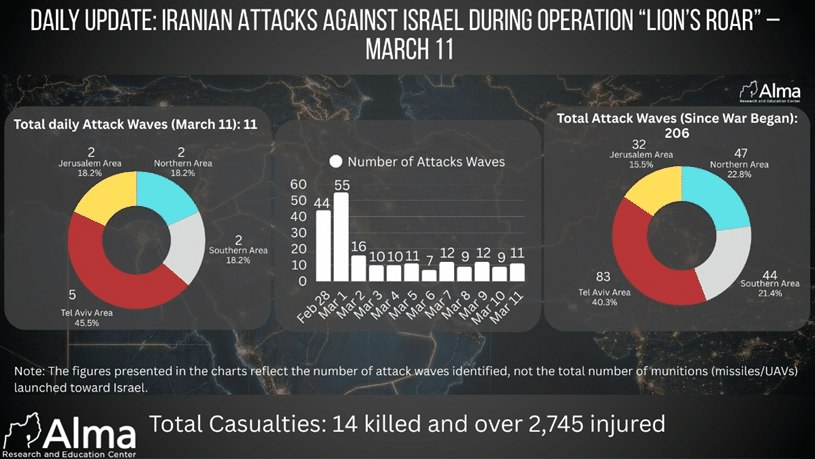
On March 11, 11 Iranian waves of attacks against Israel using ballistic missiles were identified. Geographically, most of the attacks were directed toward the Tel Aviv area, which absorbed 5 waves of attacks (45.5%). In addition, 2 waves of attacks were recorded in the north (18.2%), 2 waves in the south (18.2%), and 2 waves in the Jerusalem area (18.2%).
Since the beginning of the campaign, 206 Iranian waves of attacks against Israel have been identified. In the cumulative geographic distribution of all attacks, the central region—particularly the Tel Aviv metropolitan area—continues to be the primary target, with 83 waves of attacks (40.3%). It is followed by the northern region with 47 waves (22.8%), the southern region with 44 waves (21.4%), and the Jerusalem area with 32 waves (15.5%).
Examining the daily trend, it can be said that the average number of attack waves has remained steady since the fourth day of the war (March 3) and stands at approximately 10 waves of attacks per day.
Impact on the civilian space in Israel: Since the beginning of the war, 14 civilians in Israel have been killed and 2,745 have been injured to varying degrees. In the past 24 hours alone, 179 civilians were injured as a result of missile fire from Iran.
The data indicate that despite the decrease in the scope of attacks compared to the first stage of the campaign, Iran continues to exert sustained pressure on the Israeli home front, with a significant focus on the central region and Israel’s major urban areas.
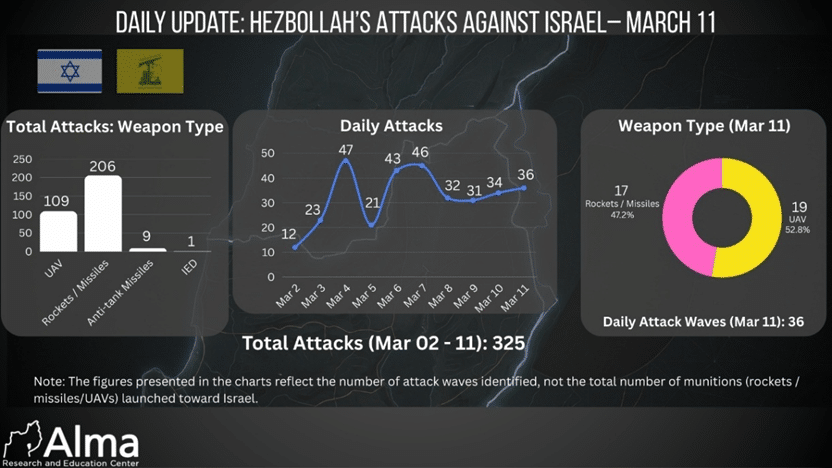
On March 11, 36 waves of attacks carried out by Hezbollah against Israel were identified. Last night, an escalation in the scope of fire occurred. During the night, Hezbollah launched and also carried out several launches toward northern and central Israel. Approximately 220 munitions were launched toward Israel from Lebanon, 66% of them directed at IDF forces in positions and in southern Lebanon.
In the barrages toward both the center and the north, residential houses were hit, including in one of the Arab towns in the Galilee, despite Hezbollah’s claim that the fire was directed at military bases in Israel. In addition, after more than a week of attacks, Hezbollah publicly announced the launch of an operation against Israel.
An examination of the types of weapon systems indicates a shift in the daily trend of the number of waves by weapon type, with 19 waves of attacks carried out using UAVs (52.8%), compared to 17 waves using rockets and missiles (47.2%). This trend is particularly notable in light of the preceding days, during which a relative decline in the number of UAV launches had been recorded. In fact, despite the broad scope of rocket fire, the number of attack wave events carried out using UAVs was higher than the number of rocket fire events on that day.
It is not clear and we do not know whether some of the attacks carried out by Hezbollah in the past 24 hours were coordinated with Iran, in an attempt to increase pressure on Israel through parallel activity from several arenas at the same time.
The Iranian Revolutionary Guards stated in their announcement that a joint operation with Hezbollah had been carried out, which included planning for continuous fire for approximately five hours.
It is possible that this was not actual coordination, but rather only synchronization of launch timing by Hezbollah, which in any case conducts launches throughout the day. Since the flight time of an Iranian missile toward Israel takes several minutes and early warning is received, Hezbollah can monitor these data, exploit the fact that its launch operation is relatively simple and rapid, and time its launches to coincide with the Iranian launches, thereby creating the appearance of inter-theater coordination.
Examining the daily trend indicates relative stabilization around 30–36 waves of attacks per day, reflecting the maintenance of a continuous offensive activity rate by Hezbollah.
Since Hezbollah joined the fighting on March 2, a total of 325 waves of attacks against Israel have been identified. The data refer to the number of attack waves and not to the total number of munitions actually launched.
In a cumulative view of all attacks since the beginning of the fighting, rockets and missiles continue to constitute Hezbollah’s primary means of attack, with 206 waves of attacks. At the same time, the use of UAVs has become a central component of the organization’s operational activity, with 109 waves of attacks using UAVs during this period. In addition, 9 attacks using anti-tank missiles and one explosive device attack were documented (an event based on a Hezbollah publication).
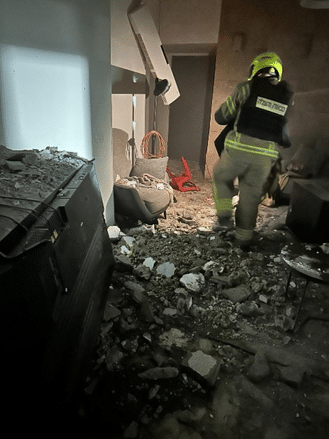
Damage to a house in Bi’ina, credit: Israel Fire and Rescue Services (Fire and Rescue Authority).
Lebanon and Hezbollah
According to reports in the Lebanese media, internal and external discussions are continuing around the ceasefire initiative proposed by Lebanese President Joseph Aoun. Parliament Speaker Nabih Berri is holding consultations with Hezbollah regarding the details of the initiative, and the issue is also being discussed with international actors.
At the same time, France continues to be the most active diplomatic actor in the arena. French President Emmanuel Macron called on Hezbollah to cease its attacks and warned against further escalation. He also held discussions on the matter with President Aoun and with Syrian President Ahmad al-Sharaa.
Meanwhile, Hezbollah continues to reject the demand for the exclusivity of weapons in the hands of the Lebanese state. According to reports in Lebanon, the organization continues to define its arsenal as “the weapons of resistance,” arguing that as long as Israel continues to attack Lebanon there is no place for discussing the dismantling of its weapons.
At the same time, the discussion in Lebanon regarding the role of the Lebanese Army continues. The commander of the army, Rudolph Haikal, emphasized that the army seeks to deploy the authority of the state across the entire territory of Lebanon and to consolidate state control, but warned against steps that could place the army in an internal confrontation within Lebanese society.
The newspaper Al-Akhbar reported internal tensions within the Lebanese Army, against the backdrop of political pressure to direct the army against Hezbollah, as well as a campaign to dismiss the army commander. According to the report, there are two main groups within the officer corps of the Lebanese Army: the first threatens to resign if the army commander is dismissed, while the second group—known as the “national officers”—threatens to resign if the army is required to act against “civilians” (Hezbollah), who they claim are confronting “external aggression.”
According to these sources, such a move could undermine the legitimacy of the army and deepen the internal divisions within Lebanon. At the same time, it is claimed that a campaign is underway in Lebanon—apparently with American backing—to remove the army commander, based on the claim that Hezbollah’s Radwan Force is still operating south of the Litani. The officers involved emphasized that this is not a rebellion, but rather a step intended to prevent harm to the status of the army, while stressing their continued commitment to defending Lebanon.
In the diplomatic arena, the Saudi channel Al-Hadath reported that a representative from the Iranian embassy in Beirut was summoned for clarification following the wave of launches carried out during the previous night, which according to reports was conducted jointly by the Islamic Revolutionary Guard Corps and Hezbollah.
The Lebanese Minister of Information stated that the Lebanese government is conducting diplomatic efforts to curb the escalation and is in contact with international actors in order to prevent Israeli strikes on vital targets in the country. At the same time, the Lebanese government expressed anger that in the statement issued by the Revolutionary Guards it was explicitly stated that the launches were carried out as part of a “unified front,” meaning coordination between Iran and Hezbollah.
At the same time, over the past 24 hours Israel continued its strikes in Dahieh, southern Lebanon, and the Bekaa Valley. According to IDF reports, ten buildings in Dahieh that were used as headquarters for terrorist activity were struck within half an hour, including intelligence headquarters, a headquarters of the Radwan Unit, and additional headquarters.
Over night (March 12) the Israeli Air Force eliminated Ali Maslam Tabaja, commander of the Imam Hussein Division. In the same strike, Jihad al-Safira, deputy commander of the Imam Hussein Division, Sajed al-Handasa, the division’s UAV officer, and several other senior commanders in the division were also eliminated.
In addition, Abu Dhar Mohammadi, a commander on behalf of the Islamic Revolutionary Guard Corps who operated within Hezbollah’s missile unit in Beirut, was eliminated.
The IDF also reported the elimination of the commander of the South Lebanon sector in Hezbollah’s “Radwan Force” unit.
The Shiite Amal movement reported that three of its operatives were killed in a strike carried out overnight in the coastal area of Beirut.
According to the IDF Spokesperson, more than 100 operatives have been eliminated so far and more than 60 headquarters of the “Radwan Force” unit have been destroyed.
On the humanitarian level, various estimates indicate that the number of displaced persons in Lebanon currently ranges between approximately 760,000 and 780,000 people, while some reports indicate that the number has already surpassed 800,000 displaced persons.
Syria
A trilateral phone call took place between Lebanese President Aoun, Syrian President al-Sharaa, and French President Macron regarding the current situation in Lebanon and the region in light of the rapid security developments.
According to the Lebanese newspaper Nidaa al-Watan, Hezbollah has concentrated a large number of operatives along the eastern border with Syria, from Jroud al-Nabi Sheet to al-Qaa and al-Hermel in the Bekaa. This is due to fears of action from the Syrian side in light of the preparations being carried out by the Syrian government and concerns over any intervention in Lebanese territory.
The International Arena
The UN Security Council yesterday (March 11) approved a resolution submitted by Bahrain on behalf of the Gulf states condemning Iran’s attacks against countries in the region. The proposal was adopted with the support of 13 council members, while Russia and China abstained. The resolution states that the attacks carried out by Iran constitute a violation of international law and pose a threat to international peace and stability. Council members called for an immediate cessation of attacks and threats by Tehran and emphasized the need to maintain freedom of navigation and regional security in the Gulf, particularly in light of the growing tensions in trade and energy routes. A total of 135 UN member states joined the resolution—an exceptional number intended to emphasize that this is an initiative enjoying broad international support and not only a move originating from the Gulf states.
In a conversation between the Sultan of Oman, Haitham bin Tariq, and the President of Iran, Masoud Pezeshkian, the Sultan emphasized Oman’s neutral position and expressed dissatisfaction and condemnation in light of the ongoing aggression on its territory. According to him, Oman is taking all necessary measures to preserve its security and stability.
Oman’s Foreign Minister referred to the regional escalation in parallel with the Iranian attack on the fuel storage facilities at the port of Salalah, noting that the current escalation does not stem directly from the nuclear issue, as negotiations on the matter have reached an advanced stage. According to him, Iran has committed not to possess nuclear material capable of producing nuclear weapons and not to stockpile enriched materials. He further emphasized that Oman does not intend to join regional initiatives for normalization with Israel, and warned that the American and Israeli strikes against Iran could harm the legal and security framework that has preserved regional stability for decades.
Russian President Vladimir Putin spoke yesterday with Iranian President Masoud Pezeshkian. During the conversation, Putin emphasized that Russia supports reducing the escalation as soon as possible and returning to a diplomatic track.
At the same time, it was reported that Iran continues to export oil to China through the Strait of Hormuz. According to tanker tracking data, since the beginning of the war on February 28, at least 11 million barrels of oil have been sent through the strait—all destined for the Chinese market.