The Iranian Arena
Over the past 24 hours, extensive strikes were reported in Tehran, focusing on security and industrial infrastructure. Among the targets struck were a central site used for the production of key components for a range of weapons systems, facilities for manufacturing engines for unmanned aerial vehicles, a research and development site for components of anti-tank missiles, short-range surface-to-air missiles and other weapons, as well as a factory used for casting and filling warheads of ballistic missiles with explosive material.
In another arena, in Isfahan, an underground “missile city,” weapons depots, and military bases were targeted. Additional strikes were also reported in Shiraz and Parchin. In addition, the IDF struck a site where air defense systems had been installed near the Caspian Sea.
Iranian Activity in the Region:
United Arab Emirates – A strike was reported on a Kuwaiti oil tanker docked at the port of Dubai.
Turkey – It was reported that a ballistic missile launched from Iran entered Turkish airspace and was intercepted by NATO air defense systems (the fourth time an Iranian missile has been fired toward Turkey).
Qatar – Several unmanned aerial vehicles launched from Iran were intercepted.
In addition, strikes were also reported in Kuwait and Bahrain.
In Bahrain, the Ministry of Interior announced the arrest of three suspects who had established a Hezbollah terrorist cell, which operated in cooperation with terrorist elements outside the country with the aim of undermining the state’s sovereignty and endangering its security.
According to a report by Bloomberg, Iran is pressuring the Houthis to resume attacks against ships in the Red Sea in the event of further escalation in the war.
At the same time, an Iranian political-security source told Al-Mayadeen that Ukrainian forces had been deployed in Kuwait and the United Arab Emirates, and that Iran had already struck them alongside American forces.
Iraq
The Shiite political coalition in Iraq, the “Coordination Framework,” condemned violations of Iraqi sovereignty by the United States and called for preventing the use of Iraqi territory and airspace for strikes against Iran.
In addition, three Iraqi sources in Baghdad confirmed to the newspaper Al-Araby Al-Jadeed that several armed factions affiliated with Iran rejected military and security directives issued by the Iraqi government, which were intended to regulate the redeployment of forces along the borders and in Baghdad, as part of efforts to prevent attacks carried out by these factions using UAVs and missiles against facilities, military bases, and embassies within Iraq and in neighboring countries.
The Israeli Arena
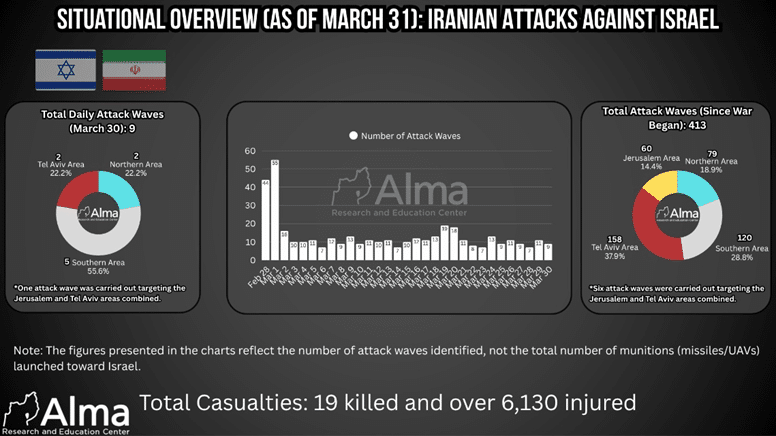
Iran continues to maintain a consistent pattern of attacks as part of its strategy of sustained pressure against Israel, using ballistic missiles while maintaining a relatively moderate daily pace of attacks, alongside localized fluctuations in the number of attack waves.
Over the past 24 hours, 9 attack waves were identified, most of them directed toward southern Israel, alongside attacks targeting the Tel Aviv area and the north. These data indicate a combination of broad geographic dispersion and continued focus on the central and southern regions.
During the attacks, impacts were recorded in civilian areas, including a missile with a cluster warhead launched from Iran that struck multiple locations in the north, including the Arab town of Shefa-‘Amr and the Bazan facilities in the Haifa area. The use of such a weapon increases the area of impact and raises the risk to civilian populations and sensitive infrastructure.
Since the beginning of the campaign, a total of 413 Iranian attack waves against Israel have been identified. In cumulative distribution, the central region—particularly the Tel Aviv metropolitan area—continues to be the primary target, alongside an expansion of activity to the south and north.
Since the beginning of the war, 19 civilians have been killed in Israel, and more than 6,130 people have been injured to varying degrees as a result of direct hits, falling interception debris, and secondary damage. In addition, extensive damage has been caused to residential buildings and civilian infrastructure, and the ongoing fire continues to disrupt daily life.
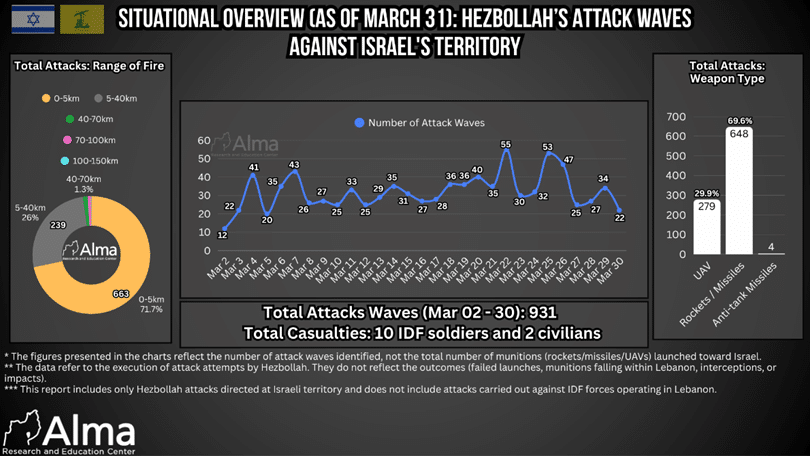
Hezbollah activity against Israel continues, maintaining a significant scale of attacks, although a relative decline in the number of attack waves has been observed in recent days compared to peaks recorded during the week.
Over the past two days, 5 IDF soldiers have been killed in fighting in southern Lebanon. To date, 10 IDF soldiers and 2 civilians have been killed as a result of Hezbollah attacks.
In terms of weapon types, there is a clear dominance of rocket and missile fire, which constitutes the majority of attacks, alongside significant use of UAVs, as well as limited use of anti-tank missiles (which have so far been directed at IDF positions along the Lebanon border).
Geographically, most attacks continue to focus on northern Israel, particularly border communities:
662 attacks (71.7%) were directed at border communities within a range of up to 5 km from the border.
239 attacks (26%) were carried out at ranges of 5–40 km, up to the Haifa line.
12 attacks (1.3%) reached ranges of 50–70 km, south of Haifa.
8 attacks (0.9%) were directed toward the central region—Tel Aviv and the Sharon area (70–100 km).
One firing incident was carried out toward the Ashkelon area, at a range of 100–150 km.
As a result of a direct hit in Avivim, one civilian was injured.
This distribution indicates a clear concentration of Hezbollah’s efforts on northern communities, alongside continued attempts to extend the range of fire toward central and even southern Israel.
Despite the relative decline in the volume of attacks, Hezbollah continues to combine large-scale fire toward the civilian rear with an ongoing effort to target IDF forces in the Lebanese arena.
Notes: This report includes only Hezbollah attacks directed toward Israeli territory and does not include attacks carried out by the organization against IDF forces operating in Lebanon. The data reflect the number of attack waves rather than the quantity of munitions fired at Israel.
Lebanon and Hezbollah
In the political arena, Al-Hadath reported that the Lebanese government sent a letter to the United Nations in which it classified Hezbollah’s military wing as an illegal organization. According to the report, the letter also included a decision to ban Hezbollah’s military and security activities.
The newspaper Al-Akhbar reported that the issue of expelling Iran’s ambassador from Lebanon deepened the crisis of trust between Lebanese President Joseph Aoun and Parliament Speaker Nabih Berri. According to the report, Berri expected full coordination with the president regarding war-related steps and was surprised that Aoun did not deny that Foreign Minister Youssef Raji’s decision had been coordinated with him.
In an interview with Al Jazeera, Hezbollah Member of Parliament Hussein al-Hajj Hassan sharply criticized the Lebanese Foreign Ministry’s decision to expel the Iranian ambassador, arguing that it is a mistake that contradicts established norms. According to him, the claim that the Iranian ambassador interfered in Lebanon’s internal affairs is incorrect and does not compare to the level of involvement by other ambassadors, particularly the United States ambassador. Addressing the possibility of a diplomatic solution with Israel, he emphasized that diplomacy has yielded no results so far.
Lebanese Army Commander Rodolphe Haikal met with the European Union ambassador to Lebanon and discussed recent developments in Lebanon and the region, with a focus on ongoing Israeli strikes.
Hezbollah published a summary of its activity for March 30, stating that the organization claimed responsibility for 40 military operations. These included rocket fire, mortar fire, and unmanned aerial vehicle attacks against concentrations of forces, positions, and Israeli bases along the border and in northern Israel, as well as strikes against military targets in the Haifa area and the Tel Aviv area. In addition, clashes were reported in several sectors in southern Lebanon, along with hits on armored vehicles.
UNIFIL announced that two soldiers were killed and two others wounded, one of them seriously, as a result of an explosion of unknown origin that struck their vehicle near Bani Hayan. In total, over the past 48 hours, three UNIFIL soldiers have been killed.
The Lebanese Ministry of Foreign Affairs condemned the attack on UNIFIL forces and emphasized that harm to United Nations personnel is unacceptable. France announced that it had requested an emergency meeting of the UN Security Council following the incidents, and the French Foreign Minister called for respect for Resolution 1701 and for ensuring UNIFIL’s freedom of movement in southern Lebanon.
The IDF carried out a strike in Beirut and eliminated Hamza Ibrahim Raqin, deputy commander of Unit 1800, along with the unit’s operations officer and another operative.
Syria
According to an unverified report, additional reinforcements from the Syrian Ministry of Defense arrived in the Syria–Lebanon border area. According to the report, the forces arrived with rocket launchers and UAVs and were deployed in order to strengthen the Syrian army’s control along the border strip.
At the same time, a state of tribal alert was reported among clans affiliated with Hezbollah, with the assistance of some local militias, aimed at securing the border and monitoring military developments in the area.
Syrian President Ahmad al-Sharaa, during his visit to Berlin, emphasized that Syria can serve as a secure route for supply chains due to its strategic location and its ability to transport oil through the Mediterranean coast to Europe. According to him, in situations of disruption in the Red Sea or the Strait of Hormuz, Syria constitutes a safe and rapid alternative for trade routes.
The International Arena
According to a report by the AP news agency, Saudi Arabia, the United Arab Emirates, Kuwait, and Bahrain are pressuring U.S. President Donald Trump to continue the war against Iran, arguing that there is a historic opportunity to bring about the fall of the regime. Saudi officials clarified that ending the fighting at this stage would not lead to an optimal agreement.
In contrast, Egyptian President Abdel Fattah el-Sisi appealed to President Trump to act to stop the war in the region.
At the same time, Qatari Foreign Ministry spokesperson Majed al-Ansari stated that the Emir of Qatar, Tamim bin Hamad Al Thani, is conducting intensive contacts with international leaders aimed at promoting regional stability. However, he emphasized that Qatar is not a direct party to mediation efforts, but supports all initiatives to end the fighting, and that ongoing communication is taking place with regional partners, including Pakistan, regarding these efforts.
The newspaper La Repubblica reported that Italy refused to allow the United States to use the Sigonella air base on its territory last Friday (March 27).