The Iranian Arena
Over the past 24 hours, Israel carried out dozens of waves of strikes in Iran targeting missile arrays – launchers, air defense systems, and ammunition depots (reports indicate weapons depots were struck in the areas of Vardavard and Dezful). In addition, the Air Force attacked Iranian regime infrastructure, including dozens of Basij headquarters. Mehrabad Airport in Tehran was also struck. The Iranian Air Force base in Shiraz was attacked. In Tabriz, a police building was struck, and in Qom, military headquarters were targeted.
According to an IDF spokesperson’s statement, the Air Force has put 300 missile launchers out of use. Since the beginning of the war, the Air Force has dropped 4,000 munitions in 1,600 aerial sorties over Iran.
An Israeli Air Force F-35 aircraft shot down an Iranian fighter jet of the YAK-130 type. This marks the first downing of an enemy fighter aircraft since 1985, when Syrian aircraft were shot down in an aerial battle over Lebanon.
Reports indicate the elimination of Rahman Moghadam, head of the Special Operations Division of the IRGC.
It was also reported that Davoud Alizadeh, deputy to Hassan Mahdavi, the commander of the Lebanon Corps of the Iranian Quds Force (who was eliminated in IDF strikes) was eliminated.
According to the International Atomic Energy Agency, damage was identified to two buildings at the nuclear facility in Isfahan.
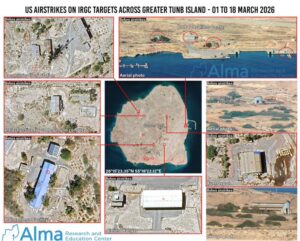
According to CENTCOM data, since the beginning of the war the United States has carried out 2,000 strikes in Iran and has sunk 20 Iranian vessels, including the new helicopter and drone carrier Shahid Bagheri.
In international waters off the coast of Sri Lanka, a U.S. submarine attacked an Iranian Navy vessel (IRIS Dena) with torpedoes and sank it. More than 100 crew members are missing and 78 were wounded.
The frigate Sayyad Shirazi was attacked by the United States near the port of Bandar Abbas.
According to CNN, the CIA is working to arm Kurdish rebel groups in western Iran.
The Pentagon confirmed that B-52 bombers carried out strikes in Iran over the past 24 hours.
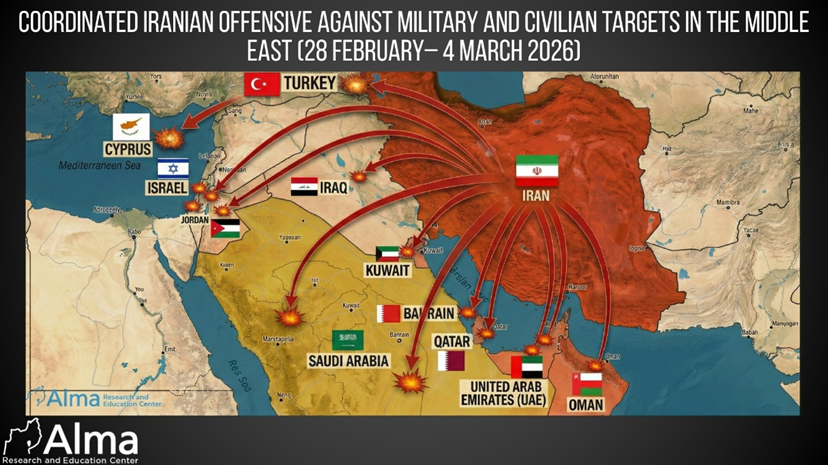
Iran Attacks Targets Across the Middle East
Over the past 24 hours, Iran and its proxies carried out several attacks against American targets, energy facilities, and civilian infrastructure in a number of Middle Eastern countries, including the United Arab Emirates, Iraq, Kuwait, Qatar, Bahrain, and Saudi Arabia. For the first time, an Iranian missile directed toward Turkey was intercepted.
Turkey: An Iranian missile that crossed Syrian and Iraqi airspace on its way to Turkey was intercepted by NATO air defense systems in the eastern Mediterranean. Interception debris fell in Hatay Province in southern Turkey. No casualties were reported. This constitutes an attack on a NATO member state.
United Arab Emirates: The U.S. consulate in Dubai was attacked. According to the Emirati Ministry of Defense, three people have been killed and 68 injured so far.
Iraq: Iran and Shiite militias in Iraq attacked several targets across the country, including Baghdad International Airport, a U.S. base in Erbil, and a hotel in Erbil used to house American forces. In addition, the IRGC targeted Kurdish forces in northern Iraq using drones.
Kuwait: The U.S. bases at Arifjan and Ali Al-Salem were attacked. The Islamic Resistance in Iraq also carried out attacks against targets in Kuwait.
Qatar: Two ballistic missiles were fired toward the U.S. Al Udeid base.
Bahrain: The U.S. air base in Sheikh Isa was attacked using drones and missiles. In addition, a hotel in Manama was struck by a Shahed-type drone, and two people were injured.
Saudi Arabia: An Aramco oil facility was attacked again.
Oman: An oil tanker was attacked with missiles, and a container ship flying the Maltese flag was struck by a missile in the Strait of Hormuz off the coast of the Sultanate of Oman.
The events over the past 24 hours indicate a regional expansion of Iranian and proxy activity, including attacks against U.S. bases, energy facilities, and civilian infrastructure across multiple countries simultaneously. The interception of the Iranian missile over Turkey points to the potential for further expansion of the conflict arena.
The Israeli Arena
Since yesterday (as of 15:00 on March 4), eight Iranian attack waves have been carried out against Israel, including the launch of ballistic missiles. Two of the attack waves included simultaneous launched from Iran and Lebanon toward central Israel (according to several reports, there may be attempts to coordinate the attacks between Iran and Hezbollah).
Since the beginning of the war, 12 civilians in Israel have been killed, and more than 1,200 have been injured to varying degrees. Since the start of the missile fire toward Israel, damage has been reported in several locations in the civilian rear. Hits to residential buildings were reported, as well as damage to homes and property.
On the first day of the war (February 28), there were 25 attack waves. On the second day (March 1), which has so far been the most intense, there were 62 attack waves. On the third day there were 24 attack waves from Iran, and on the fourth day 7 attack waves. A gradual decline in the number of attack waves has been observed.
Since the beginning of the war, a total of 128 attack waves have been launched from Iran against Israel.

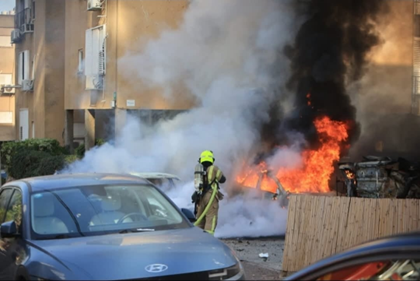
Missile fragment impact in central Israel. Credit: Israel Fire and Rescue Services.
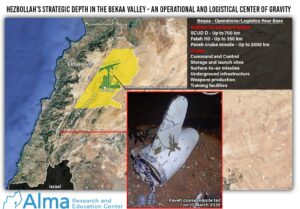
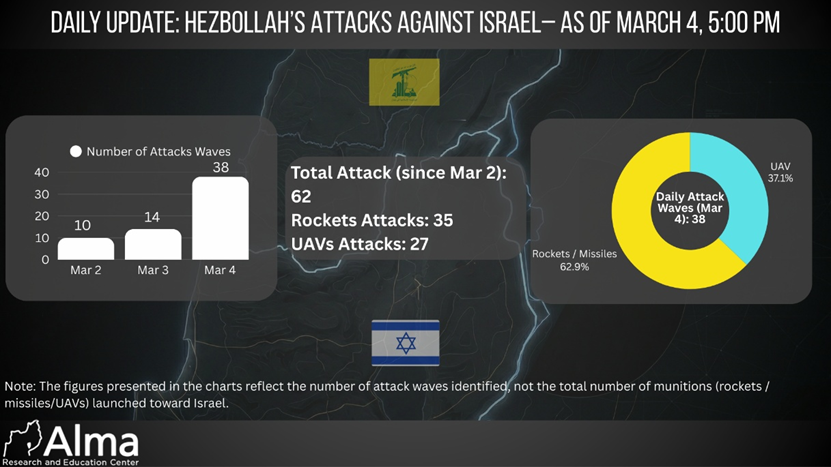
Hezbollah continues to launch rockets and drones toward Israel. Over the past 24 hours, Hezbollah carried out 38 attacks against Israel using drones, anti-tank missiles, and missiles. Hezbollah has expanded the range of its attacks and, over the past day, carried out two launches toward the Tel Aviv area. This is in addition to attacks directed at communities along the confrontation line, the Galilee, and Haifa.
Since the beginning of its involvement (March 2), Hezbollah has carried out 62 attack incidents against Israeli territory, including launches of rockets and UAVs.
While Hezbollah claims it is targeting military objectives, over the past 24 hours a hit on a residential home in a Galilee community was reported, causing extensive damage. The current threat spans a broad civilian area from the Lebanese border to Tel Aviv, including the Galilee, Haifa Bay and the Krayot, the Jezreel Valley, and the Tel Aviv metropolitan area. Millions of Israeli civilians live in these areas.
According to the IDF spokesperson, two IDF soldiers from the 401st Brigade were moderately wounded today (March 4) as a result of anti-tank fire toward our forces operating in southern Lebanon.
Lebanon and Hezbollah
Since Hezbollah joined the war, the IDF has struck more than 250 targets in Lebanon. Over the past 24 hours, the Al-Jama’a al-Islamiyya center in Sidon was attacked.
So far, the IDF has issued evacuation notices for hundreds of villages and communities in southern Lebanon. According to official data provided by the authorities, the number of officially registered displaced persons has surpassed 60,000 within just a few days.
The Lebanese government continues to emphasize its decision of March 2 to prohibit Hezbollah’s military and security activity and to require the organization to hand over its weapons to the state. Lebanese President Joseph Aoun clarified in discussions with international officials that this is a sovereign and final decision, and that the army and security forces have received full political backing to begin implementing it on the ground.
A meeting was held between President Aoun and the ambassadors of the five countries involved in monitoring developments in Lebanon. During the meeting, the U.S. ambassador to Lebanon, Michel Issa, emphasized that the decision had been made belatedly but called for giving the army and security forces the opportunity to implement it in practice and to act decisively against any armed actor operating outside the framework of the state. Aoun, for his part, claimed that the rocket fire carried out on Monday (March 2) toward Israel originated from areas outside the region south of the Litani, an area where the Lebanese army is deployed and operating (note – this claim is incorrect. The launches were from south of the Litani).
At the same time, the Lebanese leadership continues diplomatic contacts with international actors in an effort to curb the escalation and avoid a further expansion of the fighting.
Alongside the ongoing strikes and clashes in southern Lebanon, the Lebanese army is adjusting the deployment of its forces. The Lebanese army has established checkpoints and inspection points on roads leading to the south of the country in order to strengthen security control in the area.
Alongside these political and military developments, Hezbollah’s activity on the ground continues. According to various reports, the organization took control of the government hospital in Bint Jbeil after the facility ceased operations citing a fuel shortage, and transferred medical equipment to it from another medical institution.
Syria
The Syrian army announced a significant reinforcement of its forces along the borders with Lebanon and Iraq amid the regional escalation and the ongoing clashes between Israel and Hezbollah in Lebanon. According to a statement by the “Operations Administration” of the Syrian army, the deployed forces include border guard units and reconnaissance units tasked with monitoring activity along the borders, preventing smuggling, and strengthening security control in the border areas.
It was also reported that Syrian security forces reinforced their presence in the south of the country, particularly in the Daraa area and along the border with Israel, in order to prevent attempts by Iran-aligned militias to exploit the situation and become drawn into another confrontation.
In recent days, significant aerial activity has been recorded over southern Syria. Local media reported repeated interceptions of Iranian unmanned aerial vehicles in the skies of Daraa province. According to the reports, more than ten UAVs were shot down over various areas, including the city of Inkhil and the village of Deir al-Adas. Several incidents of drone and missile debris falling in the Quneitra and Daraa areas were also reported, though in most cases no casualties were reported.
The escalation in Lebanon has also led to a significant wave of Syrians returning from Lebanon back into Syrian territory. According to Syrian authorities, approximately 11,000 people crossed the border into Syria through the Jdeidet Yabous and Jousieh crossings within a single day, most of them Syrians returning to the country following the security escalation in Lebanon.
Iraq
The Islamic Resistance in Iraq claimed responsibility for 27 attacks against targets in Iraq and neighboring countries using missiles and UAVs.
The International Arena
In response to Spain’s statement that it would not allow the United States to use its bases, President Trump decided to sever trade relations with the country.
The President of France stated that France has defense agreements with Qatar, Kuwait, and the United Arab Emirates, and that France will stand by them. The aircraft carrier Charles de Gaulle has been deployed to the Middle East. France announced that it is acting for defensive purposes only but is prepared to respond to threats. Macron also called for the renewal of diplomatic negotiations and for avoiding further escalation.
According to various reports, French aircraft participated in intercepting Iranian UAVs launched toward Gulf states.
In the United Arab Emirates, the possibility of striking Iranian missile facilities is being considered following Iranian attacks in the region. Officials in the UAE claimed that Iran carried out hundreds of missile and UAVs launches against Gulf states. The leadership emphasized its right to self-defense, but no decision on military action has yet been made.
Turkey announced that it reserves the right to respond after Iran launched a missile toward its territory that was intercepted.
Many countries in the Global South condemned the war between the United States and Israel and Iran, arguing that it is illegal and constitutes a violation of international law. Some also emphasized that the attack occurred while diplomatic contacts were underway between the United States and Iran, and therefore cannot be justified. Some Global South countries also condemned Iranian attacks on Gulf states. In these countries, the war is perceived as part of a pattern of Western intervention and regime change (as in Iraq and Libya). Some view it as reflecting an unequal global power system and even having “imperialist undertones.”
Below are some of the statements by Global South countries:
China strongly condemned the war, stating that killing the leader of a sovereign state is unacceptable. It views the attack as a violation of the principles of sovereignty and international law.
Pakistan: Prime Minister Shehbaz Sharif expressed condolences over the death of Khamenei. He emphasized that international law prohibits the assassination of heads of state. The attack is viewed as a violation of international law. At the same time, Pakistan issued a warning to Iran following Iran’s attacks in Saudi Arabia. Pakistan informed Iran that it should take into account Pakistan’s mutual defense agreement with Saudi Arabia.
South Africa: President Cyril Ramaphosa questioned the justification for a “pre-emptive action.” According to him, self-defense is justified only in response to an actual military invasion. He emphasized that there is no military solution to fundamentally political problems.
Brazil expressed grave concern over the attacks. It emphasized that the strikes occurred while negotiations between the parties were underway and therefore harm the prospects for peace. It called for a diplomatic solution.
Cuba condemned the United States and Israel, claiming that they are endangering regional and international peace and stability.
Indonesia expressed regret over the failure of negotiations with Iran. The President of Indonesia offered to travel to Tehran to renew dialogue. The country’s Council of Religious Scholars also called on the government to withdraw from the initiative for an international security force in Gaza in protest of the war.