
The Iranian Arena
Over the past day, strikes across Iran against regime infrastructure have continued. As part of a wave of strikes completed in Tehran, the Air Force targeted the central security headquarters of the Islamic Revolutionary Guard Corps, which was located within civilian infrastructure.
During the night, missile sites in western and central Iran were also struck, as well as additional headquarters in Tehran.
Additional strikes were reported against energy facilities in Isfahan and Khorramshahr, as well as in the cities of Tabriz, Bandar Abbas, and Sirjan.
Eliminations
According to Iranian opposition sources, Prof. Saeed Shamgadari, a member of the Faculty of Electrical Engineering at the Iran University of Science and Technology, is the scientist who was eliminated in the strike yesterday, and he likely served as an expert in the field of ballistic missile production.
According to additional reports, Mohammad Navid Karishi, a senior researcher in Iran’s missile and space project, was also eliminated.
In addition, a brigadier general, engineer Hamid Mirzadeh, a senior figure in the missile array, was eliminated.
In the diplomatic arena, efforts to advance negotiations are evident. According to a Reuters report, a Pakistani official confirmed that Vice President J.D. Vance, Steve Witkoff, and Jared Kushner are expected to meet with Iranian officials in Islamabad during the week.
Iran Attacks Targets in the Middle East
Over the past day, attacks across the regional arena have continued:
Saudi Arabia – The Saudi Ministry of Defense reported that 24 Iranian UAVs were intercepted in eastern Saudi Arabia, an area where strategic energy facilities are concentrated.
Kuwait – Seven overhead power lines were damaged by interceptor debris from air defense systems, leading to the shutdown of the lines and widespread power outages in various parts of the country.
United Arab Emirates – The Ministry of Defense reported that five ballistic missiles and 17 UAVs launched from Iran were intercepted today. Since the beginning of the campaign, 357 ballistic missiles and 1,806 UAVs have been launched toward the UAE.
Iraq
The Popular Mobilization Forces (al-Hashd al-Shaabi), which include pro-Iranian Iraqi militias, announced that 15 of its members were eliminated in a strike targeting the organization’s operations headquarters. Among those eliminated were Saad al-Baiji, commander of al-Hashd al-Shaabi in Anbar Province; Haidar al-Maamouri, the province’s security official; and Wathiq al-Fartousi, the province’s intelligence official.
The Israeli Arena
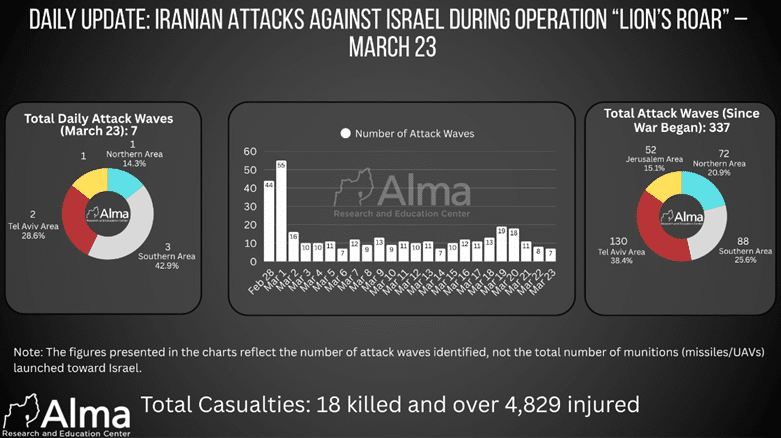
On March 23, seven waves of Iranian attacks against Israel were identified, carried out using ballistic missiles. This reflects a further decrease in the scope of attacks compared to recent days, while maintaining consistent activity within Iran’s ongoing attack pattern.
Geographically, the attacks were distributed across several regions: three waves (42.9%) were directed toward southern Israel, two waves (28.6%) toward the Tel Aviv area, and one wave each toward the north and the Jerusalem area (14.3% each). These figures indicate a continued broad geographic distribution, alongside sustained focus on the south and the center.
The use of missiles with dispersing warheads continues, reflecting an Iranian effort to increase the area of impact and the level of damage to the civilian rear.
Since the beginning of the campaign, a total of 337 Iranian attack waves against Israel have been identified. In cumulative terms, the central region—particularly the Tel Aviv metropolitan area—remains the primary target, alongside an expanded effort directed at southern Israel.
Since the start of the war, 18 civilians in Israel have been killed, and more than 4,829 people have been injured to varying degrees as a result of direct impacts, interceptor debris, and secondary damage. In addition, thousands of civilians have been evacuated from their homes due to missile impacts.
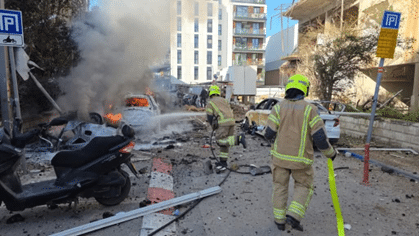
Impact site in Tel Aviv. Credit: Israel Fire and Rescue Services
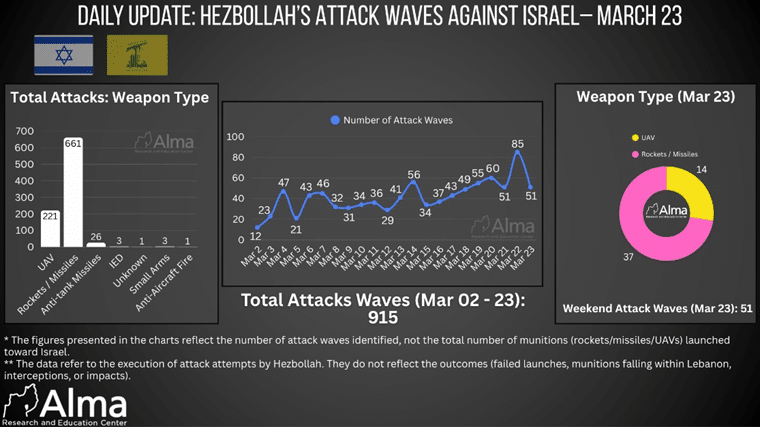
On March 23, 51 Hezbollah attack waves against Israel were identified, indicating continued high-intensity activity, though lower than the peak recorded on March 22, when 85 attack waves were observed. Despite the relative decrease, the scope of attacks remains high and reflects the maintenance of a significant offensive tempo.
In terms of weapons used, most attacks were carried out using rockets and missiles (37 waves), alongside 14 waves involving UAVs. This pattern continues to indicate the dominance of rocket fire, combined with the regular use of unmanned aerial systems.
Geographically, the attacks were primarily directed at border communities and the Galilee, with continued impact on populated areas in northern Israel and sustained pressure on the region. On March 23, Hezbollah rockets struck the city of Kiryat Shmona, causing damage to a public bus and hitting a residential neighborhood. As a result of the fire, civilians were injured.
It also emerges that 21 of the attacks during the day were claimed by Hezbollah as targeting IDF forces operating in southern Lebanon. It should be emphasized that even when Hezbollah presents these attacks as directed at military targets, in practice they often involve statistical weapons (rockets), which are not precise and therefore also strike civilian areas in Israel, particularly border communities. This is in addition to direct and deliberate attacks against cities and civilian communities, which the organization openly claims and even boasts about.
Since Hezbollah joined the fighting on March 2, a total of 915 attack waves against Israel have been identified. The trend indicates continued high-frequency and high-intensity fire over time.
Lebanon and Hezbollah
Lebanese Prime Minister Nawaf Salam stated, following a meeting with President Joseph Aoun, that all parties are working to bring about a swift end to the war.
Lebanese Parliament Speaker Nabih Berri expressed hope that the ongoing contacts between the United States and Iran will lead to a comprehensive agreement that will end the fighting.
Director General of the Lebanese Ministry of Foreign Affairs, Abd al-Sattar Issa, summoned the acting Iranian ambassador in Beirut and announced the revocation of Lebanon’s approval for the appointment of Iran’s designated ambassador, Mohammad Reza Shibani, declaring him persona non grata and demanding that he leave the country. At the same time, Lebanon’s ambassador to Iran was recalled for consultations following what was described in Lebanon as a violation by Tehran of diplomatic norms and accepted conduct between the two countries.
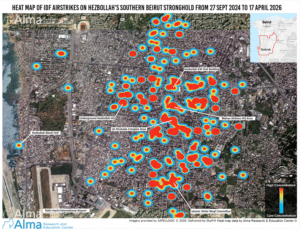
During the night, the IDF continued extensive strikes against Hezbollah infrastructure in Beirut and other areas in Lebanon. The strikes targeted organizational headquarters, including a headquarters of the “Radwan Force,” as well as a headquarters in the village of A-Tiri that had been established inside a “Nur” radio broadcasting station.
Additional reports indicated that in a strike carried out in Hazmiyeh in Beirut, Mohammad Ali Kourani, a member of the Islamic Revolutionary Guard Corps, was eliminated. Following the strike, the mayor of Hazmiyeh began preparations to expel Shiite displaced persons from the area. At the same time, a targeted strike was reported in the village of Shamon, an area with a Druze and Christian majority, illustrating Hezbollah’s activity also from civilian areas that are not necessarily part of its Shiite support base.
Over the past day, the IDF struck the Dlafy Bridge twice, the largest bridge in southern Lebanon, which serves as a central transit route from the Beqaa region to southern Lebanon. It was also reported that five gas stations belonging to the “Al-Amana” company, which is linked to Hezbollah, were struck including in the Rashidieh refugee camp, in Bureghliyeh, and in the Al-Maslakh neighborhood in Nabatieh (a number of stations had already been struck on March 18).
“Al-Amana” is a Lebanese company engaged in the import, sale, and distribution of fuel across Lebanon. The company operates approximately 50 gas stations, primarily located in Shiite population centers (southern Lebanon, the Beqaa Valley, and Beirut), as well as 15 distribution centers throughout the country.
The company was established in 2005 under the “Atlas” corporation, which was previously controlled by the Iranian Martyrs Foundation—an Iranian institution with a presence in Lebanon that provides social support to the families of Hezbollah martyrs. Control of the “Atlas” corporation was later transferred to Hezbollah’s economic portfolio.
The company’s CEO is Qassem Mohammad Ali Bazzi, and its co-manager is Osama Mohammad Alik. In 2020, the U.S. Department of the Treasury imposed sanctions on “Atlas” and its owner, Qassem Bazzi, as well as on its subsidiary companies, particularly “Al-Amana,” due to their support for terrorist activity.
“Al-Amana” gas stations are used by Hezbollah operatives for refueling as part of the organization’s military activity in both routine and emergency situations, particularly since the start of Operation “Lion’s Roar.” In addition, the gas stations serve as meeting points for Hezbollah military operatives, as part of the transition from routine to emergency operations and the military activities associated with it. The “Al-Amana” company generates millions of dollars in annual revenue for Hezbollah.
In addition, two Radwan Force operatives who had planned to carry out anti-tank missile fire against IDF forces and northern Israeli communities were captured and taken prisoner by IDF forces. Initial interrogation indicates that the operatives arrived from the Beqaa area to southern Lebanon since the beginning of the campaign.


Radwan Unit operatives arrested in southern Lebanon
The International Arena
According to a report on Al-Sharq TV, the Trump administration is not expected to push Israel toward a ceasefire in Lebanon unless a credible plan is presented by the Lebanese government to disarm Hezbollah.
At the same time, German Chancellor Friedrich Merz spoke with President Trump and expressed satisfaction with his decision to delay the ultimatum to Iran by five days, and offered Germany’s assistance in advancing negotiations.
Oman’s Foreign Minister, Badr al-Busaidi, stated in a post on X that his country is working to ensure safe passage in the Strait of Hormuz, and warned of worsening economic consequences stemming from the war.
According to a report in The Wall Street Journal, Saudi Arabia and the United Arab Emirates are moving closer to the possibility of joining the fighting against Iran, following Iranian attacks that have targeted energy infrastructure on their territory. According to the report, Saudi Arabia is already allowing the United States to use military bases on its soil, marking a policy shift after initially attempting to avoid involvement in the war. It was also reported that Crown Prince Mohammed bin Salman is considering joining the strikes in order to restore deterrence against Iran. At the same time, the United Arab Emirates is taking stricter measures against Iran, particularly in the economic arena, including closing institutions and tightening oversight of Iranian assets, in an effort to undermine the regime’s sources of funding.



One Response
You have good graphics, but they are tiny and not enlargeable. Please do something about this. Thank you