
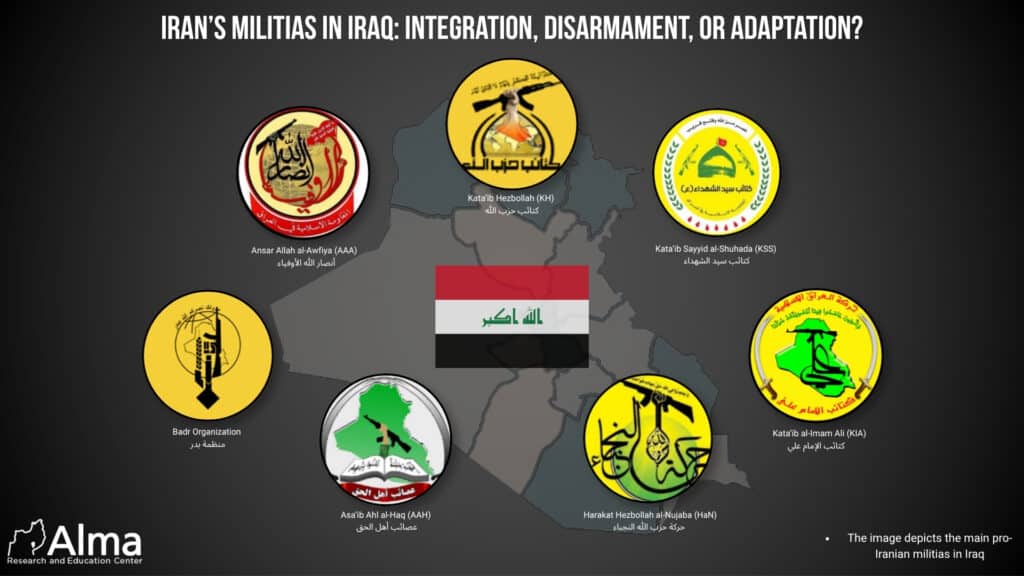
The deadline set by the Iraqi government for Iran-aligned militias to surrender their weapons is approaching, and a series of reports published over the past week appear to indicate a gradual shift from declarations and negotiations to operational measures on the ground. Prime Minister Ali al-Zaidi’s government is demanding that the weapons be handed over to the state by September 30, the date also set for the end of the international coalition forces’ presence in Iraq. The government is threatening confrontation with organizations that refuse to cooperate.
Nevertheless, it is too early to conclude that Iraq is on the path toward fully dismantling the pro-Iranian militia network. While some militias have shown a degree of willingness to integrate into state institutions or surrender at least some of their weapons, the more hardline organizations continue to resist the process. At the same time, reports of a shift in the Islamic Revolutionary Guard Corps’ operational methods raise the possibility that Iran is preparing to preserve a covert and independent capability in Iraq, even if the large military formations are reduced or formally dismantled. The significance of this process extends beyond the Iraqi arena: in recent years, Iraq’s pro-Iranian militias have actively participated in the regional conflict and carried out numerous drone and cruise missile launches against Israel and the Gulf states.
A New Iranian Strategy: Fewer Visible Militias, More Concealed Capabilities
According to an Alhurra report based on Iraqi security sources, the Islamic Revolutionary Guard Corps has established a network of small clandestine cells in recent months that operate outside the frameworks of the established militias. According to the report, each cell consists of five to ten operatives selected from the major organizations, some of whom received training in Iran.
The cells operate in a compartmentalized manner and report directly to the Iranian mission in Iraq, independently of the local militia leaderships. Members of one cell do not know the members of the other cells, and communication between them is conducted through an Iranian intermediary. According to the report, members of the network have already been involved in drone attacks against Erbil and targets in Saudi Arabia, Jordan, and Kuwait. They operate under civilian cover, without uniforms or insignia, use civilian vehicles, and move the drones between different locations to make them more difficult to detect.
If the information is accurate, this is not merely a tactical shift but a strategic adaptation of Iran’s network to the new reality. Tehran may agree to reduce the visibility of the large militias, integrate them into state institutions, and even permit the controlled surrender of some of their weapons, while simultaneously extracting from them small and resilient cells that report directly to the IRGC. This would allow Iran to preserve its attack, sabotage, and deterrence capabilities without relying on large, visible organizations exposed to pressure from the Iraqi and US governments.
Reports concerning Iranian Parliament Speaker Mohammad Bagher Ghalibaf’s visit to Baghdad reinforce this possibility. The visit took place amid tensions between the government and the militias and followed the arrest and subsequent release of a senior member of al-Nujaba. In his meetings with Iraqi officials, Ghalibaf expressed support for regulating weapons within a legal framework and under the authority of the commander-in-chief of the armed forces. Iraq’s National Security Adviser Qasim al-Aboudi, however, made clear that the Iraqi constitution does not permit the existence of armed groups that threaten other countries and that the government is determined to place all weapons under state control.
However, according to a report in Asharq Al-Awsat, behind the scenes Ghalibaf considered proposals intended to prevent a confrontation between the government and the militias, including freezing or concealing heavy weapons and temporarily transferring some of them to Iran. If the report is accurate, this would not constitute disarmament but rather the preservation of these capabilities beyond the government’s reach, allowing them to be returned to Iraq if circumstances change.
Such an arrangement could provide the al-Zaidi government with a visible achievement, the disappearance of some heavy weapons from the public sphere, without actually dismantling the operational infrastructure. It could also allow the militias to integrate into state institutions, preserve their political and economic standing, and reduce their exposure to attacks and sanctions, while the most sensitive capabilities are retained in Iran, in concealed storage facilities, or in the hands of clandestine cells.
In recent months, Quds Force commander Esmail Qaani has visited Iraq several times and met, among others, with commanders of the pro-Iranian militias. These visits were reportedly intended to influence negotiations over the future of their weapons and prevent a process that would lead to their actual disarmament.
These developments may explain the apparent contradiction in Iran’s conduct. Kurdistan Region President Nechirvan Barzani said that Iranian officials had expressed a willingness to help Baghdad place the militias’ weapons under state control, while Ghalibaf also publicly supported their legal regulation. However, Tehran may be willing to dismantle the visible framework as long as the operational core is preserved: the commanders, communication networks, clandestine cells, and strategic assets that allow it to influence Baghdad and operate across the region.
Accordingly, the success of the Iraqi initiative will not be measured solely by the number of weapons presented as having been transferred to the state, but by the government’s ability to establish lasting control over missiles, drones, and storage facilities; dismantle independent chains of command; identify clandestine cells; and prevent weapons from being concealed or temporarily transferred.
The Iraqi Government: Declared Resolve and Gradual Regulation
Ali al-Zaidi’s government continues to present the concentration of weapons under state control as one of its primary objectives. Initially, September 30, 2026, the date set for the end of the international coalition’s mission and the withdrawal of US forces, was also presented as the deadline for the militias to surrender their weapons. According to reports, al-Zaidi even made clear that he was prepared for a “confrontation” with organizations that refused to cooperate, although it remained unclear whether this represented a genuine threat of military action or primarily a means of exerting pressure.
Since then, the government appears to have softened both its definition of the objective and its timetable. According to Al Arabiya–Al Hadath, the discourse surrounding “placing weapons under state control” is gradually giving way to the more moderate formulation of “regulating weapons.” A committee established within the Shiite political coalition continues to engage with militias that refuse to surrender their weapons, particularly Kata’ib Hezbollah and al-Nujaba, but is struggling to hold direct talks with their leaders and is forced to convey messages through intermediaries.
At the same time, the possibility of postponing the completion of weapons collection beyond September 30 is being considered in order to allow more room for negotiations and prevent an intra-Shiite confrontation. Government spokesperson Haider al-Aboudi clarified that this date marks the end of the US forces’ mission and is not necessarily the deadline for the militias to surrender their weapons. Qasim al-Araji, the prime minister’s security adviser and former national security adviser, added that the process would be implemented gradually and in an organized manner following the coalition’s withdrawal. These statements indicate a shift from an unequivocal ultimatum toward a more flexible and prolonged process.
The shift does not necessarily indicate that the government has abandoned the principle of placing weapons under state control, which Iraqi officials continue to present as a strategic objective. However, the transition from “concentrating” weapons to “regulating” them creates ambiguity: Will the heavy weapons be transferred to the full control of the military and security services, or will the militias be permitted to retain their personnel, chains of command, and some of their capabilities within a regulated framework and under merely formal authority?
This flexibility may prevent an internal confrontation and facilitate political consensus. Conversely, a process without a binding deadline could allow the militias to stall, conceal weapons, and preserve their independent capabilities. It also widens the gap with Washington, which is demanding the actual and verifiable surrender of the weapons rather than merely their legal or organizational regulation.
Initial Progress or a Symbolic Move?
Alongside the difficulties in the negotiations, some practical progress has been reported. According to Al-Araby Al-Jadeed, a militia that also has a political wing and a parliamentary bloc handed over to the government, at a site near Baghdad, approximately 20 Iranian-made drones as well as missiles with a range exceeding 100 kilometers. The drones were described as fixed-wing loitering munitions powered by fuel engines, with a range of more than 250 kilometers. According to the report, the handover took place in the presence of US representatives, as part of the government’s efforts to demonstrate progress and prevent the imposition of economic and financial sanctions on Iraq.
If the report is accurate, this would be a more significant step than the surrender of small arms or a mere declaration of willingness, since these systems enable attacks against targets far beyond Iraq’s borders. However, the militia’s identity was not disclosed, and the government has provided no official information about the quantity of weapons received, the entity that now controls them, or the arsenal that remains in the organization’s possession. It is therefore still impossible to determine whether this constitutes the substantial dismantling of an operational capability or a limited handover intended to demonstrate progress to the United States.
It was also reported that Muqtada al-Sadr’s Saraya al-Salam has begun integrating into state institutions (Saraya al-Salam is not an explicitly pro-Iranian militia, but is instead affiliated with the Sadrist movement and Iraqi Shia nationalism; this affiliation may explain why it is among the militias that have expressed a willingness to integrate into state institutions), while Asa’ib Ahl al-Haq and Kata’ib al-Imam Ali have expressed willingness to transfer their weapons to government control. These steps point to a widening divide between organizations willing to integrate into the political and security system and militias more closely aligned with the Islamic Revolutionary Guard Corps.
Militia Resistance and Expanded Conditions for Disarmament
The militias most closely aligned with the Islamic Revolutionary Guard Corps continue to resist disarmament. The most prominent among them is Kata’ib Hezbollah, which has intensified its public confrontation with the prime minister. The organization’s security official, Abu Mujahid al-Assaf, accused al-Zaidi of “provocative and irresponsible actions” and warned that the organization’s patience with him was running out.
Kata’ib Hezbollah has also expanded its conditions for any future discussion of its weapons. In addition to demanding the withdrawal of US forces, al-Assaf called for the removal of Turkish forces from northern Iraq and the dismantling of the Kurdish Peshmerga forces, which he portrayed as a threat to the country’s unity and as having ties to the “Zionist-American enemy.” Other reports have also attributed to the militias a demand for the removal of US companies from Iraq.
The expansion of these conditions indicates that the US presence is not the sole reason for retaining the weapons, but rather a justification that can be replaced by other arguments. Even after US forces withdraw, the organizations will be able to point to the Turkish presence, the Peshmerga, Israel, or other regional threats to justify preserving their military power. These demands extend well beyond the question of ending the coalition’s mission, and it is doubtful whether the government is either able or willing to meet them.
It therefore appears that the militias linked to the Iranian axis are not merely negotiating the timing or mechanism of disarmament, but are challenging the very demand that they relinquish their independent military power. They seek to portray their weapons as part of the national defense structure, even though they remain subject to chains of command and decisions that are not fully controlled by the government. The gap between al-Zaidi’s statements and the positions of Kata’ib Hezbollah and al-Nujaba increases the risk of confrontation, but also the possibility of a partial arrangement that would allow both sides to avoid a direct clash.
Iraq Is Not a Model for Hezbollah’s Disarmament
Developments in Iraq may raise expectations that a similar process could take place in Lebanon, but the differences between the two arenas are fundamental. The Iraqi network is fragmented among dozens of organizations with different interests, leaderships, and degrees of dependence on Iran. Some seek to become legitimate political actors, preserve their budgets and positions, and avoid sanctions or attacks. This fragmentation allows the government to offer incentives to some organizations, isolate others, and foster competition among them.
Hezbollah, by contrast, is a far more centralized and institutionalized organization, combining military power, a political party, and a comprehensive social network under a single leadership. Its weapons are not merely one source of its power; they are the foundation of its position within Lebanon, its ability to influence state decisions, and its role within Iran’s regional network.
Iran’s strategy in the two countries also differs. Over the years, Iran has built a decentralized network in Iraq comprising militias, political parties, economic actors, and centers of influence within state institutions. Given the multiplicity of actors and channels at its disposal, Iran can demonstrate greater flexibility, agree to reduce or alter the status of some militias, and even relinquish their visible structures, as long as it retains political, economic, and covert levers of influence. The report concerning the establishment of small cells directly subordinate to the Islamic Revolutionary Guard Corps may indicate that Tehran is preparing to replace part of the visible military infrastructure with a smaller, compartmentalized network that is more difficult to detect.
In Lebanon, by contrast, Hezbollah is not merely one component of a broad network of competing proxies, but the most important strategic asset Iran has built beyond its borders. The organization directly confronts Israel, provides Tehran with an operational capability from an arena adjacent to Israeli territory, and serves as a political, military, and ideological anchor of the Iranian axis.
Iran has invested for decades in developing Hezbollah’s capabilities, and the organization also serves as a model for establishing and training other groups in the region. Therefore, any Iranian willingness to regulate, fragment, or conceal the militias in Iraq does not indicate a similar willingness to relinquish Hezbollah’s military power. From Tehran’s perspective, Hezbollah’s disarmament would represent a far greater strategic loss than reducing the visibility or independence of some Iraqi organizations.
Moreover, Hezbollah itself has shown no genuine willingness to participate in a disarmament process. It rejects the demand itself, portrays its weapons as a guarantee of Lebanon’s defense and an existential necessity, and seeks to condition any discussion of them on an Israeli withdrawal, an end to the attacks, and a series of security and political conditions. Even if one condition is met, the organization could introduce new ones, as the Iraqi militias are now doing by expanding their list of threats beyond the US presence.
The Iraqi process should therefore not be viewed as a blueprint that can be replicated in Lebanon. At most, it offers several lessons: the importance of a binding deadline; the combination of political, economic, and security pressure; a focus on strategic weapons; and the need for an oversight mechanism that prevents capabilities from being concealed or transferred to clandestine structures. However, while Iraq has at least some partners willing to participate in the process, Hezbollah itself is the principal opponent of such a process in Lebanon, and Iran places particularly high strategic importance on preserving its power.
Ultimately, even Iraqi success will not be measured by dismantling the militias’ symbols, but by eliminating their ability to operate independently and ending their subordination to Iran. The same test applies in Lebanon: not a change of name, organizational restructuring, or any form of formal integration, but the transfer of weapons, the chain of command, and decisions over war and peace to the state. At present, there is no indication that Hezbollah or Iran is prepared to accept this.


2 Responses
Iran Exerts Significant Political Control in Iraq-
Key Points
Key points from recent elections (including the 2025 vote):
• The Coordination Framework (a major Shia alliance including Iran-aligned factions) has formed or been described as the largest parliamentary bloc, with reports of around 119 seats initially and higher totals (e.g., ~165) after alliances.
• Specific Iran-aligned or militia-linked groups have held substantial seats, such as:
• Al-Sadiqoun (political wing of Asaib Ahl al-Haq): ~27 seats in some tallies.
• Badr Organization: ~18–21 seats.
• Other groups tied to Kataib Hezbollah, Kataib Sayyid al-Shuhada, etc., adding dozens more.
• Collectively, parties or lists linked to Iran-backed armed factions have controlled 50–100+ seats in recent parliaments (exact numbers vary by election and alliance shifts), giving them major leverage over government formation, legislation, and security policy.
Dear Dr Zoe,
For me the bottom line is that the IRGC and the quds force are the equivalent to the Nazi SS and the WWII death camp operators of the extermination of innocents.
All of them need to be tracked, hunted, isolated and eliminated from the earth. Then proceed to execute the same Justice against hamas, hezbollah, houthis and muslim brotherhood terrorists and their leaders. Track and terminate all terror funding and those providing it. Then peace will be possible.