
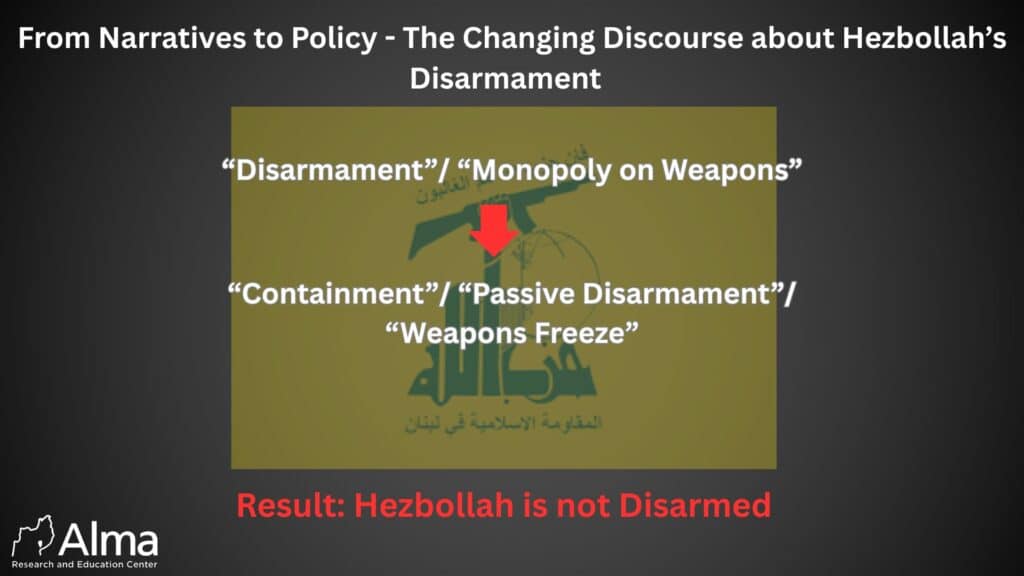
The discourse surrounding the disarmament of Hezbollah has undergone a substantive shift in recent months, from a discourse emphasizing disarmament to one focused on the containment of weapons. Semantics are significant as it facilitates and legitimizes policy change, with the aim of creating a favorable “climate” for Hezbollah. The first phase of Hezbollah’s disarmament south of the Litani River, which concluded at the end of 2025 in accordance with the timetable to which the Lebanese Armed Forces committed, was declared a success by the Lebanese government.
According to the government, the Lebanese Army completed the mission, and its forces are now deployed throughout southern Lebanon, except for five strategic points where the IDF remains present. According to Lebanese Army data, this deployment includes more than 10,000 soldiers at approximately 200 positions. In addition, it was reported that 177 tunnels and 566 missile launchers were located and neutralized.
However, alongside the figures presented by the Lebanese Army, no documented evidence was provided to substantiate these numbers. Moreover, the IDF’s offensive activity in southern Lebanon points to a significant gap between official declarations and the reality on the ground: even after the (ostensible) announcement of the completion of the first phase by the Lebanese Army, numerous weapons storage sites, launch sites, efforts to rehabilitate military infrastructure, and an ongoing presence of Hezbollah operatives continue to exist – including south of the Litani River.
The gap between public rhetoric and actual practice has long characterized the discourse in Lebanon regarding the weapons issue. On the one hand, repeated statements by the President of Lebanon, the Prime Minister, and the Minister of Foreign Affairs have ostensibly presented a unified “sovereign” line, emphasizing the principle of the state’s monopoly over weapons (without explicitly mentioning Hezbollah or the “resistance”) and the need to extend the authority of the Lebanese government over the entirety of the country’s territory. Within this framework, objectives were also articulated that were perceived as aiming toward the disarmament of Hezbollah.
On the other hand, in practice a more gradual and cautious policy pattern is taking shape, stemming from the need to balance international pressure exerted on the Lebanese government with the desire to avoid tension or direct confrontation with Hezbollah, and, in effect, to create a favorable “climate” for the organization. Accordingly, the Lebanese Army operates in coordination with Hezbollah in a manner that is acceptable and convenient for the group, does not materially undermine its military rehabilitation efforts, yet allows the government to present externally an image of progress in the disarmament process in line with the objectives that were set.
In August 2025, an official decision was adopted in Lebanon to disarm Hezbollah’s weapons, framed in terms of “the confiscation of weapons” (حصر السلاح) and “the monopoly of weapons by the state” (حصر السلاح بيد الدولة), and accompanied by a timetable for the disarmament process.
However, already in November–December 2025, the discourse began to change gradually and to soften. The terms “containment” or “confinement” (احتواء) began to replace the terms “disarmament” and “exclusivity.”
The terms “containment of weapons” or “confinement of weapons” were defined as a situation in which the weapons are stored, not used, not transferred or smuggled, and placed under supervision – but not confiscated. In practice, this means that the weapons remain in Hezbollah’s hands and under its full control.
Another strategy raised in a document of the Lebanese Army, according to an article published in the Lebanese–French journal L’Orient, is “passive disarmament.” This approach avoids direct confrontation with Hezbollah over the weapons issue and instead focuses on preventing smuggling from Syria and restricting the transfer of weapons and equipment within Lebanon, with the aim of “drying up” the organization’s weapons stockpiles over the long term.
In December 2025, against the backdrop of concerns over escalation with Israel due to the Lebanese Army’s failure to meet its commitment to disarm Hezbollah south of the Litani River, the discourse of containment began to appear among American officials as well. For example, the U.S. Ambassador to Lebanon, Michelle Issa, noted that if Hezbollah cannot be disarmed, there should be a weapons “freeze” instead, that is, the weapons will be left in the organization’s possession but stored and not used. The Egyptian intelligence director, Hassan Rashad, used a similar term: “strategic dormancy.”
Statements made by the special envoy, Tom Barrack, in November 2025, indicating that it was unlikely the Lebanese government would succeed in disarming Hezbollah, also contributed to advancing the discourse within Lebanon regarding softened alternatives to disarmament.
In early January 2026, after the Lebanese government announced that the first phase of weapons disarmament south of the Litani River had been completed, discussions began regarding the implementation of the next phase, north of the Litani and in the rest of the country. Lebanese officials clarified that while a policy of exclusive state control over weapons would be applied south of the Litani, a policy of containment would be implemented north of the Litani and throughout the remainder of the country. Here too, this refers to preventing the transfer, smuggling, and use of weapons, but not to their disarmament or confiscation from Hezbollah. In this context, Prime Minister Nawaf Salam stated: “We are committed to the plan – disarmament of weapons south of the Litani and containment of weapons in the other areas.”
The Lebanese Minister of Information, Paul Marcus, also reiterated this approach, noting that the Lebanese Army would begin work on a plan to disarm weapons north of the Litani, a matter to be discussed in February 2026, while, in parallel, the principle of containment would be applied in the rest of the country.
Lebanon’s Minister of Foreign Affairs, Youssef Rajji, addressed the issue in an interview with the Washington Institute, arguing that due to a lack of resources and manpower, the Lebanese Army is unable to disarm Hezbollah simultaneously both south and north of the Litani. On January 12, the Lebanese foreign minister acknowledged that Hezbollah’s disarmament south of the Litani had not, in fact, been completed (despite the Lebanese government having already declared this phase successfully concluded). Regarding continued activity north of the Litani, he noted that at this stage the policy is one of containment in the north, but that this is not a substitute for disarmament, and that when the second phase begins, the army will act to disarm weapons throughout Lebanon.
The current discourse therefore points to a clear shift in trend: a move from the semantics and terminology of comprehensive disarmament to a gradual and softened semantic framework, whose purpose is to legitimize a softened policy that is convenient for Hezbollah. The intention and objective are to retroactively legitimize the policy applied to the area south of the Litani and to prepare the ground for future policy in the subsequent stages of the process.
In contrast to the softened line emerging within the Lebanese government and among senior American officials, Hezbollah is in fact sharpening its tone and hardening its positions.
In response to the government’s decisions to disarm Hezbollah, the organization and its leader, Naim Qassem, are promoting narratives of “national unity” and “internal stability,” primarily in the face of what they define as foreign interests threatening Lebanon. The issue of disarmament is presented as an American–Israeli project. According to their claims, relinquishing the weapons would lead to further demands and additional concessions by Lebanon. Accordingly, it is argued that “anyone who calls for disarmament serves the Israeli project, whether they intend to or not.”
In Hezbollah’s narrative, the weapons are not portrayed as a problem but as a solution. According to Qassem, “the weapons of the resistance have never been a burden on Lebanon, but rather a component of its defense.” Lebanon’s security and that of its citizens depend on resistance to Israeli aggression. Hezbollah further portrays Israel as responsible for its unwillingness to relinquish its weapons, emphasizing: “We will remain armed as long as occupation and threat exist – this is a decision from which there is no return.”
Qassem categorically rejects any possibility of disarmament: “Hezbollah’s weapons are a red line, and we will not allow anyone to disarm them under any circumstances… No government, no state, and no international decision can force us to give up our weapons.”
In response to the Lebanese foreign minister’s statement of January 12, according to which Israel has the right to continue its strikes as long as Hezbollah has not disarmed, Qassem attacked the minister in a public speech, accusing him of “playing with civil peace” and of incitement. He claimed that the minister was collaborating with Israel and attempting to drag Lebanon into a civil war. Qassem further called on the government to replace him, silence him, or impose “Lebanon’s policy” upon him.
The shift in the discourse of decision-makers in Lebanon, from a policy of exclusivity and disarmament to a softened discourse of containment, points to a lack of willingness and determination on the part of the Lebanese government to act against Hezbollah, and to a move toward (or a return to) a conciliatory line vis-à-vis the organization.
When this trend is also reflected in statements by senior American officials, Hezbollah’s narrative, already articulated publicly in clear terms, is further reinforced:
a. The weapons are a right, not a problem.
b. The weapons of the resistance are not a burden on Lebanon, but a component of its defense.
c. The weapons will remain in Hezbollah’s hands under any scenario.
d. The state has no authority to disarm the weapons.
Instead of seizing the opportunity for a thorough effort to disarm Hezbollah throughout Lebanon, the Lebanese government is focusing on public relations and attempts to appease all sides – at the expense of a long-term strategic course of action.




One Response
Dear Dr Zoe,
Thank you for your report. We cannot accept a policy of containment. This was tried in Gaza with catastrophic result. Zombie army enforcement is not acceptable either. That was tried in Lebanon already with catastrophic result. The LAF and UNIFIL were partners in crime to support Hezbollah.
Hezbollah must be disarmed and defeated.