Dr. Yossi Mansharof and Tal Beeri
Amid pressure from Tehran, Hezbollah stands torn between ideological loyalty to the Iranian axis and considerations of its own organizational survival — with the scenario of a “rogue” action entirely plausible.
After the unusual Israeli strike on Hezbollah positions in the Beqaa on Saturday (February 21), the IDF stated that the operation targeted the organization’s missile array. The statement further noted that this array is responsible for launching missiles and rockets at Israel and is “currently engaged in planning such attacks against our territory.” Reports indicated that, in addition to eight Hezbollah operatives, Mohammed Yaghi was killed in the strike. Based on his title, he served at least as a unit commander within Hezbollah’s missile and rocket array. In that capacity, Yaghi was expected to play a significant role in advancing and coordinating launches against Israel in the event of a war involving Iran.
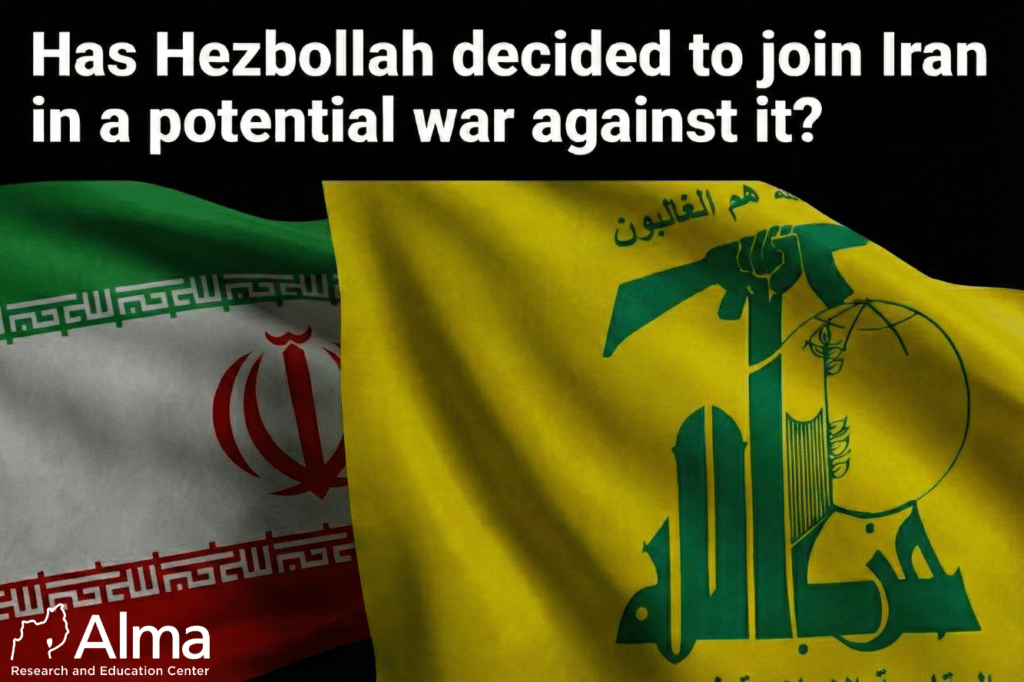
Amid the growing prospect of war surrounding Iran, Hezbollah now faces a pivotal question that could significantly shape its future. Has the organization taken a strategic decision to enter a potential conflict in support of Iran, should one erupt? Which path will it choose? Will it prioritize ideological commitment over considerations of self-preservation? From an ideological standpoint, Hezbollah would be compelled to join a possible war waged against Iran, particularly because, unlike during the “Am K’Lavi” campaign, the United States is expected to play a far more substantial role this time. From a survival perspective, however, Hezbollah would be better served by staying out of the fighting, hoping the Iranian regime withstands the conflict and, in doing so, safeguarding its own long-term position.
What will lead Hezbollah to decide to join the war?
If Hezbollah has in fact resolved to join a potential war waged against Iran, it seems likely that this decision reflects a sustained pressure campaign by Tehran in recent weeks. In a February 1 speech, Iran’s Supreme Leader, Khamenei, limited himself to a broad assertion that any forthcoming war against Iran would take on a regional character. Yet on February 5, his senior adviser on international affairs, Ali Akbar Velayati, released a letter he had sent to Hezbollah Secretary-General Naim Qassem, unmistakably signalling Iran’s expectation that Hezbollah prepare to enter the fray. Velayati underscored that the Iranian regime constitutes the central pillar of the Axis of Resistance. He maintained that Tehran is ready to confront any threat and that, should war break out, the Axis of Resistance would ultimately prevail. At the same time, he conveyed the regime’s anticipation that Hezbollah would take part in the conflict, arguing that the Shiites of Iran and Lebanon represent “a continuation of one path of faith,” bound together by profound religious and historical ties. He praised the “formidable dam” Hezbollah has erected in Lebanon against Israel, while implicitly rebuking Lebanon’s political leadership, whom he labelled “detached elements” and “appointed officials”, for failing to grasp that Hezbollah’s arsenal alone serves as an effective bulwark against Israel’s expansionist aspirations in Lebanon and Syria. In a related development, Israeli media reported on February 18 that Iran has been undertaking various measures, some discreet, to intensify pressure on Hezbollah.
However, considering the significant geo-political changes in the region, Iran cannot appear as being responsible for the enormous damage that Lebanon would suffer if Hezbollah joined the circle of fire. Therefore, in an interview with Al-Jazeera on February 7, Iranian Foreign Minister Araghchi expressed Iran’s aspiration to be perceived as not having pushed Hezbollah into the campaign. Accordingly, he emphasized that Hezbollah would decide on the issue itself, and that Iran can defend itself and does not require assistance from anyone.
Another element that could account for a Hezbollah decision to enter the war is its persistent concern over possible Syrian retaliation. As is well known, Hezbollah played a central role in acts of genocide and war crimes during the Syrian civil war. The Lebanese daily Al-Akhbar, which serves as a mouthpiece for Hezbollah, reported on February 5 that al-Sharaa stated in a closed meeting that “now it is Hezbollah’s turn,” expressing his intention to exploit the opportunity created by a war against Iran to exact revenge on the organization. This Syrian drive for retribution was further underscored by remarks from a Syrian security source on February 16 to the Israeli channel i24news, who said that “the score with Hezbollah has not yet been settled,” and noted that al-Sharaa’s regime is currently concentrating on dismantling the infrastructure Hezbollah established on the Syrian side of the Lebanon–Syria border.
Opting for ideological commitment in accordance with clerical jurisprudential rulings, or being pulled into war on the grounds of “insubordination”?
Hezbollah’s decision to join the “Swords of Iron” war caused enormous damage to the Lebanese state, estimated by the World Bank at approximately $14 billion. Another decision on its part to drag Lebanon into an additional regional confrontation would constitute another blow to the Lebanese vertex in the organization’s web of identities and would unequivocally clarify the dominance of its revolutionary-Iranian character, in accordance with the pronounced Iranian influence over the organization.
However, it is important to emphasize that the ultimate decision regarding Hezbollah’s participation in a potential war rest with the supreme religious cleric—Iran’s leader, Khamenei—as well as with the organization’s “Shura Council,” which serves as its highest strategic decision-making body. The council is headed by Secretary-General Naim Qassem, who has been consolidating his control over the organization, particularly through the reorganization process he has been advancing in recent months.
At the same time, under the current circumstances, we assess that the probability of a “rogue” action could increase, especially in the event of an American strike on Iran. At any given moment, an independent move of this kind could emerge, driven by an alternative worldview and/or internal disagreements over the broader directives set by the political leadership.
Hezbollah’s military leadership is grappling with a prolonged leadership crisis, coupled with marked attrition within its mid-level command ranks. The targeted eliminations the organization sustained during the war created a leadership vacuum that deepened internal disagreements and heightened tensions among the senior figures who remained. The elimination of Abu Ali Tabatabai in November 2025 further compounded this challenge, widening the vacuum and increasing the risk of “insubordination.”
Hezbollah’s containment policy during the ceasefire, alongside Israel’s continued strikes against the organization’s military infrastructure and personnel, has fuelled growing resentment, frustration, and internal disputes over the wisdom of maintaining restraint. This situation is exacerbated by the substantial weakening of the mid-level command tier due to the loss of seasoned commanders and key knowledge hubs, the mounting burden on those still in position, and disruptions to command and operational continuity. In this context, an Iranian trigger could serve as a catalyst from the perspective of a fatigued, embittered, and frustrated “rogue” actor.
Yossi Mansharof is a researcher of Iran and Hezbollah at the Misgav Institute for National Security; Tal Beeri is the Director of Research at the “Alma” Center for the Study of Security Challenges in the Northern Arena.
Published in the newspaper Israel Hayom on February 23, 2026.