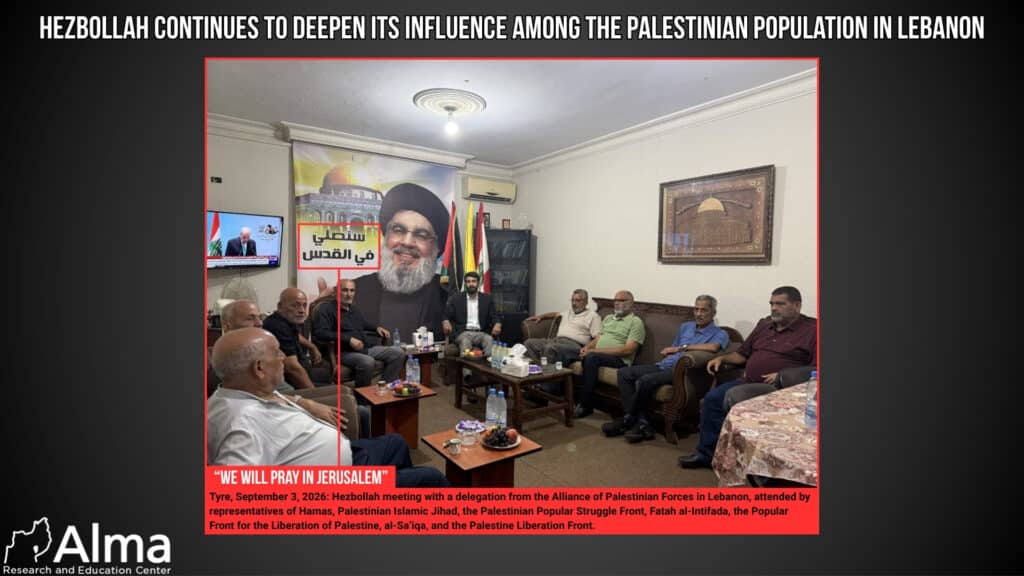
On September 3, Hezbollah held a meeting in Tyre with a delegation from the “Alliance of Palestinian Forces in Lebanon,” attended by representatives of Hamas, Palestinian Islamic Jihad, and other Palestinian organizations. The meeting was intended to continue the political and operational coordination between the parties against the backdrop of developments in Lebanon and the Palestinian arena.
Behind the participants was a banner featuring an image of Hassan Nasrallah, the Dome of the Rock, and the words: “We Will Yet Pray in Jerusalem.”
The relationship between Hezbollah and the Palestinian organizations is not based solely on coordination between their leaderships and joint photo opportunities. Over the years, this relationship has also manifested itself in both military cooperation and civilian activities, enabling Hezbollah to maintain its influence within the Palestinian arena in Lebanon.
These activities illustrate how Hezbollah also uses its civilian apparatus to establish and deepen its influence among the Palestinian population in Lebanon.
For example, Hezbollah periodically holds free health days for Palestinians in Lebanon through its Islamic Health Organization, in cooperation with bodies operating in the Palestinian refugee camps and supporting the Palestinian “resistance.” These initiatives provide free medical treatment and medications.
From Israel’s perspective, this means that the Palestinian threat emanating from Lebanon does not exist independently of Hezbollah. Despite rivalries and separate interests, Hezbollah continues to maintain political and civilian ties with Palestinian organizations—a network of relationships that supports Hezbollah’s military activity against Israel. During the most recent war, we saw all of the major Palestinian organizations physically participate in the fighting against Israel in coordination with Hezbollah, with dozens of their operatives killed in the fighting.