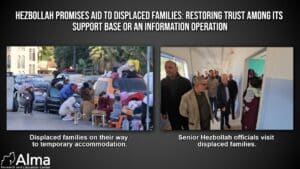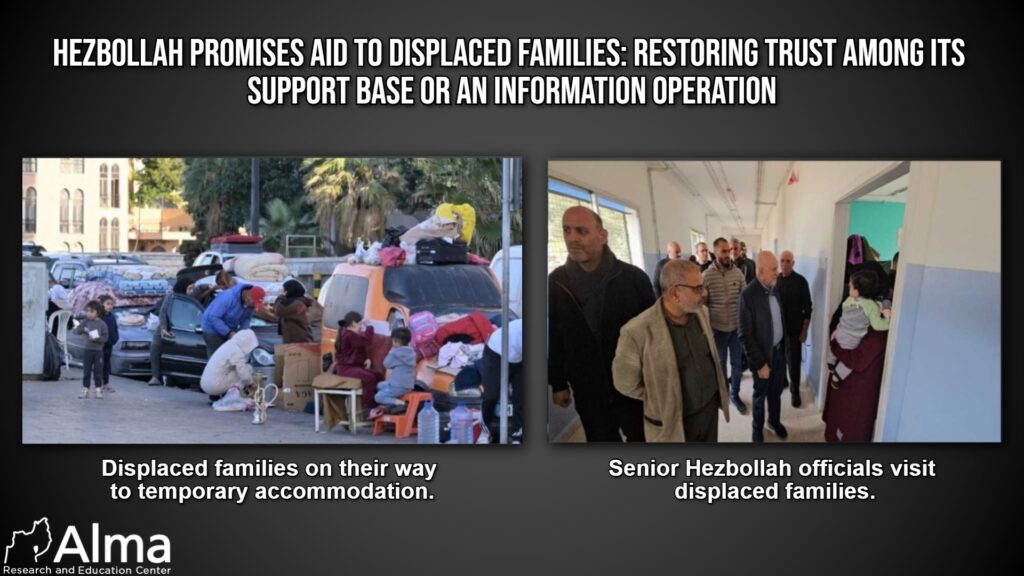
Are the reports published in recent weeks regarding Hezbollah’s preparations to resume financial assistance to displaced families, along with the latest Reuters report concerning the transfer of $200 million in Iranian aid to Hezbollah for this purpose, the result of an information and influence campaign conducted by Hezbollah?
Are these reports actually intended to reinforce a central narrative in which the Lebanese state and government are blamed for their failure to address social and economic issues, while Hezbollah is portrayed as acting to improve the situation of displaced families, provide housing allowances, and support reconstruction?
At this stage, we do not know the answers to these questions, nor are we able to assess the reliability of the reports. In any case, it is important to remember that Hezbollah has a clear interest in reinforcing the perception among its support base that the state is failing to provide solutions, while seeking to divert criticism away from itself and toward the government.
The Reuters report published on October 7 details a payment of $3,000 per family, with priority given to 50,000 families whose villages have been destroyed and who are unable to return to their homes. The report did not emerge in a vacuum. In fact, it follows several earlier reports published in Lebanon.
On October 3, it was reported that Hezbollah officials had begun receiving numerous inquiries from families regarding when financial assistance and “housing allowance” payments would resume. According to the information, the organization had begun conducting a new survey of eligible families to determine where they currently reside and assess their present circumstances.
According to the report, priority is expected to be given to families still residing in displacement centers, schools, or temporary accommodations that they do not own. This initiative follows a statement by Naim Qassem that Hezbollah would once again participate in financing housing for affected families.
Earlier, on September 19, it was reported that Hezbollah was in the advanced stages of preparing a mechanism for paying housing allowances to families whose homes had been destroyed. According to the report, the organization had recently focused on raising the necessary funds and establishing a mechanism that would enable their distribution to eligible recipients.
As noted above, at this stage, it remains unclear whether Hezbollah will actually provide financial assistance to displaced families and, if so, what the scale of these payments will be.
Currently, given the organization’s financial difficulties and challenges in general, and the even greater difficulties involved in transferring funds to Hezbollah in Lebanon in particular, Hezbollah is clearly prioritizing the allocation of its resources to military reconstruction over providing financial assistance to its support base.
On the other hand, Hezbollah has a clear interest in restoring its position as a direct provider of financial support to its support base.
Accordingly, we assess that despite these difficulties, Hezbollah will seek to provide some financial assistance to displaced families, although probably on a limited scale.