Within the framework of Hezbollah’s attacks against IDF forces and Israeli territory, it is, as expected, making use of anti-tank missiles. On March 4, it even succeeded in hitting an IDF force and wounding two soldiers. We do not have data regarding the quantities of anti-tank missiles currently in Hezbollah’s possession, but it can be estimated that the size of the arsenal, across the various missile types, stands at several thousand. This would allow Hezbollah to make prolonged use of them, provided operational conditions arise that enable launches. What types of anti-tank missiles can Hezbollah launch toward IDF forces along the line of contact and toward Israeli territory near the border?
Below is a breakdown of the anti-tank missiles in Hezbollah’s arsenal (in addition to RPG rockets):
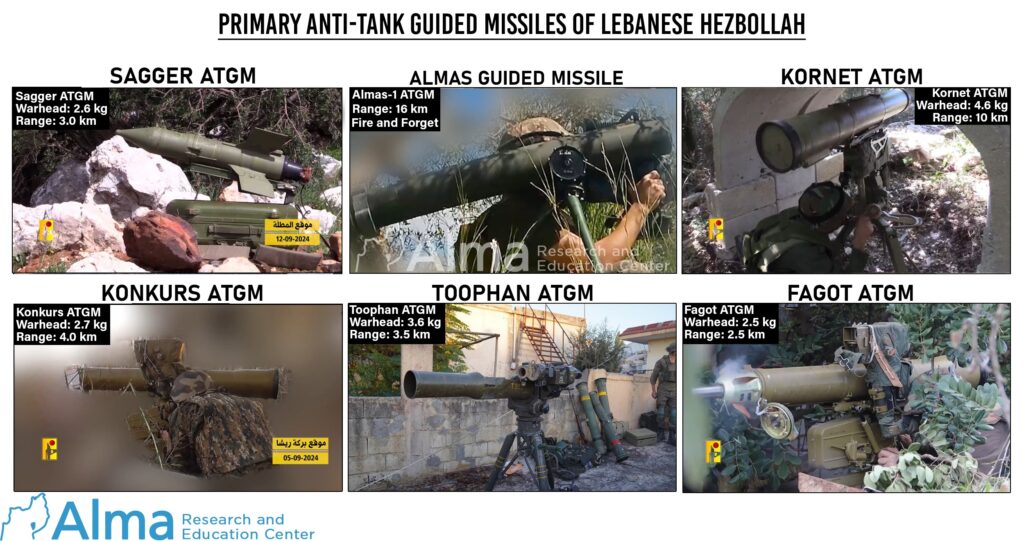
Sagger – up to 3,000 meters. First generation (see explanation below) – manually guided via wire.
Fagot – up to 2,500 meters. Second generation (see explanation below) – wire-guided.
Metis – up to 1,000 meters. Second generation – wire-guided (capable of launching from enclosed spaces due to a two-stage activation, where the motor ignites only after the missile has been launched by an initial charge).
Milan – up to 3,000 meters. Second generation – wire-guided.
Toophan – up to 3,500 meters. Second generation.
Konkurs – up to 4,000 meters. Second generation.
Kornet – up to 5,500 meters (improved version up to 10,000 meters), second generation, laser beam-riding (without wire).
Almas – up to 16 kilometers. An Iranian version of the Israeli Spike missile. Operates on the “fire-and-forget” principle (third generation). Ballistic movement toward the target (top-attack). Equipped with a camera transmitting back during flight.
In the first generation, the operator (the shooter) must control, from the moment of launch until impact, the position of the sight relative to the target, the position of the missile itself, and physically track the target’s location. In the second generation, the operator must control the position of the sight relative to the target and physically track the target’s location, but there is no need to control the missile’s position during its flight.