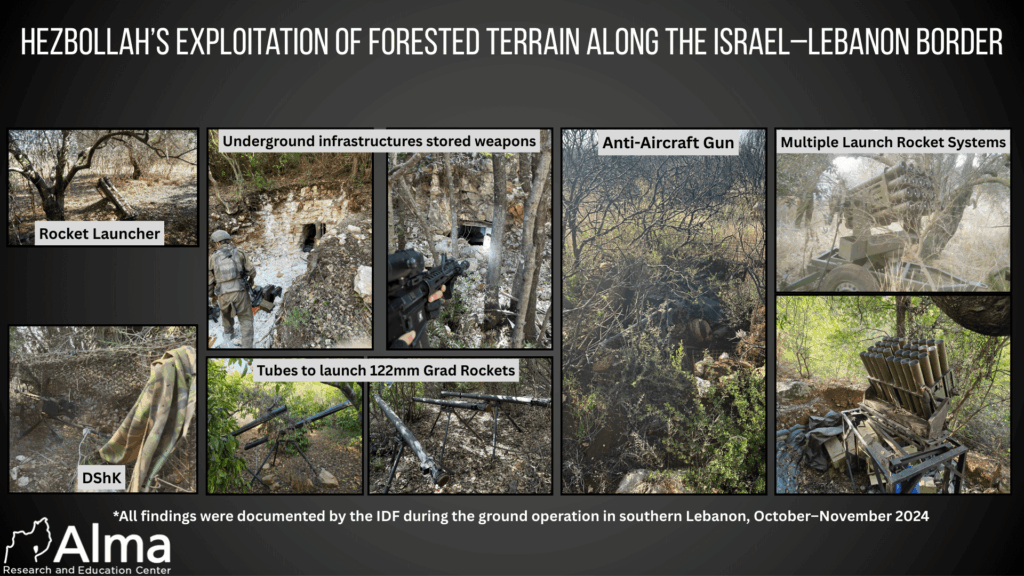
For years, Hezbollah has exploited dense and forested areas in southern Lebanon and along the Israel–Lebanon border for military purposes. As part of this effort, the organization has promoted agricultural projects and so-called “green initiatives” involving tree planting, which in practice contribute to the creation of dense vegetated areas. These areas are subsequently used for concealment, weapons storage, and operational preparations for attacks against Israel.
The body responsible for this activity is Jihad al-Bina, Hezbollah’s construction and rehabilitation arm. Although presented as a civilian entity, it in fact plays a central role in building military infrastructure, including the concealment of rockets and missiles and the establishment of underground tunnel networks. In this capacity, it functions as a key link between Hezbollah’s civilian arm and its military force build-up.
Operating under Jihad al-Bina is also the “Agricultural Jihad” campaign—initiatives involving tree planting, community-based agricultural projects, and broader agricultural development. These initiatives are framed as social efforts aimed at strengthening the Shiite population. However, when the same body is simultaneously responsible for constructing military infrastructure and concealing weaponry, the blurring of civilian and military spheres emerges as systematic rather than incidental.
In addition, the organization “Green Without Borders,” presented as an environmental NGO, served as another instrument for consolidating Hezbollah’s presence in forested areas adjacent to the border under civilian and “ecological” cover, effectively functioning as a preparatory platform for a potential incursion into the Galilee.
The implications are clear: tree planting, agricultural development, and the growth of dense vegetation create physical conditions that enable the natural concealment of military infrastructure, provide depth and cover for weapons stockpiles, and prepare the ground for future underground storage facilities and operational staging positions for infiltration into Israeli territory.

In recent weeks, Hezbollah has promoted tree-planting campaigns marking the birth of Imam Mahdi. Although these activities are not currently taking place directly along the border, past experience demonstrates that forested areas developed by the organization have later been utilized for military purposes and effectively constitute a potential operational asset. Hezbollah’s motivation does not stem from environmental concern, but from strategic military considerations aimed at facilitating future terrorist activity.
Against the backdrop of Lebanese and Syrian reports regarding Israeli crop-dusting aircraft operating in areas adjacent to the borders with Lebanon and Syria, it is important to recognize that vegetative cover constitutes a natural protective infrastructure for terrorist activity. It is not a question of if, but when, terrain covered with dense vegetation will be exploited to carry out a terror operation against Israel from Lebanese or Syrian territory. Hezbollah’s “Agricultural Jihad” initiative is intended to create precisely such an infrastructure in southern Lebanon.
For years, Hezbollah has exploited dense and forested areas in southern Lebanon and along the Israel–Lebanon border for military purposes. As part of this effort, the organization has promoted agricultural projects and so-called “green initiatives” involving tree planting, which in practice contribute to the creation of dense vegetated areas. These areas are subsequently used for concealment, weapons storage, and operational preparations for attacks against Israel.
The body responsible for this activity is Jihad al-Bina, Hezbollah’s construction and rehabilitation arm. Although presented as a civilian entity, it in fact plays a central role in building military infrastructure, including the concealment of rockets and missiles and the establishment of underground tunnel networks. In this capacity, it functions as a key link between Hezbollah’s civilian arm and its military force build-up.
Operating under Jihad al-Bina is also the “Agricultural Jihad” campaign—initiatives involving tree planting, community-based agricultural projects, and broader agricultural development. These initiatives are framed as social efforts aimed at strengthening the Shiite population. However, when the same body is simultaneously responsible for constructing military infrastructure and concealing weaponry, the blurring of civilian and military spheres emerges as systematic rather than incidental.
In addition, the organization “Green Without Borders,” presented as an environmental NGO, served as another instrument for consolidating Hezbollah’s presence in forested areas adjacent to the border under civilian and “ecological” cover, effectively functioning as a preparatory platform for a potential incursion into the Galilee.
The implications are clear: tree planting, agricultural development, and the growth of dense vegetation create physical conditions that enable the natural concealment of military infrastructure, provide depth and cover for weapons stockpiles, and prepare the ground for future underground storage facilities and operational staging positions for infiltration into Israeli territory.
In recent weeks, Hezbollah has promoted tree-planting campaigns marking the birth of Imam Mahdi. Although these activities are not currently taking place directly along the border, past experience demonstrates that forested areas developed by the organization have later been utilized for military purposes and effectively constitute a potential operational asset. Hezbollah’s motivation does not stem from environmental concern, but from strategic military considerations aimed at facilitating future terrorist activity.