Latest Developments in the Investigation
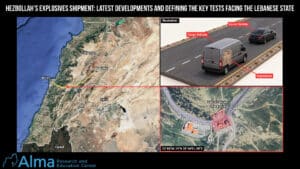
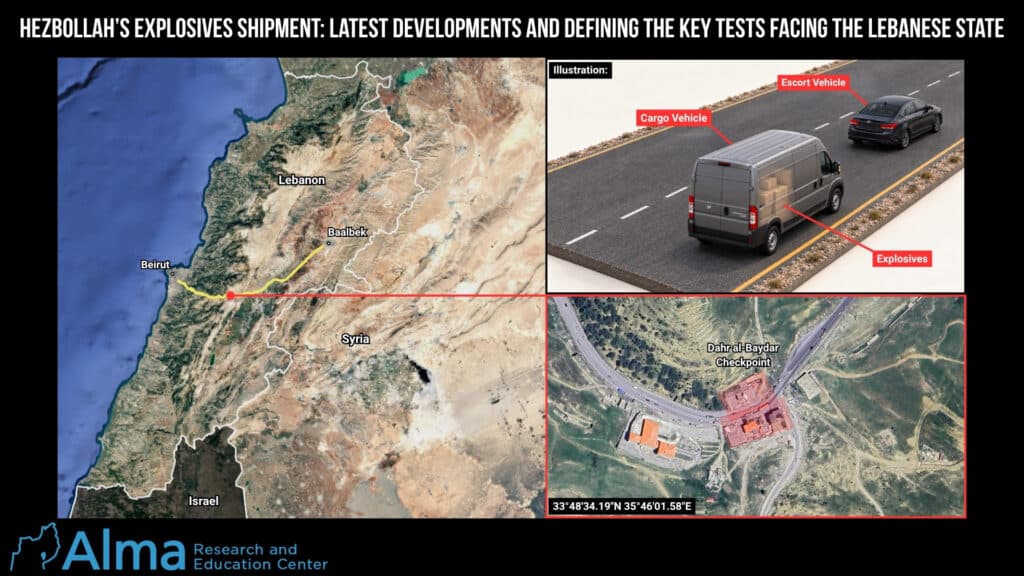
Recent reports indicate that the investigation into the explosives shipment seized at the Dahr al-Baydar (ضهر البيدر) checkpoint, en route from the Bekaa Valley to Beirut, has expanded. On October 27, it was reported that the explosives had been loaded at a warehouse in Baalbek and transported toward Beirut’s southern suburb, the Dahieh, in a Dodge vehicle. An escort vehicle traveled ahead to scout the road and secure the transfer route. This is a known Hezbollah operating method that we have also observed in similar weapons transfers within Lebanon. One example is the overturning of a weapons truck in the Christian town of al-Kahaleh on August 9, 2023, at a bend near St. Antoine’s Church, while traveling from the Bekaa Valley to Beirut. That incident escalated into an exchange of fire between Hezbollah operatives and Lebanese Forces members, leaving two people dead. In the present case, the escort vehicle passed through the Dahr al-Baydar checkpoint before the explosives were seized. Its occupants continued toward Beirut, where their trail was lost. [1]
On October 26, it was reported that the Information Branch of Lebanon’s Internal Security Forces had identified three Hezbollah members who had traveled in the escort vehicle, a Kia. Efforts to locate and arrest them were reportedly underway, although their names had not been published. [2] The vehicle’s license plates were also reportedly identified. [3]
Following the seizure, members of Hezbollah’s security coordination committee reportedly moved quickly to disable surveillance cameras along the route from Baalbek to Beirut. However, the security agencies reportedly obtained footage from other cameras that had remained operational. Lebanese security authorities are examining this footage alongside communications data to identify those who traveled in the escort vehicle.[4] According to one report, the vehicle had entered Lebanon from the Jarajir (جراجير) area in Syria through an illegal crossing before reaching the Dahr al-Baydar checkpoint. [5]
Reports differ on the weight of the shipment. Local reporting put the quantity found in the vehicle at 500 kilograms of explosives, including approximately 250 kilograms of TNT and a similar quantity of C4. Lebanese Justice Minister Adel Nassar (عادل نصار), by contrast, referred to a shipment weighing 800 kilograms. The shipment therefore contained hundreds of kilograms of explosives, although its precise weight is not consistently reported. [6]
Military prosecutor Claude Ghanem (كلود غانم) is expected to complete the investigation by the end of October at the latest and to pursue charges against more than four individuals. In parallel, Lebanese Army Intelligence may have questioned several Hezbollah members in recent days after their names were mentioned in the detainees’ statements. They were reportedly released after no direct involvement in the incident was established. [7]
The Detained Transporters Ali al-Kurdi and Haitham Amhaz
The two operatives arrested in the vehicle carrying the explosives were identified as Ali al-Kurdi (علي الكردي) and Haitham Amhaz (هيثم أمهز). During questioning, they claimed that they had been hired to drive the vehicle from the Bekaa Valley to Beirut for payment, park it at a designated location, and hand it over there. In this initial account, they claimed that they did not know the contents of the shipment or the identities of those handing it over and receiving it. According to reporting on his background, Amhaz had previously been detained in a drug-trafficking case and had been released from prison some time before the present incident. [8]
According to some reports, the two worked for Hezbollah without formal organizational affiliation. Investigators were also reportedly examining possible ties to individuals associated with Saraya al-Muqawama (سرايا المقاومة – literally: “Resistance Brigades”). Hezbollah established this military proxy framework in 1997 to enable Lebanese from different sectarian communities, including Sunnis, Christians, and Druze, to participate in operations against Israel without formally joining Hezbollah.
A separate report attributed direct membership in Saraya al-Muqawama to al-Kurdi. A claim that one of the detainees was the son of a senior Hezbollah official was also denied. [9]
Hezbollah’s Weapons Transfer Organizers Sajed and Dhu al-Fiqar
Two aliases emerged during the detainees’ questioning: “Sajed” (ساجد), who reportedly handed the shipment to al-Kurdi and Amhaz in Baalbek, and “Dhu al-Fiqar” (ذو الفقار), who was supposed to receive it in the al-Musharrafieh area of Beirut’s southern suburb. Available open-source information does not establish their identities or their roles within the organization. [10]
On October 19, it was reported that Lebanese Army Intelligence had identified the two, but that they had not yet been arrested.[11] On October 20, a report stated that Judge Claude Ghanem, acting as a government prosecutor at the Military Court, had issued warrants to bring them before the judicial authorities after their full identities had been verified. As of this writing, their full names have not been published. A conflicting report dated October 21 stated that the Military Court was still awaiting the completion of the investigation and that no warrants had yet been issued. [12]
Expansion of the Investigation to Amhaz’s Wife and the Vehicle Owner
On October 23, it was reported that the investigation had expanded to include Haitham Amhaz’s wife and the owner of the seized vehicle. Judge Ghanem, acting as a government prosecutor at the Military Court, issued notices to locate them for questioning, but they did not appear.[13] Examination of the phones belonging to the two detainees and Amhaz’s wife reportedly yielded additional information. Further names may also have emerged as suspects with possible links to the shipment. [14]
The Lebanese Justice Minister’s Position
In an interview on October 23, Justice Minister Adel Nassar stated that he had submitted a formal proposal to refer the entire case to the Judicial Council (المجلس العدلي). This is a special criminal court in Lebanon that hears cases involving offenses against state security and certain crimes against public order, referred to it by a cabinet decision. According to Nassar, the proposal was registered with the cabinet secretariat and placed on the agenda after he had raised the matter in earlier discussions and secured support from other ministers, including those representing the Lebanese Forces party. Nassar emphasized that the transportation and storage of the explosives themselves posed a danger to the public and a threat to national security. He treated Hezbollah’s statement as an acknowledgment that the explosives belonged to the organization. He argued that even the military purpose Hezbollah attributed to the materials, as part of its “resistance” against Israel, conflicted with Lebanon’s constitution, the state’s exclusive authority over military force, and the cabinet decision prohibiting the organization’s military activity. [15]
The cabinet decision of March 2, 2026, imposed an immediate ban on all Hezbollah military and security activity, demanded that it surrender its weapons to the state, and restricted its activities to the political sphere within the framework of the law and constitution. Nassar’s position therefore rests on an explicit government decision, in addition to his criticism of the danger posed by transporting explosives. [16]
Alongside the claim that the shipment had a military purpose, Nassar raised the possibility that the materials were intended for operations inside Lebanon. He made clear that determining their intended use was a matter for the investigation and the judiciary. His remarks do not establish that the shipment was intended for an internal attack or assassination. Nevertheless, the public discourse in Lebanon reflects widespread suspicion that the shipment was intended for domestic use rather than operations against Israel. [17]
In an October 25 interview with Al Jadeed, Nassar said that President Joseph Aoun and Prime Minister Nawaf Salam supported referring the case to the Judicial Council in principle but disagreed with him over the timing. He announced that he would continue raising the request at cabinet meetings. [18]
Hezbollah’s Justification
In a video published on October 21, Hezbollah MP Hussein al-Hajj Hassan (حسين الحاج حسن) responded to Lebanese public criticism of the incident by calling for an end to what he described as incitement. He suggested that the Lebanese government was focusing on Hezbollah’s explosives while “the Israelis are bringing 100 truckloads of explosives into Lebanon”.[19]
In another clip, al-Hajj Hassan addressed efforts to prevent Hezbollah from transporting weapons across Lebanon and suggested that President Aoun should “first prevent the Israelis from transporting weapons and carrying out airstrikes” on Lebanese territory. [20]
In a further statement on October 25, al-Hajj Hassan accused American officials of interfering in the Dahr al-Baydar shipment investigation and attempting to “dictate to the judiciary what is acceptable and what is not.” He argued that the government was contributing to tensions by yielding to American pressure driven by Israeli interests, and warned of the implications of complying with such “dictates” for Lebanon’s stability and national cohesion. [21]
At a cabinet meeting on October 22, Prime Minister Nawaf Salam delivered a strongly worded statement on the Dahr al-Baydar incident. He said that the storage or transportation of weapons and explosives by an unauthorized actor violated the law and cabinet decisions, endangered public safety, and required investigation, prosecution, and stringent punishment. Despite his remarks, the decision on referring the case to the Judicial Council was postponed. Ministers representing the Lebanese Forces walked out in protest, with the exception of Justice Minister Adel Nassar.
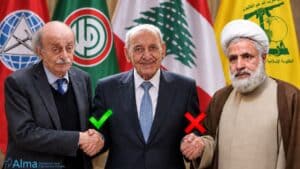
According to reports, Parliament Speaker Nabih Berri, who heads the Amal movement, held contacts aimed at averting a confrontation within the cabinet. Hezbollah also conveyed a message through intermediaries that refraining from referring the case to the Judicial Council could serve as a step toward rebuilding relations between the organization and the presidency.
Threats and Warnings Between External Action and Internal Confrontation
Alongside the public statements, reports described threatening messages directed at Lebanon’s security and judicial authorities. The Lebanese authorities reportedly received a clear warning that any leniency in investigating the case could prompt further Israeli military action. At the same time, Hezbollah members conveyed messages to the authorities warning that legal action against the organization, or any move to designate it a terrorist organization, could provoke a response on the streets. [22]
Hezbollah made clear to the security agencies that operations against apartments, warehouses, or senior figures associated with it in the Dahieh could lead to confrontation. Publications aligned with the organization even portrayed a raid conducted without coordination as a hostile act. Hezbollah also conveyed forceful messages through political and media channels and reportedly considered mobilizing street pressure if the government referred the case to the Judicial Council.
On October 24, Hezbollah MP Ibrahim al-Moussawi (ابراهيم الموسوي) criticized the government’s conduct, arguing that the state was failing to protect residents of the south while pursuing and prosecuting members of the “resistance’s support base.” Mahmoud Qmati (محمود قماطي), a member of Hezbollah’s Executive Council, added that Hezbollah would not disarm and that this was out of the question. He argued that disarmament would cause the state to disintegrate and lead to disastrous consequences. Qmati added: “No one should test us. We are stronger than the state.”
Conclusion
The Lebanese state once again faces a test of both capacity and political will. Can it – and is it willing to – fully investigate the chain of responsibility while Hezbollah demands the return of the vehicle and its contents and exerts pressure against expanding and pursuing the investigation to its conclusion?
A central test is the state’s ability and willingness to arrest “Sajed” and “Dhu al-Fiqar” and bring them in for questioning.
Failure to complete the investigation, uncover their full identities, arrest them, and take measures informed by the findings to prevent further Hezbollah weapons transfers within Lebanon – particularly to areas south of the Litani River – would provide further evidence of the state’s inability to exercise its sovereignty effectively.
[1] https://www.alhadath.net/2026/10/27/%D8%AC%D8% –
[2] https://www.mtv.com.lb/News/%D9%85%D8%
[3] https://www.almodon.com/politics/2026/10/26/%D8%AC%D8%
[4] https://www.alhadath.net/2026/10/27/%D8%AC%D8% –
[5] https://dailybeirut.com/%D9%84%D8% /
[6] https://www.lebanondebate.com/article/891976 ; https://kataeb.org/articles/-%D9%86%D8%
[7] https://www.almodon.com/politics/2026/10/28/%D9%83%D8%
[8] https://www.lebanondebate.com/article/887221
[9] https://www.lebanon24.com/news/lebanon/1581936 ; https://dailybeirut.com/%D9%84%D8% 2/
[10] https://www.almodon.com/politics/2026/10/21/%D8%B4%D8%
[11] https://www.mtv.com.lb/news/1749740
[12] https://www.mtv.com.lb/news/1749740 ; https://www.lebanondebate.com/article/890784 ; https://www.almodon.com/politics/2026/10/21/%D8%B4%D8%
[13] https://www.thisislebanon.com/exclusive/789040/
[14] https://aawsat.com/%D8%A7%D9%84%
[15] https://x.com/AlArabiya/status/2113408811297919045 ; https://kataeb.org/articles/-%D9%86%D8%
[16] https://www.pcm.gov.lb/arabic/subpg.aspx?pageid=26904
[17] https://kataeb.org/articles/-%D9%86%D8%
[18] https://kataeb.org/articles/%D8%B9%D8%
[19] https://x.com/waqa2e3/status/2112879635377643977?a=6Y3m5So7fiPf8ekrmlA&s=20
[20] https://x.com/waqa2e3/status/2112942063012733158?a=YIIUgTc8EWHzFyatu3k&s=20
[21] https://alahednews.news/post/105724/%D8%A7%D9%
[22] https://www.almodon.com/politics/2026/10/21/%D8%B4%D8%