The main strengths of Hezbollah and possible scenarios for the organization’s response against Israel if Iran is attacked.
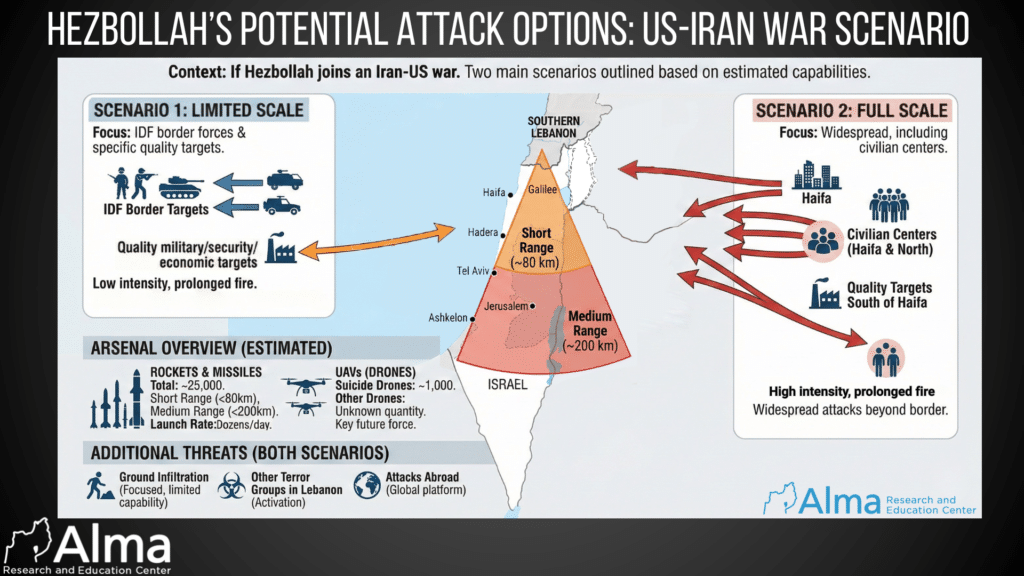
Hezbollah currently possesses an arsenal of rockets and missiles estimated at up to 25,000 items, based mainly on short-range (up to 80 kilometers) and medium-range (up to 200 kilometers) rockets and missiles. Its estimated launch capacity is up to dozens of rockets and missiles per day. The organization’s strategic missile array has been greatly reduced as a result of damage sustained during the war, and we estimate that it consists of only a few hundred advanced missiles, including precision missiles, cruise missiles, air defense and coastal missiles.
The UAV’s array is a central component in building the organization’s future strength. It is estimated that Hezbollah has about 1,000 suicide UAVs, while the full extent of its drone capabilities is unknown. Hezbollah’s “army” is estimated to have a total of 40,000-50,000 regular operatives and 30,000-50,000 reservists. At the core of the ground offensive force is the Radwan unit, in which Hezbollah is investing significant efforts in rehabilitation and force building. The unit currently has about 5,000 operatives, including about 3,000 fighters and about 2,000 support personnel in the areas of administration, logistics, and the like.
If Hezbollah joins Iran in the war, there are two main scenarios: The first is limited fighting. In such a scenario, we estimate that Hezbollah will attempt to attack IDF forces deployed along the border/in Lebanon, with an emphasis on firing from long-range /launching (not necessarily a single attack, but also the possibility of low-intensity fire over time) and/or targeted firing at quality military/security/economic targets in Israel territory. There may also be sporadic shooting against civilian settlements located close to the border.
The second scenario is full-scale warfare. In such a scenario, we believe that Hezbollah will attempt to conduct sustained, relatively broad and large-scale fire (within the limits of its current arsenal). Hezbollah will not be satisfied with firing at IDF targets in the border area but will also add targeted firing/launching at high-value targets in Israel (including south of Haifa) and at civilian population centers in Israel, with an emphasis on the Haifa line and northward.
Both scenarios could also include targeted ground incursions against targets in the border area (Hezbollah does not currently have extensive capabilities in this regard) and the activation of other terrorist organizations in Lebanon (seven in potential) – as was the case in the war.
In addition, Hezbollah has the capability to operate a platform for attacks abroad, which is relevant in both scenarios. In our assessment, this capability will be activated when there is a tangible threat to the survival of the Iranian regime.