By: Tal Beeri and Dr. Zoe Levornik
In an Alma Center report published in August 2026, we examined the negotiations conducted by the Iraqi government with the pro-Iranian militias in an effort to bring weapons under state control. The report found that while several groups expressed a willingness in principle to hand over their weapons or integrate into the security institutions, the more hardline militias with closer ties to the Quds Force, including Kata’ib Hezbollah and Harakat Hezbollah al-Nujaba, continued to oppose disarmament. We also assessed that even in the event of a formal arrangement, Iran might seek to preserve independent capabilities in Iraq by embedding militia operatives within state institutions, concealing weapons, and operating clandestine cells. The real test, therefore, is not a change of name, formal integration, or the symbolic surrender of weapons, but the transfer of all weapons, the chain of command, and decisions regarding the use of force to the Iraqi state.
The Deadline for Bringing Weapons Under State Control Has Been Postponed, While the Militias Retain Their Arms
Developments in September 2026 reinforce the assessment that Iraq remains far from the genuine disarmament of the pro-Iranian militias. Although the government continues to declare its commitment to bringing weapons under state control, the original deadline of September 30, 2026, passed without any significant change in the militias’ status or capabilities.
On September 18, Qasim al-Araji, the Iraqi prime minister’s national security adviser, stated that September 30 marked the end of the international coalition’s mission, rather than a final deadline for the militias to surrender their weapons. He added that the process would proceed gradually, without setting a date for its completion.
One day later, the London-based newspaper Al-Araby Al-Jadeed, citing anonymous Iraqi sources, reported that weeks of negotiations between the government and the militias had produced no results. The talks, mediated by government officials and politicians, including representatives of Shia parties, were intended to find a formula for addressing the weapons issue without triggering an internal confrontation.
According to the report, the militias set a series of conditions: the withdrawal of U.S. and Turkish forces from Iraq; an end to what they describe as U.S. interference in the country’s political and economic decisions; the inclusion of the Kurdish Peshmerga’s weapons in the process; and the acquisition of advanced air defense systems by the Iraqi military. A Shia official quoted in the report also claimed that Iran opposes the disarmament of the militias and views the initiative as a U.S.-driven move directed against it. According to the official, the militias still possess hundreds of UAVs, and the prospect of the state gaining control over them remains remote.
Because these claims are based on anonymous sources, neither the number of UAVs nor the details of Iranian involvement can be independently verified. Nevertheless, additional reports have confirmed the depth of the disagreement between the government’s desire to regulate the weapons and the refusal of major groups to surrender them fully.
Subsequent reports referred to preliminary understandings that included the surrender of “strategic weapons” and the integration of some forces into state institutions. However, the succession of contradictory announcements, the absence of a timetable, reports of apparent understandings, and the subsequent setting of a new deadline indicate that no binding agreement has yet been reached with all the militias.
In late September, Iraqi Foreign Minister Fuad Hussein announced that June 2027 would be the planned final deadline for completing the process of bringing weapons under state control. In an interview with Sky News Arabia, he explained that some factions had linked their willingness to discuss the weapons issue to the end of the coalition’s mission. Now that the coalition’s mission has ended, the process is ostensibly expected to move forward.
However, a distinction must be made between “bringing weapons under state control” and dismantling the militias. The term could encompass formal integration, a change in administrative subordination, or the transfer of some weapons without dismantling the militias’ organizational structures and economic networks, ending their allegiance to Iran, or eliminating their ability to resume independent operations. Moreover, following the withdrawal of U.S. forces, the “Islamic Resistance in Iraq,” an umbrella name used by several pro-Iranian militias, announced that no agreement had been reached with the government and that the militias were not bound by the timetable announced by government officials and political figures.
Therefore, June 2027 currently represents a declared government target, rather than a deadline backed by the militias’ consent or a clear enforcement mechanism.
The Americans Have Left, the Militias’ Excuse Has Disappeared, but So Has the Deterrent
On September 30, the United States completed the withdrawal of its military forces from Iraq and formally ended the coalition’s mission against ISIS in the country. The move was carried out in accordance with an agreement reached by Washington and Baghdad in 2024, during the Biden administration, and was completed under the Trump administration. The CENTCOM headquarters coordinating operations against ISIS in Syria was relocated to Jordan, while U.S. cooperation with Iraq in training and intelligence is expected to continue in a format that does not involve stationing military forces in the country.
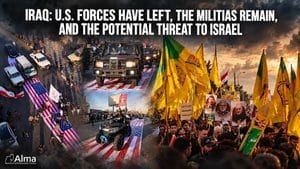
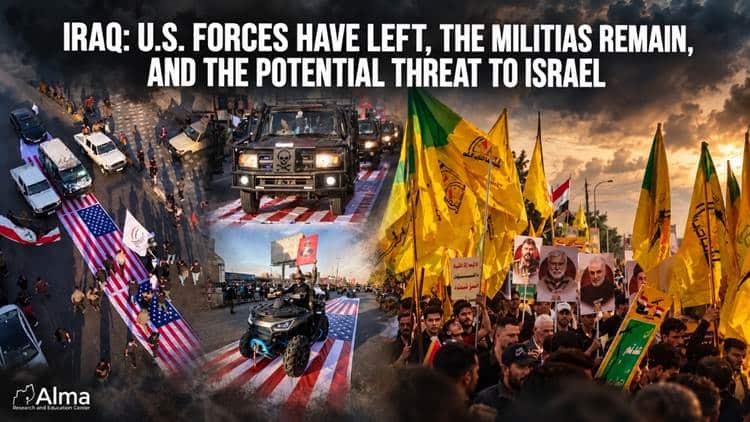
The pro-Iranian militias portrayed the withdrawal as a victory. A senior Kata’ib Hezbollah official described it as the beginning of full sovereignty and warned the government against implementing U.S. plans. The organization’s secretary-general, Ahmad al-Hamidawi, called on his fighters to cease military activity, but excluded action against “hostile” aircraft violating Iraqi airspace. This exception illustrates that even a declaration ending military activity is not equivalent to transferring decisions regarding the use of force to the state.
The withdrawal of U.S. forces therefore creates a twofold situation. On the one hand, it removes the principal justification used by the militias for continuing to retain their weapons. On the other hand, a military force capable of monitoring their activities, deterring them, and responding rapidly against infrastructure threatening U.S. forces or the wider region has departed.
The pro-Iranian militias in Iraq are not merely a domestic problem. In recent years, they have actively participated in the regional conflict and carried out numerous UAV and cruise missile launches against Israel, Saudi Arabia, and other Gulf states. More recently, it was reported that these militias, acting under Iranian direction, were involved in launches against Saudi Arabia as part of the current confrontation with the Houthis in Yemen.
The militias’ continued possession of an independent arsenal following the U.S. withdrawal therefore also affects the regional threat balance.
The Iraq–Syria Corridor: A Scenario of Ground Infiltration into Syria and Terrorist Activity Against Israel
The withdrawal of U.S. forces from Iraq follows the withdrawal of U.S. forces from Syria earlier in 2026, including the evacuation of the al-Tanf base in the Syria–Iraq–Jordan border triangle. Al-Tanf was established for the campaign against ISIS, but its location and the U.S. presence there effectively blocked the shortest route of Iran’s land corridor into Syria and onward to Lebanon. Following the evacuation, the base was transferred to the Syrian government.
The absence of a permanent U.S. presence reduces a layer of monitoring and deterrence along the routes of the land corridor. Shia militias have deployed in western Iraq and near the al-Qaim–al-Bukamal crossing. In early 2026, forces from the Shia militias were also reportedly deployed on the Iraqi side of the border following changes in territorial control on the Syrian side.
Under these conditions, a scenario must be considered in which Iraqi militia operatives, acting under Iranian direction, move toward the Syrian border, cross into Syria in the al-Tanf area or through the al-Bukamal–Deir ez-Zor area, and then attempt to advance toward southern Syria and the border with Israel. In our assessment, this should not be regarded as an immediate or inevitable scenario. However, it falls within the range of capabilities potentially available to the Iranian axis, particularly during a regional war or as part of an attempt to open an additional front against Israel. Under al-Sharaa’s rule in Syria, this scenario has not remained purely theoretical.
In our assessment, such a scenario would not necessarily involve the movement of a large, overt force. Iran and the militias may prefer small forces operating with a low signature, crossing the border in stages, gradually building up their presence in southern Syria, and awaiting orders. Their objective would not necessarily be to carry out a large-scale ground raid against Israel; they could also conduct limited operations, such as a small-scale infiltration, weapons launches, and similar activities.
Are the Iraqi and Syrian Governments Capable of Preventing This Scenario?
The Iraqi government states that all decisions concerning war and peace must remain in the hands of the state. However, its ability to enforce this principle is questionable. Some militias are formally incorporated into the Popular Mobilization Forces and receive state funding while simultaneously maintaining independent political, economic, and military structures. A direct confrontation with them could lead to internal violence, which is why the government prefers negotiations and gradual integration. This weakness is precisely what enables the militias to impose conditions and delay the surrender of their weapons.
Nor is the Syrian government’s ability to block the corridor guaranteed. The new government in Damascus has no interest in allowing Iran to rebuild the military infrastructure it lost in Syria following the fall of the Assad regime and may even regard the pro-Iranian militias as a threat to its sovereignty. However, the Syrian security forces are still undergoing reorganization, the country’s borders are long and highly porous, and its control over the desert regions and local armed groups is, to put it mildly, incomplete.
Conclusion
The withdrawal of U.S. forces from Iraq does not mean that the disarmament of Iraq’s Shia militias will begin; it merely removes the justification they used for retaining their weapons. The groups’ initial response, celebrating the withdrawal while rejecting the government’s timetable, indicates that they do not view the U.S. departure as the end of their role.
Nor does the new deadline of June 2027 guarantee an outcome. Without a binding agreement, oversight of weapons stockpiles, the dismantling of independent chains of command, and government control over UAVs, missiles, and heavy weapons, it could become merely another milestone in a series of postponements.
At the same time, the withdrawal of U.S. forces from Iraq and Syria changes the threat environment facing Israel. It does not create a completely unrestricted land corridor, but it reduces the military presence that constrained the movement of the Iranian axis and monitored key sections of the route. As long as the Iraqi militias retain their power, their ties to Iran, and their ability to operate outside the state framework, the possibility that operatives and infrastructure could be transferred through Syria to establish a ground front against Israel must also be taken into account.
In our assessment, this scenario is neither certain nor necessarily imminent, but it is feasible and has not remained purely theoretical under al-Sharaa’s rule in Syria.