
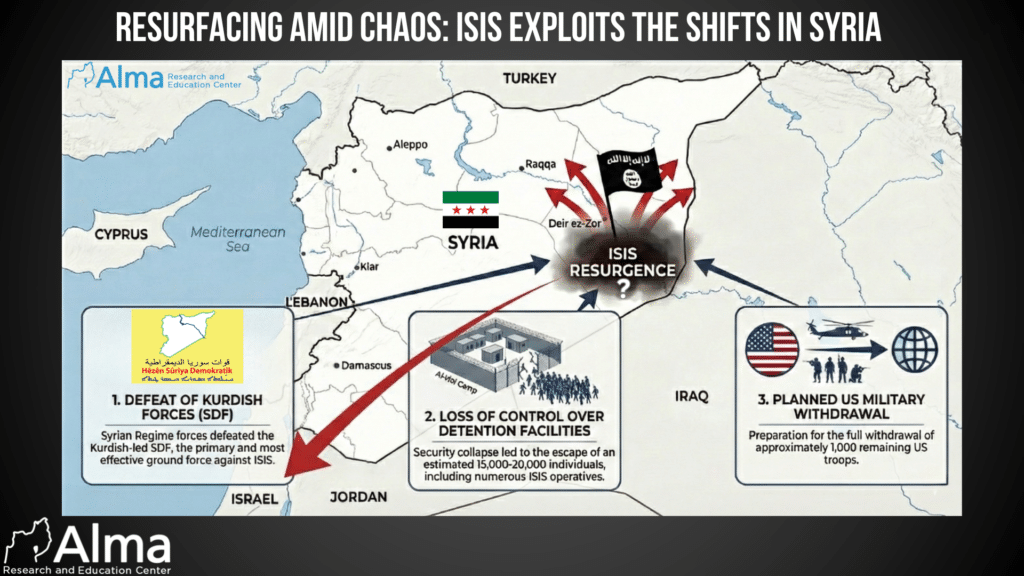
ISIS is currently regarded as one of the principal drivers of instability in Syria. In recent months—and particularly in recent weeks—there have been mounting indications that the organization is raising its head once again in the Syrian arena. Over the past week, ISIS claimed responsibility for several shooting attacks in eastern Syria targeting regime forces—in al-Raqqa and Deir ez-Zor—one of which resulted in the death of a Syrian soldier. Concurrently, for the first time in two years, the group’s spokesman, Abu Hudhayfah al-Ansari, released an audio statement declaring a “new phase of operations” and issuing a direct threat against Syrian President Ahmad al-Sharaa—whom the organization reportedly attempted to assassinate in recent months. In his remarks, al-Ansari asserted that Syria had shifted from “Iranian control” to “Turkish-American control,” arguing that “the Crusaders” are now the true rulers of Syria and that there is no higher religious priority than fighting the “secular Crusader regime” in Damascus.
Pro-ISIS networks have simultaneously circulated calls to intensify shooting attacks, including the use of motorcycles and light weapons—a pattern associated with rapid urban assassinations and indicative of a return to a focused guerrilla warfare model.
This renewed momentum unfolds against the backdrop of three parallel strategic developments: first, the defeat of the Kurdish-led Syrian Democratic Forces (SDF) by the Syrian regime—forces that had constituted the most central and effective actor in combating ISIS within Syria; second, the loss of control over ISIS detention facilities, with estimates suggesting that between 15,000 and 20,000 individuals, including ISIS operatives, escaped from al-Hol camp following the collapse of its security apparatus; and third, the full withdrawal of approximately 1,000 remaining U.S. troops from Syrian territory.
The convergence of a growing security vacuum, the weakening of the principal counter-ISIS force, and the escape of experienced ISIS operatives creates favorable conditions for the organization to rebuild infrastructure, expand its activities, and reassert both operational and symbolic presence—even if, at this stage, in a limited and decentralized format. Compounding these dynamics is the fact that the new leadership in Damascus draws on actors with jihadist backgrounds, with numerous reports indicating expressions of sympathy for ISIS among certain members of the security forces—raising serious questions regarding the regime’s long-term commitment to containing the group.
Taken together, these developments may constitute a strategic window of opportunity for ISIS to intensify its activities in Syria, particularly in areas where it already maintains operational networks and latent infrastructure, including southern Syria near the Israeli border.




One Response
Islamists must be so grateful to have idiots ruling the us and Israel and Europe and Russia 🤓