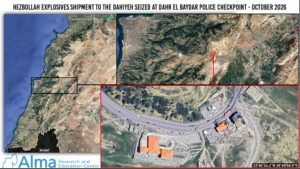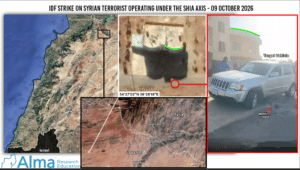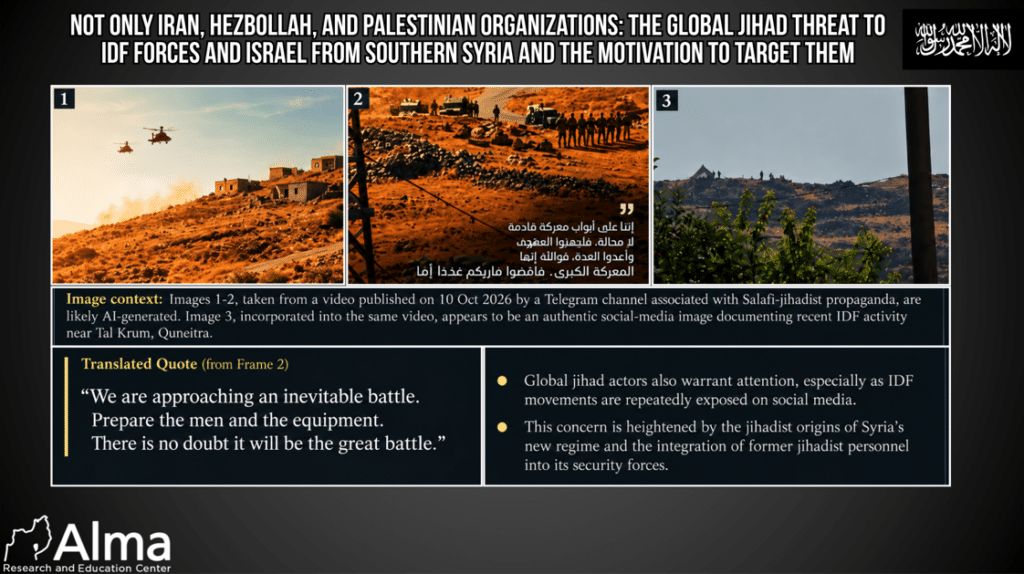
On October 10, a video encouraging preparations for attacks against IDF forces in the Quneitra and Golan Heights area was published on a Telegram channel associated with the Salafi-jihadist movement, which disseminates, among other materials, official Al-Qaeda propaganda.
The threat posed by global jihad actors in southern Syria is not limited to IDF forces operating in the security zone. Given the geographical proximity and the documented presence of these actors in southern Syria, it could also develop into a threat to Israeli communities and civilians in the Golan Heights and along the border.
The video features a jihadist song whose lyrics encourage preparations for combat, with a style and rhythm reminiscent of propaganda songs used by ISIS and other global jihad organizations. One of the frames displays the following message: “We are approaching an inevitable battle. Prepare the men and the equipment. There is no doubt that this will be the great battle.”
The caption accompanying the video reinforces this message: “The battle is inevitably coming. O Allah, use us and do not replace us” (المعركة قادمة لا محالة، اللهم استعملنا ولا تستبدلنا), alongside the hashtag #Quneitra_Golan.
The message presents the coming battle as inevitable and participation in it as a religious mission. The phrase “use us and do not replace us” echoes the Quranic concept of replacing believers who turn away with others (Surah Muhammad, 47:38). In this context, it expresses a willingness to participate in combat in the name of religion.
The video includes three images depicting IDF forces. The first two appear to have been generated using artificial intelligence (AI), while the third appears authentic and, according to our assessment, documents recent IDF activity in the Tal Krum (تل كروم) area of Quneitra province. The image circulated on social media and illustrates the ongoing monitoring and documentation of IDF activity in the area by local actors, including accounts presenting themselves as “journalists” and “reporters.”
The security implications extend beyond the video itself. The threat to IDF forces operating in the security zone in southern Syria is not limited to networks associated with Iran, Hezbollah, or Palestinian organizations. Global jihad actors ideologically aligned with Al-Qaeda and other Salafi-jihadist movements also represent a potential source of threat.
ISIS’s presence in southern Syria is not a new phenomenon. The organization operated in the area for years, particularly in the Yarmouk Basin in western Daraa province, where it previously controlled territory through local organizations that had pledged allegiance to it. Even after losing its territorial control, cells and individuals affiliated with ISIS continued to operate in the area.
In recent months, additional evidence of continued ISIS activity has emerged. In August, an ISIS-affiliated cell was uncovered in Khan Arnabah, Quneitra province. In September, an armed confrontation erupted in al-Sanamayn, Daraa province, between Syrian security forces and a cell reportedly affiliated with ISIS, resulting in the deaths of three Syrian security personnel.
Adding to this threat is the complexity of Syria’s new regime, which emerged from Hayat Tahrir al-Sham (HTS), an organization that originated in Jabhat al-Nusra, Al-Qaeda’s former affiliate in Syria. Commanders and operatives with backgrounds in jihadist organizations remain integrated into Syria’s military and security forces. It is highly likely that some of these individuals are motivated to attack IDF forces in southern Syria, potentially even through independent action.
Although the video itself does not constitute evidence of an operational plot or an immediate intention to attack IDF forces, the combination of messages encouraging preparations for battle, documentation of IDF activity, and the dissemination of this material through channels associated with global jihad illustrates the potential threat to Israeli forces operating in the area.
The threat to Israel from southern Syria is not solely Iranian. Alongside networks associated with Iran, Hezbollah, and Palestinian organizations, global jihad actors also represent a threat that must be taken into account.
This is particularly relevant given IDF operations in the security zone, the continued exposure of troop movements on social media, and the fact that Syria’s new regime emerged from organizations with jihadist roots, including Al-Qaeda-linked groups, whose former members and commanders are now integrated into the Syrian military and security forces.