On September 6, an altercation between Hezbollah and Amal operatives was reported in the village of Arabsalim, in the Nabatieh District. The confrontation reportedly stemmed from an attempt by Hezbollah to move operatives and weapons between homes in the village, prompting opposition from individuals affiliated with Amal who feared that Hezbollah’s military activity would expose residents’ homes to Israeli strikes.
That same morning, the IDF issued a targeted evacuation warning for a building in Arabsalim and the buildings adjacent to it, stating that a Hezbollah facility was located nearby. A short time later, the building was struck.
The incident in Arabsalim does not stand alone. In recent months, additional frictions have been reported between individuals affiliated with Amal and Hezbollah in Kfar Hatta (January 2026) and al-Baysariyah (June 2026), likewise surrounding Hezbollah activity and infrastructure within civilian areas.
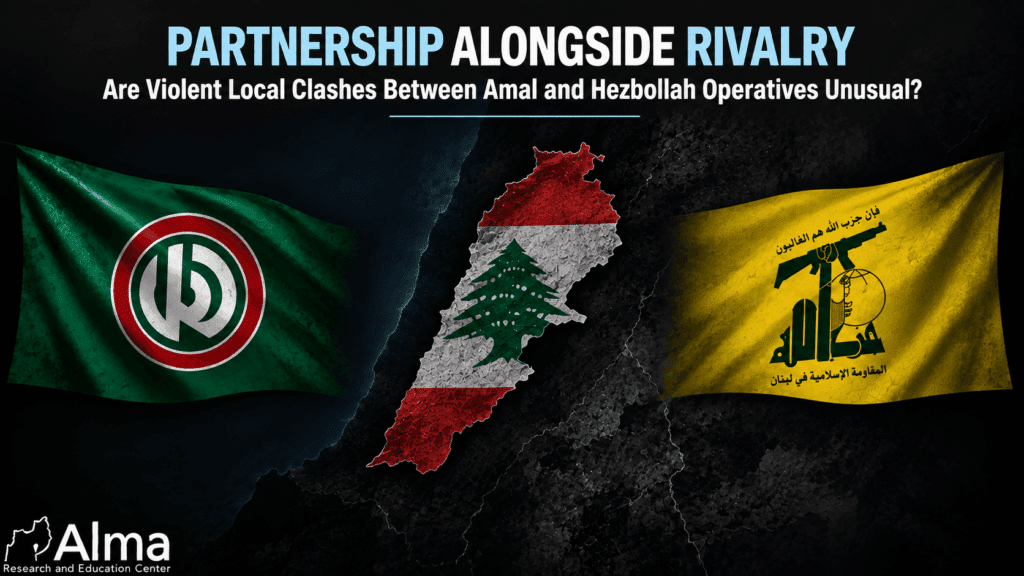
Relations between Hezbollah and the Amal Movement have long been characterized by a combination of cooperation and rivalry. The two movements cooperate in the political arena as well as on the military level. Since October 2023, Amal operatives have participated alongside Hezbollah in the fighting against Israel, and some have been killed in the course of this activity. At the same time, behind the unity of the so-called “Shiite duo,” there has long been competition between the two movements for power, influence, and control within Lebanon’s Shiite community.
The identity of the villages where these frictions occurred is also significant. These are not clear-cut Hezbollah strongholds: both movements have a presence in all three. Kfar Hatta is considered a traditional Amal stronghold, in al-Baysariyah, the movement has a significant and well-established local presence and in Arabsalim, the local balance of power between the two movements is more closely matched and is even reflected in the distribution of power within the municipality.
Against the backdrop of the severe blows Hezbollah has sustained since September 2024, the question arises as to whether its weakening is also affecting local dynamics within the Shiite camp. The fact that the recent frictions occurred specifically in communities where Amal has a significant local power base raises the question of whether local Amal operatives and supporters now feel more confident in opposing Hezbollah’s activities, and even confronting its operatives when their local interests clash.
It is important to recall that even in the years preceding the war, when Hezbollah’s position was largely unchallenged, violent confrontations—including the use of firearms—occasionally erupted between Amal supporters/operatives and Hezbollah supporters/operatives over control of local centers of power and influence. Examples included disputes over the composition of municipal councils, as well as struggles over the operation and provision of medical services.
At this stage, these incidents do not indicate a shift in the balance of power between the two organizations or a rift between the Amal and Hezbollah leaderships. They remain localized incidents that did not develop into a broader confrontation. At present, we are not certain that the willingness of local Amal-affiliated elements to confront Hezbollah operatives—even, in some cases, physically or with firearms—can in itself be considered unusual.