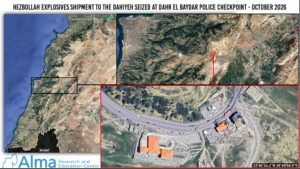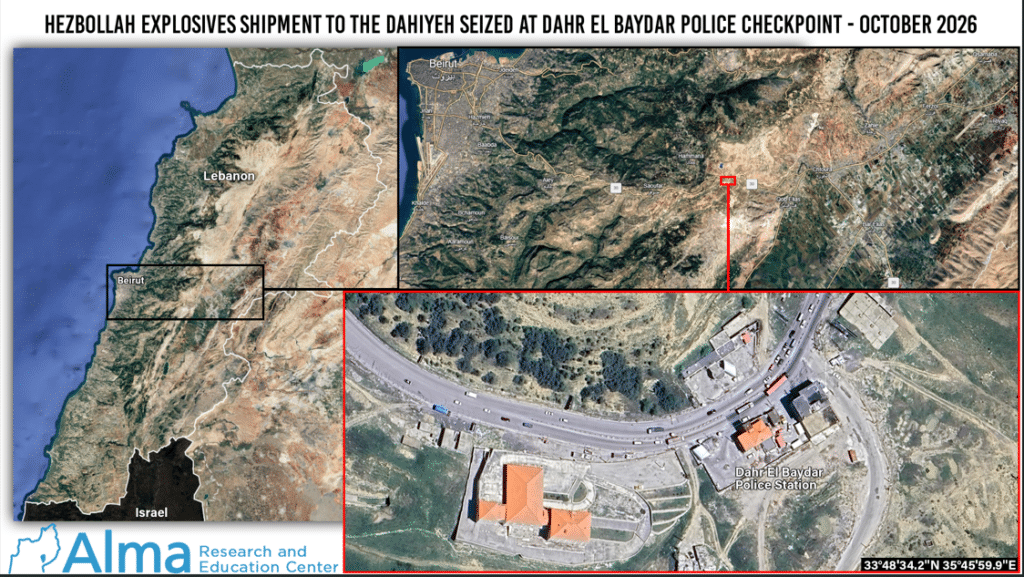
On October 5, 2026, Lebanon’s Internal Security Forces (ISF) intercepted a vehicle at the Dahr al-Baidar (ضهر البيدر) checkpoint, on the main route connecting the Beqaa Valley to Beirut. The vehicle was transporting a shipment containing hundreds of kilograms of explosives from the Baalbek area in the Beqaa Valley toward the Dahiyeh, Beirut’s southern suburbs.
Some reports indicated that the shipment contained approximately 250-500 kilograms of TNT and a similar quantity of C4, while others put the total weight at 700-800 kilograms. Some reports also claimed that nails and small metal pellets were found.
The two individuals transporting the shipment were arrested. According to reports, they belonged to the Amhaz and/or al-Laylaki families and operated within a network linked to Hezbollah.
Based on published details of the investigation, the two had been instructed to deliver the shipment to a Hezbollah figure known as “Dhu al-Fiqar” (ذو الفقار), based in the Dahiyeh, on the orders of another individual within the organization known as “Sajed” (ساجد). The full identities of those involved and the shipment’s ultimate intended purpose remain unclear.
Hezbollah’s Unit 112 is known to be responsible for the logistical transportation of weapons and military equipment within Lebanon.
The interception raises questions not only about the intended use of the explosives, but also about the continued operation of Hezbollah’s military and logistical infrastructure inside Lebanon:
Were the materials intended for the preparation of explosive devices targeting IDF forces in southern Lebanon, for replenishing Hezbollah’s explosives stockpiles, and/or for the immediate or future production of weapons, such as rockets, mortars, UAVs, drones, and other systems? Or were they intended for violent operations within Lebanon, including political assassinations?
What does the seizure reveal about the Lebanese state’s ability to enforce its decisions restricting Hezbollah’s military activities?
The possibility that the explosives were intended for political assassinations is particularly significant in light of the ongoing struggle between Hezbollah and the Lebanese government over the organization’s disarmament. If the materials were indeed intended for such a purpose, this could indicate that Hezbollah is preparing for the possibility of an internal confrontation, during which it might target political or security figures who threaten its position and its ability to retain its weapons.
The possibility of operations against Israel is also relevant in the context of the existing motivation within Hezbollah to carry out “special operations” inside the security zone in southern Lebanon or within Israeli territory.
Continued Transfer of Explosives Through the Syrian Corridor
The seizure at Dahr al-Baidar follows two additional incidents in early October 2026, indicating that smuggling routes from Syria into Lebanon continue to be used to transport explosives and weapons, and that the border between the two countries remains porous to such transfers.
On October 1, the Lebanese Armed Forces (LAF) intercepted an attempt to smuggle approximately 245 kilograms of TNT, four explosive devices, and eight initiation components from Syria into Lebanon. On October 9, another smuggling attempt was thwarted in the al-Qusayr–Hermel area, during which artillery shells and approximately 24 kilograms of TNT were seized.
These recent seizures demonstrate that the Syrian corridor continues to serve as a route for transferring explosives and weapons into Lebanon, even after the fall of the Assad regime. Although no direct connection between the shipments has been established, the incidents indicate that Hezbollah continues to exploit these routes to replenish its weapons stockpiles and rebuild its military capabilities.
The Dahr al-Baidar Seizure: A Deliberate Test, a Threatening Message, or Genuine Enforcement?
Another question arising from the incident concerns the choice of transportation route. The Dahr al-Baidar checkpoint is a permanent and well-known Internal Security Forces checkpoint located on the main road connecting the Beqaa Valley to Beirut. If the shipment was indeed transported on the orders of Hezbollah operatives, why would the organization choose to move such a large quantity of explosives through a known security checkpoint, risking the loss of the shipment, the arrest of its operatives, and the exposure of those behind the operation?
The simplest explanation is that the shipment was transported through the checkpoint on the assumption that it could pass without a significant inspection. If so, the incident may indicate Hezbollah’s confidence in its ability to move explosives along major transportation routes in Lebanon, and raise the possibility that similar shipments had previously passed through without being detected. It is also possible that, as part of its risk management, Hezbollah operates on the assumption, based on previous incidents, that even if a shipment is seized, its contents will ultimately be returned to the organization.
This is not the first time that Hezbollah’s transportation of weapons along major routes in Lebanon has been exposed.
On August 9, 2023, a Hezbollah weapons truck overturned on a sharp bend along Route 30 in the Christian town of Kahaleh, while traveling from the Beqaa Valley toward Beirut. The incident escalated into an armed confrontation between Hezbollah operatives and local residents, leaving two people dead. The Lebanese Army intervened and took possession of the ammunition.
For further reading, see Alma’s article: What Happens When a Hezbollah Weapons Truck Overturns in the Middle of a Christian Town?
Another incident occurred on January 23, 2026, when an ISF patrol attempted to inspect two Hezbollah trucks near the Tayyouneh roundabout in Beirut. The trucks had raised suspicion because they had no license plates and their windows were tinted. Hezbollah operatives prevented the inspection, confronted the police officers, and detained one of them. Following negotiations with a Hezbollah representative, the ISF officer was released, while the trucks continued toward the Dahiyeh without their contents being inspected. According to reports, the trucks were carrying military equipment transferred from Syria into Lebanon.
For further reading, see Alma’s publication: Hezbollah Abducted a Lebanese Police Officer.
Another possibility is that the shipment was part of a deliberate operation, serving as a decoy intended to divert the operational attention of state security agencies while simultaneously testing their enforcement capabilities. Such an operation could also enable Hezbollah to assess the willingness of the security forces to act against it and the potential consequences of doing so.
A further possibility is that Hezbollah sought to send a threatening psychological message within Lebanon, particularly to political and security figures working to disarm the organization. Under this scenario, the exposure of the shipment would not necessarily constitute a failure from Hezbollah’s perspective, but could instead be part of an effort to demonstrate its capabilities and the potential cost of confronting it.
The seizure of a shipment containing explosives alongside components that could be used to produce fragmentation devices may raise concerns about the quantities of explosives the organization still possesses and about other shipments that may already have been transported without detection.
Thus, even without actually using the explosives, their exposure alone could serve as a means of exerting pressure and deterrence within Lebanon, as reflected in the extensive media coverage and public reactions surrounding the incident.
Does the seizure reflect a genuine change in the conduct of Lebanon’s security agencies toward Hezbollah, or is it an isolated incident that does not alter the organization’s ability to continue transporting and stockpiling weapons throughout Lebanon?
A Test of Lebanese State Sovereignty
The seizure of the explosives shipment at Dahr al-Baidar illustrates the challenges facing the Lebanese state in its efforts to restrict Hezbollah’s military activities. Beyond the question of the shipment’s intended purpose, the incident once again demonstrates Hezbollah’s continued use of its units and infrastructure to transport weapons within Lebanon, alongside ongoing smuggling activities across the Syrian border.
If it emerges that the materials were intended for the preparation of explosive devices for political assassinations, the implications would be particularly serious, as this could indicate preparations for an internal confrontation with figures seeking to limit Hezbollah’s power and disarm the organization.
The Lebanese state’s test does not end with the seizure of a single shipment. Rather, it lies in its ability to expose the networks behind such transfers, prevent further weapons shipments into and within Lebanon, and take action against those directing them, even when they are affiliated with Hezbollah.
As long as the organization continues to maintain independent military infrastructure and preserve its supply routes, a significant gap remains between the government’s decisions establishing the state’s exclusive authority over weapons and its ability to implement those decisions in practice.
This gap is particularly evident in the issue of weapons transfers into the area south of the Litani River. We intend to publish a report addressing this issue in the near future.