General
One of the most effective tools for disrupting Hezbollah’s production and force-building system is targeting “knowledge hubs” within Hezbollah, and not only commanders or infrastructure. This concept is based on the understanding that technological, engineering, and scientific knowledge in Hezbollah is often concentrated in a relatively small number of experts. Therefore, harming them may create a broader impact than destroying material or operational infrastructure alone.
The “knowledge hubs” in Hezbollah are mainly concentrated in the “Production Directorate” (a knowledge hub in the field of technological capabilities and, among other things, responsible for the project of manufacturing and converting precision missiles) and in Unit 127 (the aerial unit) of Hezbollah.
The “Production Directorate” (which operates under Hezbollah’s logistics array) coordinates the research, development, and production of the organization’s strategic weapons.
Unit 127 has overall responsibility for research, development, production, maintenance, assembly, and upgrading of Hezbollah’s UAV array, which is distributed for operational use across various units such as the Radwan Unit and the geographical units.
“Knowledge hubs” play a particularly critical role in light of Hezbollah’s new doctrine, which in recent years seeks to expand the independent production of weapons within Lebanon. This is due to the increasing difficulties in smuggling weapons through various land, air, and maritime routes. As a result, Hezbollah is required to “bring the factory home,” to build internal development and production infrastructures—a process that further amplifies the necessity and importance of individuals with technological knowledge within the organization (scientists, engineers, developers, technicians, and individuals with advanced technological expertise). This is a strategic existential need for Hezbollah.
Hezbollah’s “knowledge chain”, which influences its force buildup, is composed of four main links: first, the transfer of knowledge from an external source (Iran/other or academia); second, the “knowledge hubs” (engineers, R&D experts, etc.); third, development and production personnel (weapons systems, UAVs, operational technical capabilities, etc.); and fourth and final, the operational units (which receive the final product in the form of weapons or operational training on the systems).
The rationale behind targeting Hezbollah’s “knowledge hubs” is simple: damaging the “knowledge hubs” link will create a break in the entire chain.
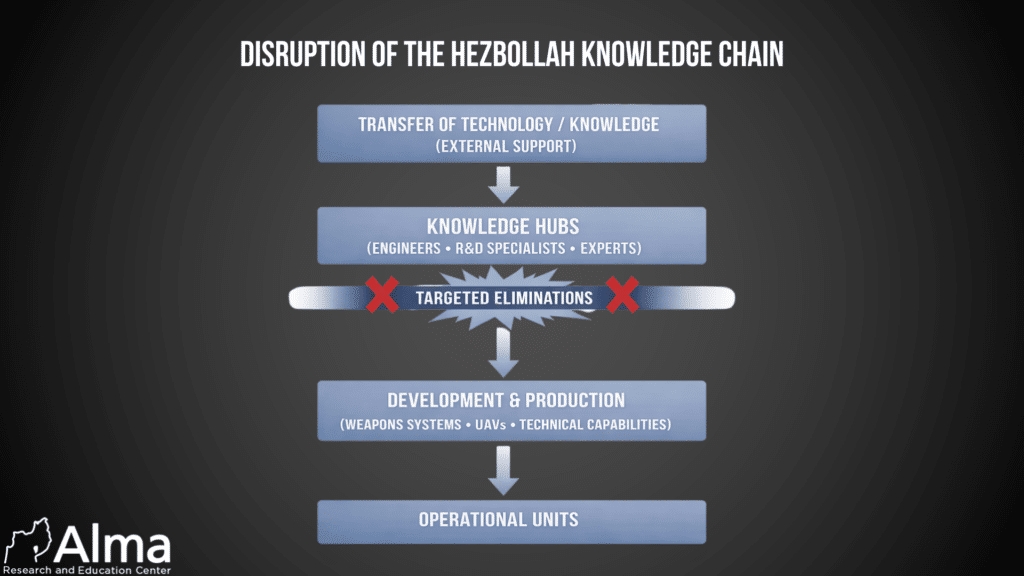
Who is a “Knowledge Hub”?
The term “knowledge hub” refers to a person, group, or unit that holds critical professional, technological, or organizational knowledge, which constitutes a central component in the functioning and development of the organization. Knowledge hubs accumulate unique experience, expertise, and professional capabilities, making them a “bridge” between theoretical knowledge and its practical implementation within the organization.
Within Hezbollah’s activities, the term “knowledge hub” refers to individuals or units that hold professional, technological, or organizational knowledge essential to the organization’s force-building process. Typically, in military organizations like Hezbollah, knowledge hubs include engineers, R&D personnel, technological experts, and professionals involved in the development, upgrading, and production of various systems.
In practice, they connect technological knowledge coming from external sources with its practical implementation in the development of various types of weapons, electronic systems, or unmanned aerial vehicles. Therefore, knowledge hubs in Hezbollah are a central component in the organization’s internal force-building process, as they enable it to develop new capabilities, improve existing systems, and preserve professional knowledge over time.
The Elimination at the Lebanese University (March 12)
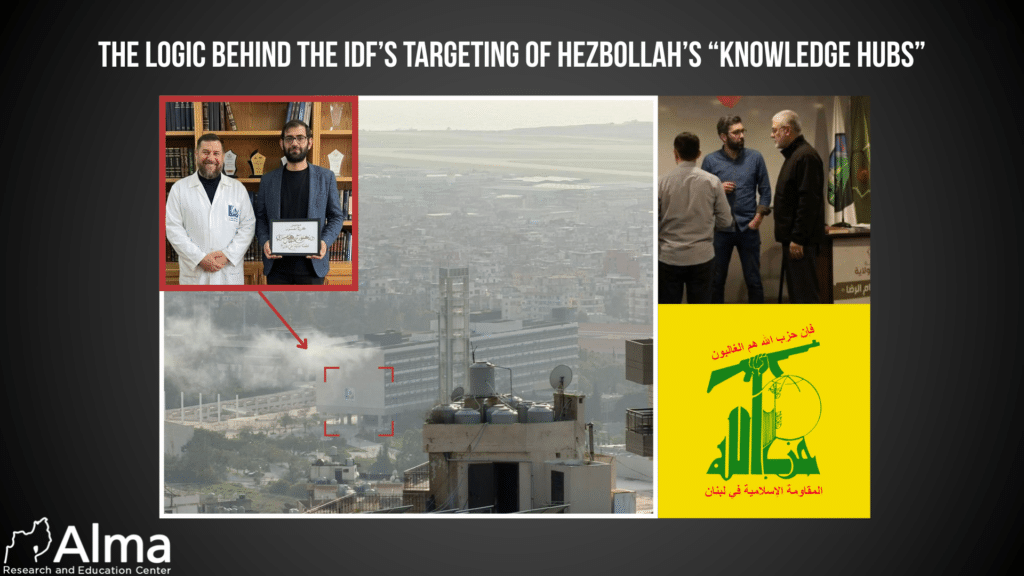
On March 12, 2026, Dr. Hussein Bazzi and Dr. Murtada Srour were eliminated while they were in the Faculty of Science at the Lebanese University, located in the Al-Hadath neighbourhood in the southern Dahieh of Beirut.
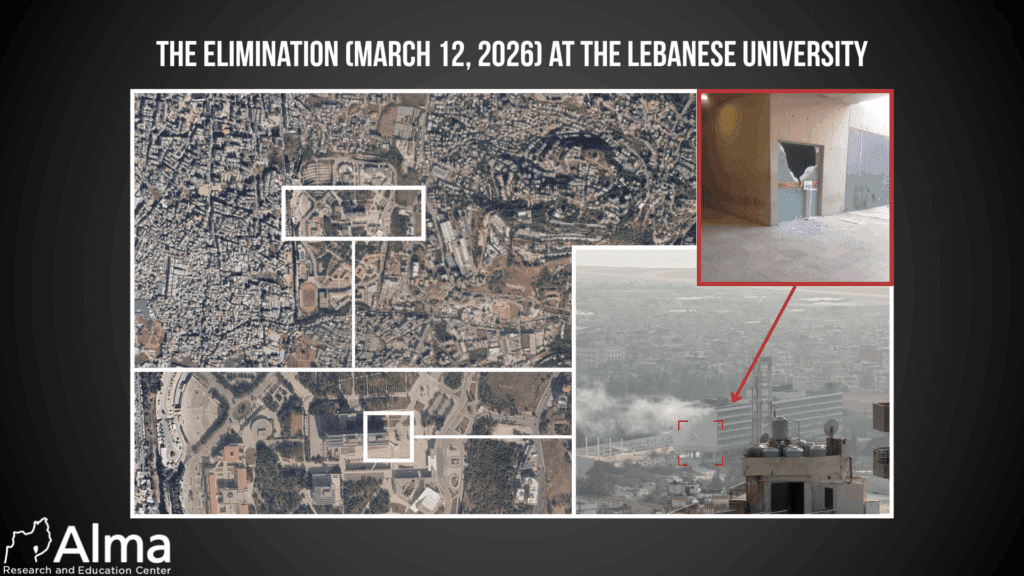
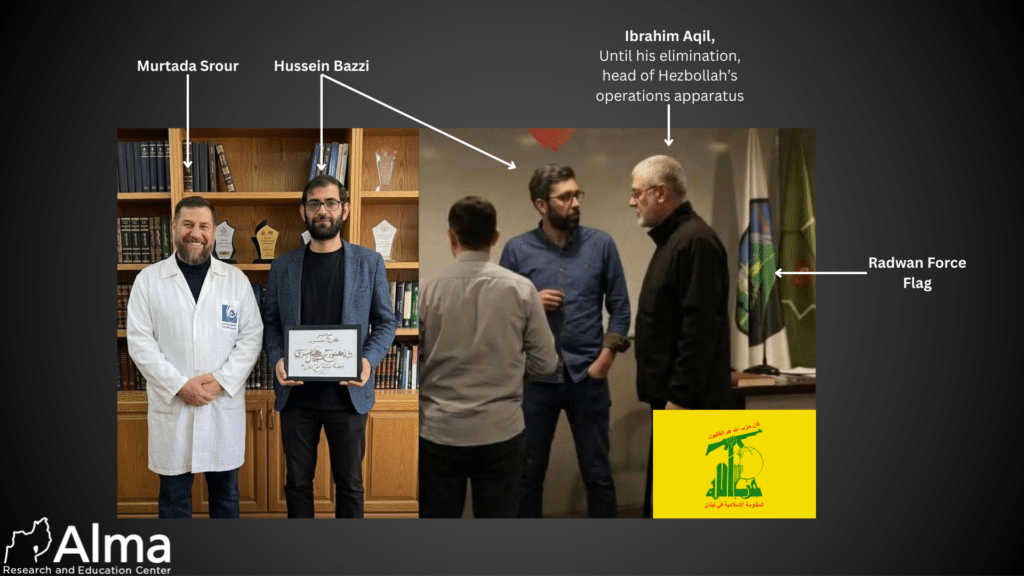
Dr. Hussein Bazzi served as a lecturer and administrator in the Faculty of Science at the Lebanese University in Beirut, while Dr. Murtada Srour was also a lecturer at the same institution. Despite their close personal relationship, they were not merely innocent academics. Both were in fact Hezbollah operatives who functioned as knowledge hubs, contributing to the organization’s technological-military programs.
This is a familiar pattern of operation. Hezbollah operatives work within legitimate civilian professional frameworks while simultaneously exploiting their education, expertise, and civilian access for Hezbollah activity.
Dr. Murtada Srour specialized in fields of physics and engineering such as; propulsion dynamics, which includes rocket and aerial propulsion systems; ballistics, which deals with processes occurring in acceleration systems, including those of rockets and missiles; and mechanics, which is important for aerodynamics, propulsion, and aircraft design.
Dr. Hussein Bazzi was an expert in nanotechnology. This is one of the emerging technological fields in the world that enables control over material properties at the nanometric level (advanced, lightweight, and sometimes extremely small materials). This field is prevalent in military industries and in the aerospace industry—and in the Hezbollah context: propulsion and launch of rockets, missiles, and UAVs, as well as compact protection components.
It was not by chance that Hussein Bazzi was seen together with Ibrahim Aqil (who, until his elimination on September 20, 2024, served as a member of the Jihad Council and commander of Hezbollah’s operations array responsible for the Radwan Unit, and following the elimination of Fuad Shukr on July 30, 2024, assumed his role as commander of the military wing).
Their meeting was likewise not incidental; it appears they encountered one another at a professional conference of Hezbollah’s operations array / Radwan Unit, as indicated by the Radwan Unit flag visible in the background of the image.
Previous Knowledge Hubs Eliminated
Hussein Bazzi and Murtada Srour join additional Hezbollah “knowledge hubs” who have been eliminated in recent years.
On July 6, 2024, in the Bekaa region, Maytham Mustafa al-Attar (Hadi), a central operative in Unit 127 who visited Iran many times to acquire professional training, expertise, and knowledge in his field, was eliminated.
During October 2024, in the Beirut area, Muhammad Yusuf Anisi, a mechanical engineering expert and one of the leaders of Hezbollah’s precision missile production project, was also eliminated.
On May 21, 2025, in the Tyre area, engineer Hussein Nazih Barji, a central figure in Hezbollah’s “Production Directorate”, was eliminated. Baraji was responsible for developing the infrastructure for producing precision surface-to-surface missiles as part of the organization’s rehabilitation efforts.
Sources:
https://israel-alma.org/hezbollah-quantitative-and-qualitative-analysis-of-the-effectiveness-of-israels-targeted-eliminations-during-the-ceasefire/
https://israel-alma.org/hezbollah-independent-weapons-production-a-hybrid-doctrine-in-light-of-a-strategic-need/
https://www.thecmst.com/he/o-profile/Unit-127-Air-Force-Unit-Hezbollah
https://tps.co.il/articles/inside-unit-127-the-hezbollah-drone-unit-escalating-the-conflict-with-israel/
https://al-ain.com/article/unit-127-hezbollah-drone-lebanon-israel
https://www.eremnews.com/news/arab-world/c8ftbl3
https://israel-alma.org/hezbollahs-uav-array-its-transformation-from-a-potential-strategic-threat-to-a-actual-strategic-threat/
https://tps.co.il/articles/israel-identifies-the-4-soldiers-killed-in-hezbollah-drone-attack/
https://israel-alma.org/shahed-101-type-uav-in-hezbollah-use-key-insights/
https://x.com/Israel_Alma_org/status/1925214507254817205?s=20
https://x.com/Israel_Alma_org/status/1809667907770634672?s=20
https://x.com/IDF/status/1841933436035977480?s=20